ENEnglish
 LTLietuviškai
 DEDeutsch
 FRFrançais
 RUРусский
 ESEspañol
 PLPolski
 ITItaliano
 UKУкраїнська
 CSČeština
 PTPortuguês
 JA日本語
 LVLatviešu valoda
 ETEesti
 HUMagyar
 IDBahasa Indonesia
 TRTürkçe
 HIहिन्दी
 ELΕλληνικά
 ARالعربية
 THไทย
 VITiếng Việt
 RORomână
 MSBahasa Melayu
 BNবাংলা
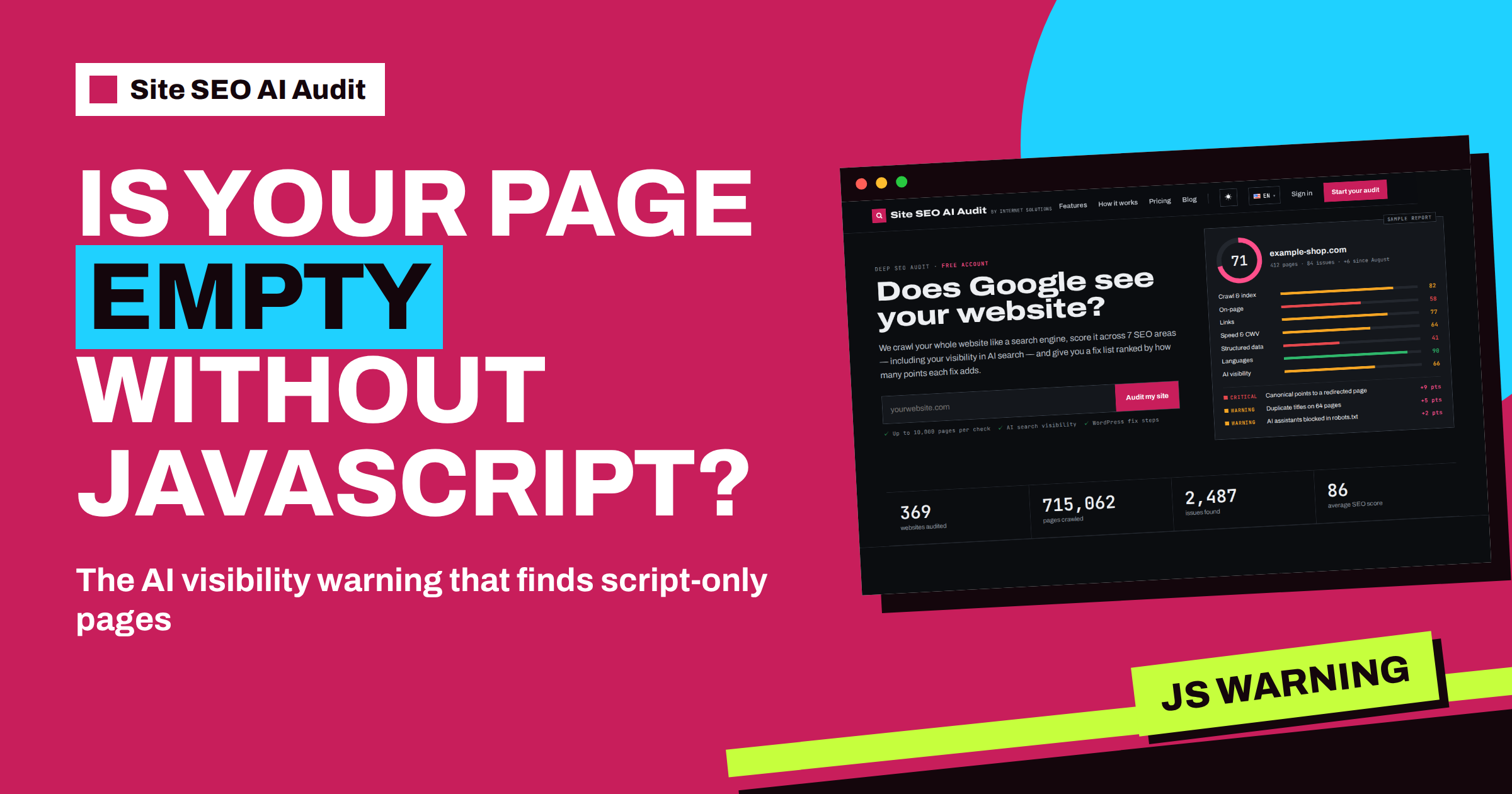
Short answer: “Content needs JavaScript to appear” is a warning in the AI visibility area of Site SEO AI Audit. It is raised for pages whose HTML contains almost no text, fewer than 50 words, and at least three script tags. Many AI crawlers do not run JavaScript, so such a page looks empty to them. The fix is to render the main text on the server, so that it is already in the HTML that is sent. Test a page by viewing its source, fix the template or rendering method, and run a new check.
A modern page can look rich in a browser and still be an empty shell in the HTML that the server sends. The browser downloads scripts, runs them, builds the content and shows it. A crawler that does not run scripts sees only the shell. Search engines such as Google can render many pages, but they do it later and with limits, and many AI crawlers do not render at all. The audit therefore checks a simple thing: does the page contain its own text without help from scripts? This article explains the check, how to test your pages by hand and what to change when the answer is no.
How the check decides
The audit reads the HTML that your server returns for each page, the same HTML that a simple crawler would read. For each page it counts the words of visible text and the script tags. A page is flagged when it has fewer than 50 words and at least three scripts. That combination is a strong sign of a shell: little to read and a lot of code that is supposed to fill it.
The finding is a warning, which counts four points in the formula, and it sits in the AI visibility area, which carries eight percent of the total score. As with other page-level findings, the penalty depends on the share of your indexable pages that are affected. If one small page is flagged, the effect is tiny. If the whole site is built this way, the penalty is large, and so is the risk that assistants cannot quote anything from it.
Why AI crawlers care
An assistant that answers a question with a quote from your page must first read that page. Reading is cheap when the text is in the HTML. It is expensive when a full browser must run scripts, wait for data and wait for the page to settle. Many crawlers do not do this work. They fetch the HTML, take the text and move on. If the text is not there, nothing can be cited, and your page is invisible to that part of the web, however good its content is.
The same logic applies to traditional search. Google can render JavaScript, but rendering is a second step that may happen later, and problems in it can hide content or links. Content that is in the HTML from the first moment is simply more reliable. The article on why AI crawlers miss JavaScript content goes deeper into the difference, and JavaScript SEO basics covers the search engine side.
Test one page in two minutes
- View the source. In your browser, open the page and use “view page source”, not the element inspector. The source is the HTML as the server sent it.
- Search for a sentence. Pick a sentence from the visible page and search for it in the source. If it is there, the text is server-rendered.
- Look for an empty container. If the source contains a single empty element, such as a div with an id of app or root, plus several scripts, you have found a shell.
- Disable scripts. Switch scripts off in your browser developer tools and reload. What you see is close to what a simple crawler sees.
Test a few different page types: the home page, an article, a product, a category. A site can be partly server-rendered. A common mix is a rendered home page and an application shell for the rest.
Where script-only pages come from
- Single-page applications. A framework builds every view in the browser from data, and the server sends one empty page for every address.
- Headless sites with client rendering. A content management system supplies the data through an interface, and the front end fetches it in the browser.
- Page builders and widgets. Some blocks load their text through scripts after the page appears, such as tabs, accordions, reviews and product descriptions.
- Consent or login walls. A script covers the page until the visitor clicks, and the real content is loaded only afterwards.
Not every flagged page is a real problem. A login page, a calculator or an app screen has little text by design and does not need to be quoted by an assistant. Look at the affected list and ask for each page whether it is meant to be found. Pages that should rank or be cited are the ones to repair first.
How to fix it
The report gives one instruction: render the main text on the server. In practice, there are several ways to do that, from small to large.
| Approach | When it fits |
|---|---|
| Print the main text in the page template | Content widgets or tabs that load text late |
| Server-side rendering in your framework | Single-page applications with many content pages |
| Static generation at build time | Documentation, blogs and pages that change rarely |
| Prerendering for crawlers | Existing applications that are hard to change |
Whatever route you choose, the test is the same: the page source must contain the headline, the main text and the links to other pages. Keep scripts for interaction, not for the content itself. The article on hreflang on JavaScript and headless sites shows another case where server-rendered markup avoids trouble.
Step by step: from report to repair
- Open the issue card. Read the explanation and open the list of affected pages.
- Select the pages that matter. Mark the pages that should be found or cited, and ignore tools and private screens.
- Test two or three pages by hand. Use the source test above to see what the server sends.
- Find the rendering method. Ask your developer or check the theme documentation whether the text is rendered on the server or in the browser.
- Change the template or the rendering method. Start with one page type and verify it.
- Run a new check. Starter, Pro and Agency include re-checks. The affected pages should drop out of the list.
Speed and the same fix
There is a pleasant side effect. Pages that show their text in the first HTML often feel faster, because the visitor sees content before scripts finish. That helps the Speed and Core Web Vitals area as well. It is no coincidence that the same advice appears in two areas of the report: a page that does not depend on scripts to show its main content is better for people, for search engines and for assistants.
Prevent a relapse
This kind of problem comes back whenever a new framework, theme or widget is introduced. Add a short line to your release checklist: “view the source of three page types and find a sentence of the main text”. Run a new check after a redesign or a switch of front end. The plans count checks per month, five on Starter, twenty on Pro and a hundred on Agency, which leaves room for a check after each release. If you work with a developer, send the link to the report and the list of affected pages, so the task is clear.
What to ask your developer
If you are not the person who builds the site, the warning can be hard to translate into a task. A short message usually works: “Our SEO report flags pages whose HTML has almost no text and several scripts. Please check whether the main text of these page types is part of the HTML that the server sends, and if it is not, render it on the server or generate it at build time. Here is the list of pages.” Add the address of two or three affected pages and the steps for the source test, so that the developer can reproduce what you see.
Expect a conversation about trade-offs. Server rendering costs some server work, static generation needs a rebuild when content changes, and prerendering adds another moving part. None of these is free, but all are well known, and for content sites the cost is usually small compared with the benefit of being readable by every crawler. If a full change is too large for now, start with the pages that bring the most value: the home page, your main service or product pages and your best guides. The rest of the list can follow in later steps, and each step is visible in the next check.
Related reading
- Why AI Crawlers Miss JavaScript Content and How to Fix It
- JavaScript SEO Basics: How Search Engines Render Your Pages
- AI Visibility Checks in Site SEO AI Audit Explained
The bottom line
If a page is empty until scripts run, many assistants will never see its text. Use the warning to find shell pages, test them with the page source, move the main text into the server response and run a new check to confirm that the list is clear.
GYIK
Which pages does the audit flag?
Pages with fewer than 50 words of text in the HTML and at least three script tags. That pattern suggests that the content is filled in by scripts.
Does Google also have trouble with JavaScript content?
Google can render many pages, but it does so as a separate step with limits. Server-rendered text is more reliable for search and for assistants.
Is a flagged login page a problem?
Usually not. Pages that are not meant to be found or quoted can stay as they are. Concentrate on the pages that should rank or be cited.
How can I check without special tools?
Use “view page source” in your browser and search for a sentence of the visible text. If the sentence is missing, the text is added by scripts.
Do I need a paid plan to see the list?
Yes, to see every affected page. A free account runs one check and shows the report locked, while Starter, Pro and Agency unlock the full report.