ENEnglish
 LTLietuviškai
 DEDeutsch
 FRFrançais
 RUРусский
 ESEspañol
 PLPolski
 ITItaliano
 UKУкраїнська
 CSČeština
 PTPortuguês
 JA日本語
JA日本語 LVLatviešu valoda
 ETEesti
 HUMagyar
 IDBahasa Indonesia
 TRTürkçe
 HIहिन्दी
 ELΕλληνικά
 ARالعربية
 THไทย
THไทย VITiếng Việt
 RORomână
 MSBahasa Melayu
 BNবাংলা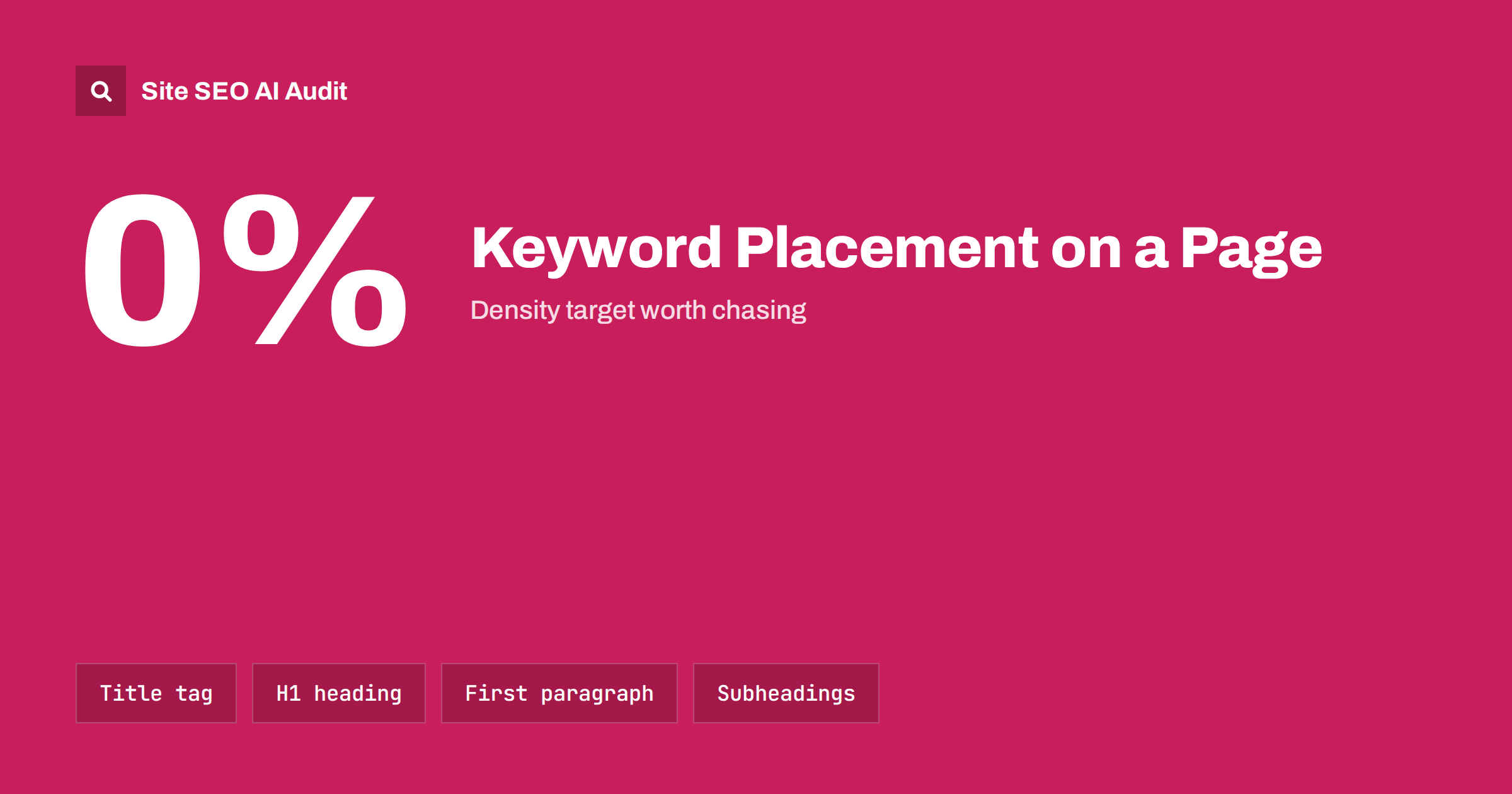
Short answer: Put your main keyword where it naturally describes the page: in the title tag, the H1, the URL, the first paragraph and at least one subheading, and use related terms throughout the text. Beyond that, write for the reader. There is no ideal keyword density, and repeating a phrase more often does not help; search engines understand synonyms and topics, and stuffing makes pages worse for people.
Why keyword placement still matters
Search engines are much better at understanding language than they were a decade ago. They recognize synonyms, understand that “running shoes” and “trainers for running” mean similar things, and can often tell what a page is about even when the exact query never appears on it. So why think about keywords at all?
Because clarity still wins. When the words people search for appear in the most prominent places on a page, both readers and search engines immediately see that the page is relevant. A searcher who typed “boiler repair Leeds” and lands on a page whose headline says “Heating Solutions for Modern Homes” has to work to confirm they are in the right place. A headline that says “Boiler Repair in Leeds” removes the doubt.
Keyword placement is not about tricking an algorithm. It is about using your audience’s language in the places they look first.
Choose one main phrase and its close variants first
Before placing anything, decide what the page is about. Each important page should have:
- One main phrase that describes its core topic, chosen from what people actually search.
- A few close variants: synonyms, singular and plural forms, and different word orders people use.
- Related terms and subtopics that anyone covering the topic properly would mention. A page about meta descriptions will naturally mention snippets, search results, character length and click-through.
- Questions people ask about the topic, which often become subheadings or FAQ items.
If you find yourself wanting two unrelated main phrases on one page, you probably need two pages.
Where do the phrases come from? Start with the words your customers use in emails, calls and reviews, then check them against what people search. Google Search Console shows the queries that already bring impressions to your pages, which is often the most useful list you have, because it reflects your real audience. Search suggestions and the “People also ask” box add the questions around the topic. Keyword tools can estimate search volumes, but treat those figures as rough guides rather than facts.
The places that matter most
| Location | What to do | Why it matters |
|---|---|---|
| Title tag | Main phrase near the start, written naturally | Strongest on-page relevance signal; shown in results |
| H1 heading | Main phrase or close variant | Confirms the topic to visitors on arrival |
| URL slug | Short version of the main phrase | Light signal; helps people read the link |
| First paragraph | Mention the topic early and answer the core question | Sets context for readers and search engines |
| Subheadings | Variants and related questions where they fit | Shows structure and subtopics |
| Body text | Main phrase a few times, related terms throughout | Demonstrates thorough coverage |
| Image alt text | Only if it describes the image | Image search and accessibility |
| Meta description | Main phrase once, naturally | Matching words are often highlighted in snippets |
| Internal link anchors | Descriptive phrases pointing to this page | Tells search engines what the page is about |
Title, H1 and URL: the essentials
These three elements carry the most weight and are the quickest to get right.
Title tag. Put the main phrase near the beginning, then add the angle that makes the page worth clicking: “Boiler Repair in Leeds: Same-Day Visits and Fixed Call-Out Fee”. Do not repeat the phrase or list variants.
H1. Use the main phrase or a close variant. It does not need to match the title word for word, but it should clearly describe the same topic.
URL. A short slug based on the main phrase, such as /boiler-repair-leeds/. Do not change existing URLs just to add a keyword; the gain is small and redirects carry risk.
The first paragraph and the body text
Mention the main topic early, ideally in the first sentence or two, and answer the core question straight away. This is good writing as much as good SEO: readers want to know immediately that they are in the right place.
In the body, use the main phrase where it reads naturally, usually a handful of times in a typical article. Much more important is covering the topic well, which naturally brings in related terms. A guide to choosing running shoes that never mentions cushioning, drop, fit, pronation or running surface is not thorough, however often it says “running shoes”.
Some practical habits:
- Use pronouns and synonyms freely. “They”, “these shoes” and “trainers” are fine.
- Use the exact phrase where it helps clarity, such as in a definition or a summary.
- Answer related questions in their own sections, using the wording people search.
- Read the text aloud. If a phrase sounds forced, rewrite it.
An example helps. Suppose the page targets “how to clean suede shoes”. A good opening might be: “To clean suede shoes, let them dry, brush off loose dirt with a suede brush, then treat stains with a suede eraser or a little white vinegar.” The phrase appears once, naturally, and the sentence answers the question at once. The rest of the page can then cover water stains, salt marks, protective sprays and what not to do, and the related words follow on their own.
Subheadings and related questions
Subheadings are a natural home for variants and questions. A page about title tags might have H2s such as “How long should a title tag be?”, “Why search engines rewrite titles” and “Title tag examples for each page type”. Each of those uses words people search, describes the section clearly and gives search engines a clean passage to match to specific questions.
Do not force the main phrase into every heading. Headings like “Title tag length”, “Title tag examples”, “Title tag mistakes”, “Title tag tips” and “Title tag conclusion” read like a list of keywords. Vary them and let each describe its section.
Keyword density: why to ignore it
Keyword density is the percentage of words on a page that are the target phrase. Older SEO advice often recommended a specific density, such as 1 to 3 percent. There is no evidence that search engines use such a target, and chasing one leads to awkward writing.
What matters is whether the page clearly covers the topic. A long, thorough guide will naturally have a lower density than a short one, and that is fine. Some SEO plugins still display a density figure or warn when a phrase appears “too few” times. Treat those warnings as reminders to check that the topic is clear, not as rules.
Keyword stuffing and how to recognize it
Keyword stuffing means repeating keywords unnaturally in an attempt to manipulate rankings. Search engines treat it as spam, and it makes pages unpleasant to read. Signs of stuffing include:
- The same phrase repeated in almost every sentence.
- Lists of cities, product names or keywords with no real content around them.
- Awkward phrases such as “cheap plumber Leeds is our cheap plumber Leeds service”.
- Hidden text, such as keywords in white text on a white background or tucked into tiny font.
- Alt text or anchors filled with keywords that do not describe the image or destination.
If a page on your site reads like that, rewrite it for people. It is one of the few on-page problems that can actively hurt rather than just fail to help.
Checking keyword use at scale
On individual pages, keyword placement is a quick editorial check: read the title, H1, first paragraph and headings, and ask whether a searcher would instantly recognize their topic. Across a whole site, the most common problems are not about keyword counts but about the elements that carry keywords: missing or duplicate titles, missing H1s, thin pages that cannot cover a topic, and weak internal linking to important pages.
Site SEO AI Audit checks those elements on every page it crawls, including titles, descriptions, H1s, thin and duplicate content and internal links, and ranks fixes by how many points each adds. On WordPress sites it shows where to make each change. You can start with a free audit.
Related reading
- Search Intent: How to Match Your Page to What Searchers Want
- How to Write Title Tags: Length, Wording and Examples
- Heading Structure for SEO: How to Use H2 to H6 Properly
The bottom line
Use your main keyword where it naturally describes the page: title tag, H1, URL, the first paragraph and a subheading or two. Then forget about counting and write a thorough, specific page that uses the related terms any expert would use. Ignore density targets, avoid stuffing, and remember that clarity for the reader is also clarity for search engines.
GYIK
How many times should I use my keyword on a page?
There is no right number. Use it in the title, H1 and early in the text, then wherever it reads naturally. Covering the topic thoroughly matters much more than repetition.
Is keyword density still a ranking factor?
There is no evidence that search engines use a target keyword density. Aiming for a percentage leads to awkward text. Focus on clarity and complete coverage of the topic instead.
Should the exact keyword appear in the title tag?
It usually helps to use the main phrase or a very close variant, near the start. Search engines understand variants, so natural wording is better than forcing an awkward exact phrase.
What happens if I stuff keywords?
Search engines treat keyword stuffing as spam, and it can harm how a page ranks. It also puts off readers. Rewriting stuffed text for people is the fix.
Do I need to use every keyword variation on the page?
No. Search engines understand synonyms and related phrases. Use the variants that fit naturally, especially in subheadings for related questions, and do not create lists of variations.