ENEnglish
 LTLietuviškai
 DEDeutsch
 FRFrançais
 RUРусский
 ESEspañol
 PLPolski
 ITItaliano
 UKУкраїнська
 CSČeština
 PTPortuguês
 JA日本語
JA日本語 LVLatviešu valoda
 ETEesti
 HUMagyar
 IDBahasa Indonesia
 TRTürkçe
 HIहिन्दी
 ELΕλληνικά
 ARالعربية
 THไทย
THไทย VITiếng Việt
 RORomână
 MSBahasa Melayu
 BNবাংলা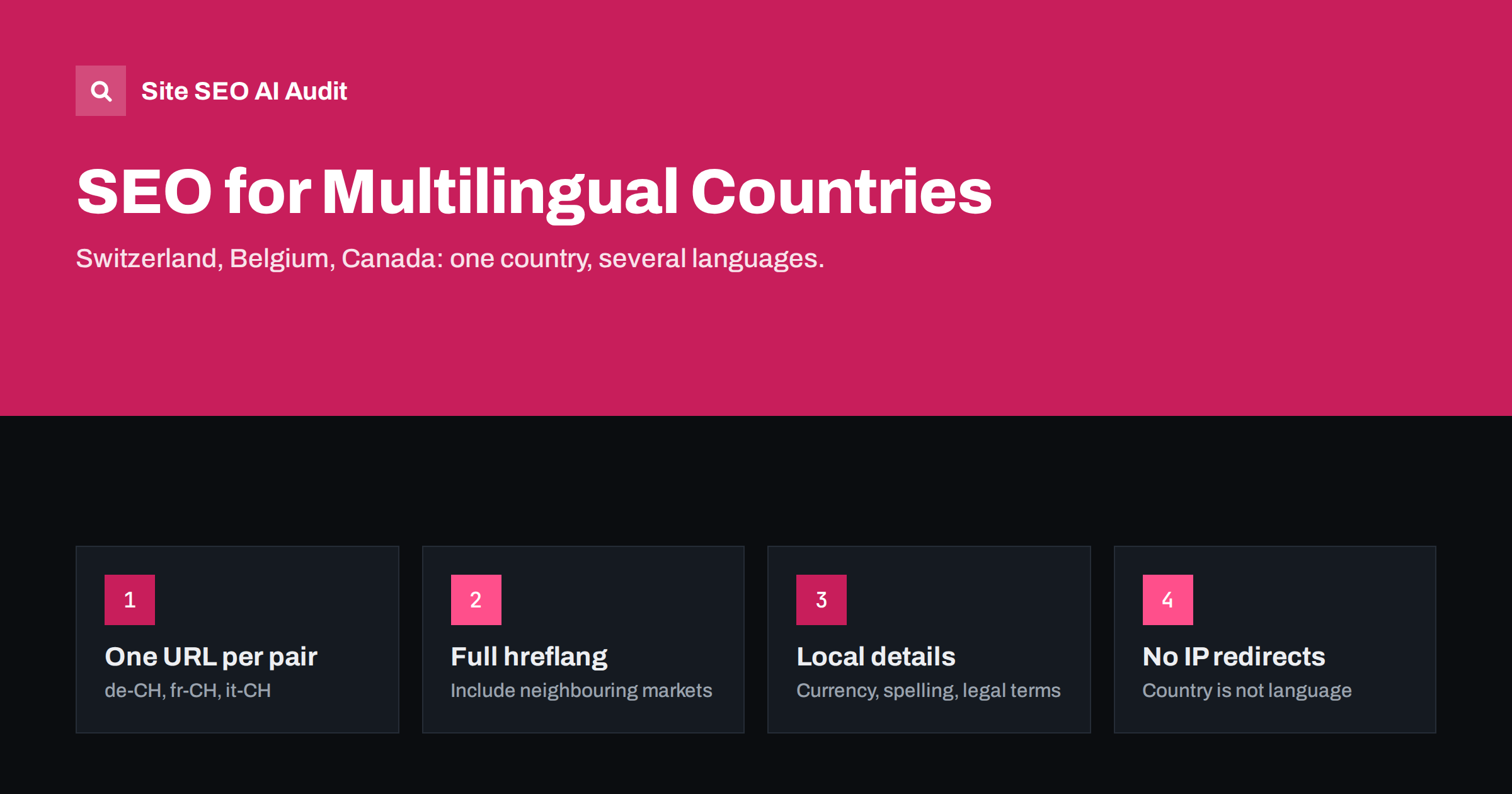
Short answer: In countries with more than one main language, create one version per language for that country, such as de-CH, fr-CH and it-CH for Switzerland, or en-CA and fr-CA for Canada. Give each its own URL, connect them with hreflang using language-plus-country codes, and adapt the content to the country, not just the language: currency, spelling, legal details and local terms. Let visitors choose their language without forced redirects, and do not reuse your German, French or US pages unchanged for these markets.
Why multilingual countries are a special case
Most international SEO advice assumes one language per country: a German site for Germany, a French one for France. Several important markets break that pattern:
- Switzerland: German, French and Italian are widely used, with Romansh as a smaller national language.
- Belgium: Dutch and French, with German in a small eastern region.
- Canada: English and French, with French dominant in Quebec.
- Luxembourg: Luxembourgish, French and German, with English common in business.
- Finland: Finnish and Swedish.
- India, Singapore, Spain’s bilingual regions and many others, each with their own mix.
In these countries the same searcher may use different languages for different purposes, and neighbouring countries share the languages. A Swiss visitor searching in German competes for results with German and Austrian pages; a Belgian searching in French sees French sites. Your job is to make it clear which page is for which language within this specific country.
Language versions per country, not per language
The key decision is whether a language version serves one country or a whole language area. For multilingual countries it usually pays to create country-specific versions, because the practical details differ:
- Prices and currency. Swiss visitors expect CHF, Canadian visitors CAD. A German-language page with euro prices is simply wrong for Switzerland.
- Spelling and vocabulary. Swiss Standard German does not use ß and has its own words; Belgian and Canadian French differ from French in France in vocabulary and some conventions; Belgian Dutch has its own terms.
- Legal and business details. VAT, company information, delivery conditions, return rules and consumer rights differ by country.
- Contact details. Local phone numbers, addresses and opening hours.
If your offer is the same across a language area and none of these details matter, a single language version (for example de) can serve Germany, Austria and German-speaking Switzerland. As soon as prices, delivery or legal terms differ, country versions are the safer choice. The broader distinction is explained in multilingual vs multi-regional sites.
URL structures that work
You need one URL per language-country combination. Common patterns:
| Structure | Example for Switzerland | Notes |
|---|---|---|
| Country domain with language folders | example.ch/de/, example.ch/fr/, example.ch/it/ |
Strong country signal; separate domain to maintain |
| Main domain with country-language folders | example.com/ch-de/, example.com/ch-fr/ |
One domain, easy to scale to more countries |
| Main domain with language-country folders | example.com/de-ch/, example.com/fr-ch/ |
Same as above, ordered by language |
| Subdomains | ch-de.example.com |
Works, but usually more setup for little benefit |
All of these can work. Choose one, apply it consistently across countries, and avoid mixing, for example /ch/ for German and /ch-fr/ for French, which makes it unclear which language is the default. The general trade-offs are in ccTLD vs subdomain vs subfolder.
A frequent question is whether one language should live at the root of a country domain, for example German at example.ch/ and French at example.ch/fr/. It works technically, but it makes the root page double as both the German page and the language entry point. Separate folders for every language are cleaner.
hreflang for multilingual countries
hreflang is where multilingual countries need the most care, because the same language exists in neighbouring markets. For a Swiss German page, the cluster might include:
<link rel="alternate" hreflang="de-CH" href="https://example.com/ch-de/">
<link rel="alternate" hreflang="fr-CH" href="https://example.com/ch-fr/">
<link rel="alternate" hreflang="it-CH" href="https://example.com/ch-it/">
<link rel="alternate" hreflang="de-DE" href="https://example.com/de/">
<link rel="alternate" hreflang="fr-FR" href="https://example.com/fr/">
<link rel="alternate" hreflang="x-default" href="https://example.com/">
Points to get right:
- Use language plus country codes:
de-CH,fr-BE,nl-BE,fr-CA,en-CA. The country code for Switzerland isCH, notSZorSW. Our language and region codes reference lists common pitfalls. - Include neighbouring markets in the same cluster if you have them, so a searcher in Germany gets
de-DEand one in Switzerland getsde-CH. - Consider language-only fallbacks. If you have
de-DEandde-CHbut nothing for Austria, adding one version as plaindetells search engines what to show other German speakers. - Use x-default for a language selector or your main international page, as described in hreflang x-default.
- Every version must list all the others and itself, with return links in both directions.
Content: localise for the country, not just the language
A Swiss French page that is a copy of your French page for France, with only the currency changed, is a near-duplicate. Search engines may pick the France version as canonical and show it in Switzerland. Make the country versions genuinely local:
- Use the country’s spelling and vocabulary. Native speakers from the country should review the text.
- Show local prices, taxes and delivery terms in the visible content.
- Mention local regions, cities, payment methods and regulations where relevant.
- Use local examples, references and, where you have them, local case studies and reviews.
- Do keyword research per language within the country; search terms differ even within one language, as shown in multilingual keyword research.
Not every page needs the same depth of localisation. Product and service pages, pricing, contact and legal pages need it most; general blog articles can often be shared across a language area with hreflang pointing to the most suitable version.
Language legislation and expectations
Some multilingual countries have rules or strong expectations about language use in business:
- Quebec has language legislation that requires French for commercial communication, including websites of businesses operating there. A Canadian site without a French version can be a legal issue, not just an SEO gap.
- Belgium and Switzerland have strong regional language identities. Addressing a French-speaking Belgian in Dutch, or the reverse, can be taken badly, so correct language routing matters for trust.
- Official and public-sector content in many multilingual countries is expected in every official language.
Check the rules for your sector and markets with a local advisor. From an SEO point of view, the lesson is the same: each language community should find a complete, correct version for its country.
Language switching without redirects
Because visitors in these countries genuinely use different languages, the language switcher is used more often than elsewhere. Make it work well:
- Link to the equivalent page in the other language, not to the home page.
- Label languages in their own language: Deutsch, Français, Italiano, Nederlands.
- Remember the choice with a cookie for returning visitors, but keep every URL accessible to everyone.
- Do not redirect by IP. IP location tells you the country, not the language. A Swiss IP says nothing about whether the visitor reads German, French or Italian. Automatic redirects also stop search engines from seeing all versions, as explained in why automatic language redirects hurt international SEO.
- Browser language suggestions are fine as a dismissible banner.
More detail on design and markup is in language switcher best practices.
Measuring each language community
Country-level reports hide the most important question in these markets: is each language community finding its own version? Set up measurement so you can see it:
- Search Console by folder. Add each language-country folder as its own property, or filter the Performance report by page path, then by country. The French Swiss folder should receive most of its clicks from Switzerland, not France.
- Analytics by language version. Compare landing pages by visitor country and browser language to spot visitors who land on the wrong version.
- Language switcher clicks. Frequent switching from one version to another right after landing suggests search engines are sending people to the wrong language.
- Separate sitemaps per version, which make indexing problems in one language easy to isolate.
Our guide to Search Console for international sites describes the reports in more detail.
Checking multilingual country setups
Multilingual country sites have many hreflang clusters and language combinations, which makes manual checking slow and error-prone. Site SEO AI Audit crawls all language versions and reports hreflang return link errors, broken language versions, x-default and lang attribute issues, together with duplicate titles and descriptions across versions. Issues are weighted by how many pages they affect, so a template error across a whole language version stands out immediately. The first audit is free.
Related reading
- Same language, different countries: how to target en-US and en-GB
- Translation vs localization for SEO: what actually changes
- International SEO audit checklist for multilingual sites
The bottom line
In multilingual countries, treat each language-country pair as its own market: its own URL, its own hreflang code, local prices, spelling and legal details. Connect the versions with complete hreflang clusters that include neighbouring markets, let visitors switch languages freely, and avoid IP-based redirects. The effort pays off in trust as much as in rankings, because these audiences notice immediately when a site was not made for them.
GYIK
Do I need a separate German version for Switzerland?
If prices, currency, delivery or legal terms differ from your German site, yes. If the offer and content are identical, a single German version with hreflang can serve both, but Swiss visitors will notice details like ß and euro prices.
Which hreflang code should I use for French in Belgium?
Use fr-BE. For Dutch in Belgium use nl-BE. Each version should list all its alternates, including versions for France and the Netherlands if you have them.
Should I redirect visitors to their language automatically?
No. IP location shows the country, not the language. Offer a clear language switcher and, if you like, a dismissible suggestion based on browser language.
Is a .ch or .be domain better than subfolders?
Both can work. A country domain is a strong local signal; subfolders on one domain are easier to manage when you serve many countries. Consistency and correct hreflang matter more than the choice itself.
Do I need Romansh or German for Belgium?
Only if you actively serve those audiences. Most businesses cover the main languages of their customers first and add smaller languages when there is real demand.