ENEnglish
 LTLietuviškai
 DEDeutsch
 FRFrançais
 RUРусский
 ESEspañol
 PLPolski
 ITItaliano
 UKУкраїнська
 CSČeština
 PTPortuguês
 JA日本語
JA日本語 LVLatviešu valoda
 ETEesti
 HUMagyar
 IDBahasa Indonesia
 TRTürkçe
 HIहिन्दी
 ELΕλληνικά
 ARالعربية
 THไทย
THไทย VITiếng Việt
 RORomână
 MSBahasa Melayu
 BNবাংলা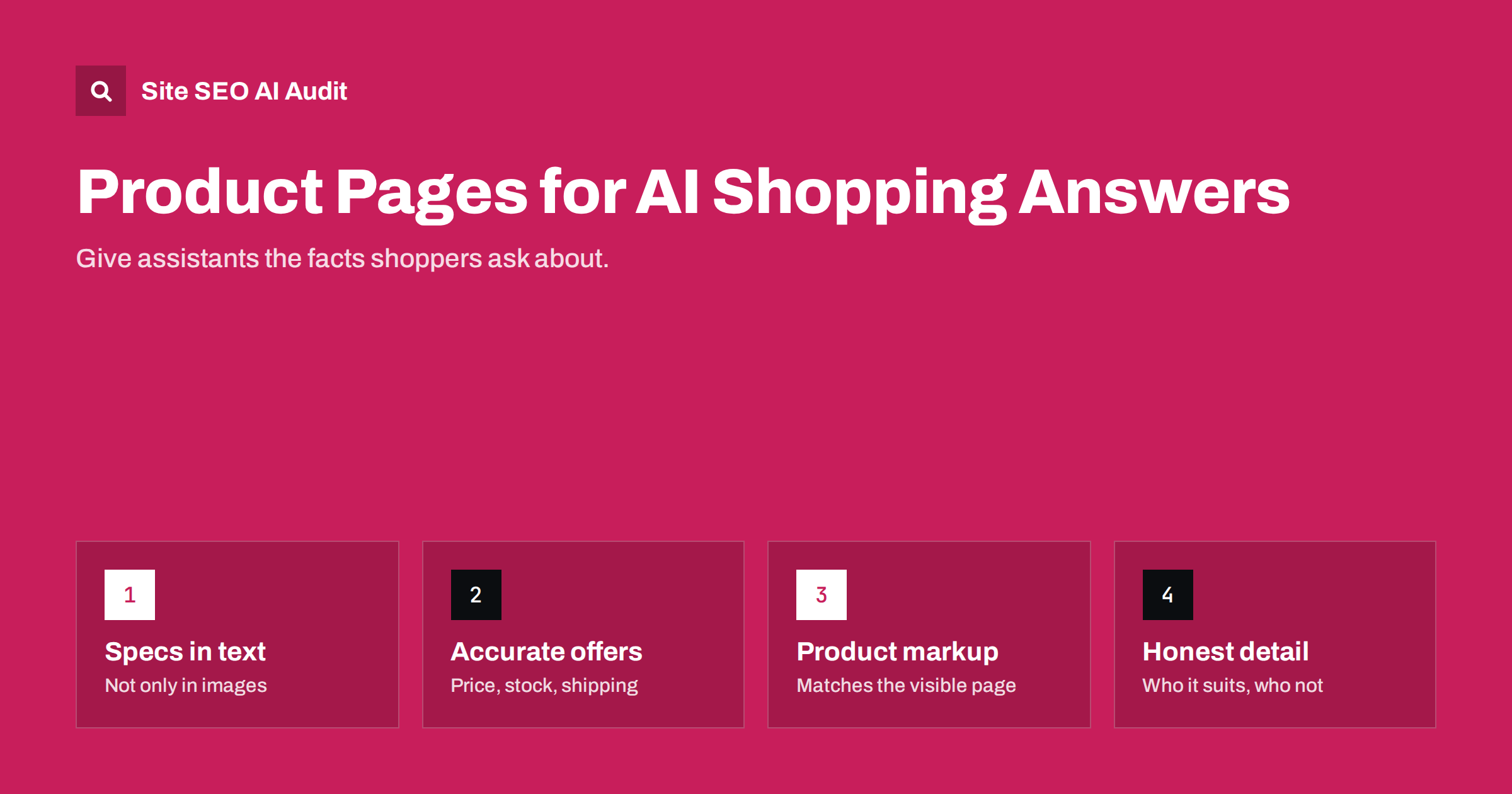
Short answer: AI shopping answers recommend products by matching a shopper’s requirements with product facts from search indexes, merchant feeds, reviews and product pages. To be recommended, your product pages need complete specifications in plain text, accurate price, availability and shipping information, valid Product structured data that matches the page, clear descriptions of who the product suits, and genuine reviews. Many shops lose out not because their products are worse, but because their pages hide these facts in images, tabs or scripts.
How AI shopping answers work
Shopping questions in AI assistants tend to be specific and conversational: “a quiet dishwasher under 45 cm wide with a delay start”, “trail running shoes for wide feet under 120 euros”, “a gift for a ten-year-old who likes science”. To answer, the assistant needs to know product attributes, prices, availability and some sense of quality, then match them against the requirements.
These facts come from several sources. Google’s shopping results and AI features draw on its Shopping Graph, fed by merchant data in Google Merchant Center and by crawling product pages. Other assistants use web search results, their own crawls, review sites and, increasingly, product feeds that merchants submit directly. Details differ by product and change often, but the common denominator is structured, accurate product information that machines can read.
A product page that looks attractive to humans but keeps its specifications in a PDF, its price in a script and its sizes in an image is effectively incomplete for these systems.
It also helps to remember how shoppers use these answers. Many use an assistant to build a shortlist, then visit two or three shops to compare and buy. Being on the shortlist depends on the facts the assistant can read; winning the sale depends on what the shopper finds when they arrive. Both steps reward the same thing: complete, honest, easy-to-find product information.
Fix 1: put specifications in plain text
Specifications are what shopping questions filter on. Make them easy to read and extract:
- Present key attributes in an HTML table or definition list: dimensions, weight, materials, compatibility, capacity, power, sizes, colours.
- Use consistent attribute names and units across all products in a category, so comparisons are possible.
- Include the attributes people actually ask about, which you can find in customer questions, reviews and support tickets.
- Avoid putting important facts only in product images, spec-sheet PDFs or manufacturer widgets.
- Make sure the specification block is in the server-rendered HTML, not loaded when a tab is clicked.
If you import manufacturer data, check it. Imported specifications are often incomplete, inconsistent or identical to hundreds of other shops, which gives no one a reason to prefer your page.
Fix 2: accurate offers everywhere
Price, availability and delivery information are among the facts AI shopping answers repeat most often, and among the most damaging when wrong:
- Show the current price clearly on the page, including currency and whether it includes VAT.
- Show availability honestly: in stock, out of stock, pre-order, or delivery time.
- State shipping costs and delivery times, at least in general terms, on product pages or a clearly linked policy page.
- Keep returns and warranty information easy to find.
- Synchronise feeds and pages. If you submit a product feed to Merchant Center or other platforms, make sure the prices and availability match the live pages. Mismatches can lead to product disapprovals.
Prices deserve special care because they change most often. If you run frequent promotions, make sure sale prices, their end dates and the regular price are clear on the page and in your feeds. An assistant that quotes a sale price after the sale has ended creates a poor first impression, and the customer will blame your shop, not the assistant.
Fix 3: valid Product structured data
Product markup states product facts in a machine-readable form. It is the bridge between your page and shopping systems.
| Property | What to include |
|---|---|
| name, description, image | Product name, a short factual description, product images |
| brand, sku, gtin or mpn | Identifiers that let systems match your product with the same item elsewhere |
| offers | price, priceCurrency, availability, url, and where relevant shipping and return details |
| aggregateRating, review | Only for genuine reviews shown on the page |
| Variant information | Sizes and colours described consistently, using product group markup where supported |
Validate markup with Google’s Rich Results Test and monitor the merchant listings and product snippets reports in Search Console. Make sure only one source outputs product markup; shop platforms and SEO plugins sometimes both do, producing conflicting data.
Fix 4: descriptions that answer “is this right for me?”
AI shoppers ask for fit, not just features. Descriptions that explain use cases help assistants match products to needs:
- Who it is for: “Suitable for small kitchens and households of one or two people.”
- Who it is not for: “Not designed for commercial use or daily heavy loads.”
- How it compares with the next model up or down in your range.
- What is in the box and what needs to be bought separately.
- Care and maintenance requirements that affect the buying decision.
Honest limitations are not a sales risk. They help the right customers choose you and reduce returns, and they make your page a more trustworthy source.
Write these descriptions in your own words. A short paragraph based on real customer feedback is worth more than a long block of marketing adjectives copied from the manufacturer.
Fix 5: category pages that explain choices
Category pages often contain nothing but a product grid. Adding a short, genuinely useful guide at the top or bottom helps both shoppers and systems: how to choose between product types, which specifications matter for which use, typical price ranges and links to comparison pages. Keep it concise and factual, and make sure the product grid itself uses real links so crawlers can reach every product.
Faceted navigation needs care. Filter combinations can create thousands of near-duplicate URLs. Keep crawlers focused on valuable category and product URLs with sensible canonicals, internal links and robots rules.
Comparison content can help too. A page that honestly compares two or three products in your range, or your product with common alternatives, answers exactly the kind of question shoppers ask assistants. Keep such pages factual, with clear criteria, and update them when products change.
Fix 6: reviews and questions
Reviews give AI answers the qualitative information they need: comfort, reliability, noise, sizing, ease of use. To make reviews useful:
- Collect reviews after purchase with a simple request, and never fake or buy them.
- Display review text on the product page in server-rendered HTML, not only in a script-loaded widget.
- Encourage reviewers to mention how they use the product.
- Answer customer questions publicly on the page, which also creates useful content.
Common technical problems in shops
Audits of online shops frequently find the same issues: product descriptions and prices loaded by JavaScript, out-of-stock products returning soft 404s, discontinued products deleted without redirects, duplicate product URLs from categories and parameters, missing or conflicting Product markup, and slow templates on mobile. Each one reduces the chance that a product is correctly understood, and many affect thousands of pages at once because they sit in templates.
Fix template-level problems first. Correcting one product template can improve thousands of pages in a single change, while rewriting individual descriptions is slow work best reserved for your best-selling and highest-margin products. A sensible order is: rendering and markup in templates, then offers and feed consistency, then descriptions for top products, then category guides.
How Site SEO AI Audit helps
Site SEO AI Audit crawls your catalogue up to your plan’s page limit, starting from the home page and sitemap, and weighs each issue by how many pages it affects, which suits shops where one template error repeats across the catalogue. It checks structured data and invalid JSON-LD, duplicate titles and thin content, broken links and redirects, speed and Core Web Vitals, and AI visibility, including content that needs JavaScript. Plans for growing shops are on the pricing page.
Related reading
- Does Structured Data Help in AI Search? An Honest Look
- Why AI Crawlers Miss JavaScript Content and How to Fix It
- Duplicate Title Tags and Meta Descriptions: How to Fix Them
The bottom line
AI shopping answers can only recommend what they understand. Put specifications in plain text, keep prices, stock and shipping accurate across pages and feeds, add valid Product markup, write descriptions that explain fit and limitations, and show genuine reviews in the HTML. These are the same improvements that help shoppers decide, which is why they work.
GYIK
Where do AI assistants get product information?
From search indexes, merchant product feeds, product pages, review sites and comparison content. Google’s shopping features also use data merchants submit through Merchant Center.
Is Product structured data required for AI shopping answers?
It is not always strictly required, but it gives search systems accurate, machine-readable product facts and is required for many shopping rich results. It is one of the most valuable markups for shops.
Should out-of-stock products stay online?
If the product will return, keep the page live and mark it as out of stock. If it is permanently discontinued, redirect it to the closest alternative or its category.
Do manufacturer descriptions hurt my chances?
Identical descriptions give systems no reason to prefer your page over many others. Add your own details, use cases, specifications and answers to common questions.
How do I make reviews visible to AI crawlers?
Show the review text in the server-rendered HTML of the product page. Widgets that load reviews by script may not be seen by crawlers that do not run JavaScript.