ENEnglish
 LTLietuviškai
 DEDeutsch
 FRFrançais
 RUРусский
 ESEspañol
 PLPolski
 ITItaliano
 UKУкраїнська
 CSČeština
 PTPortuguês
 JA日本語
JA日本語 LVLatviešu valoda
 ETEesti
 HUMagyar
 IDBahasa Indonesia
 TRTürkçe
 HIहिन्दी
 ELΕλληνικά
 ARالعربية
 THไทย
THไทย VITiếng Việt
 RORomână
 MSBahasa Melayu
 BNবাংলা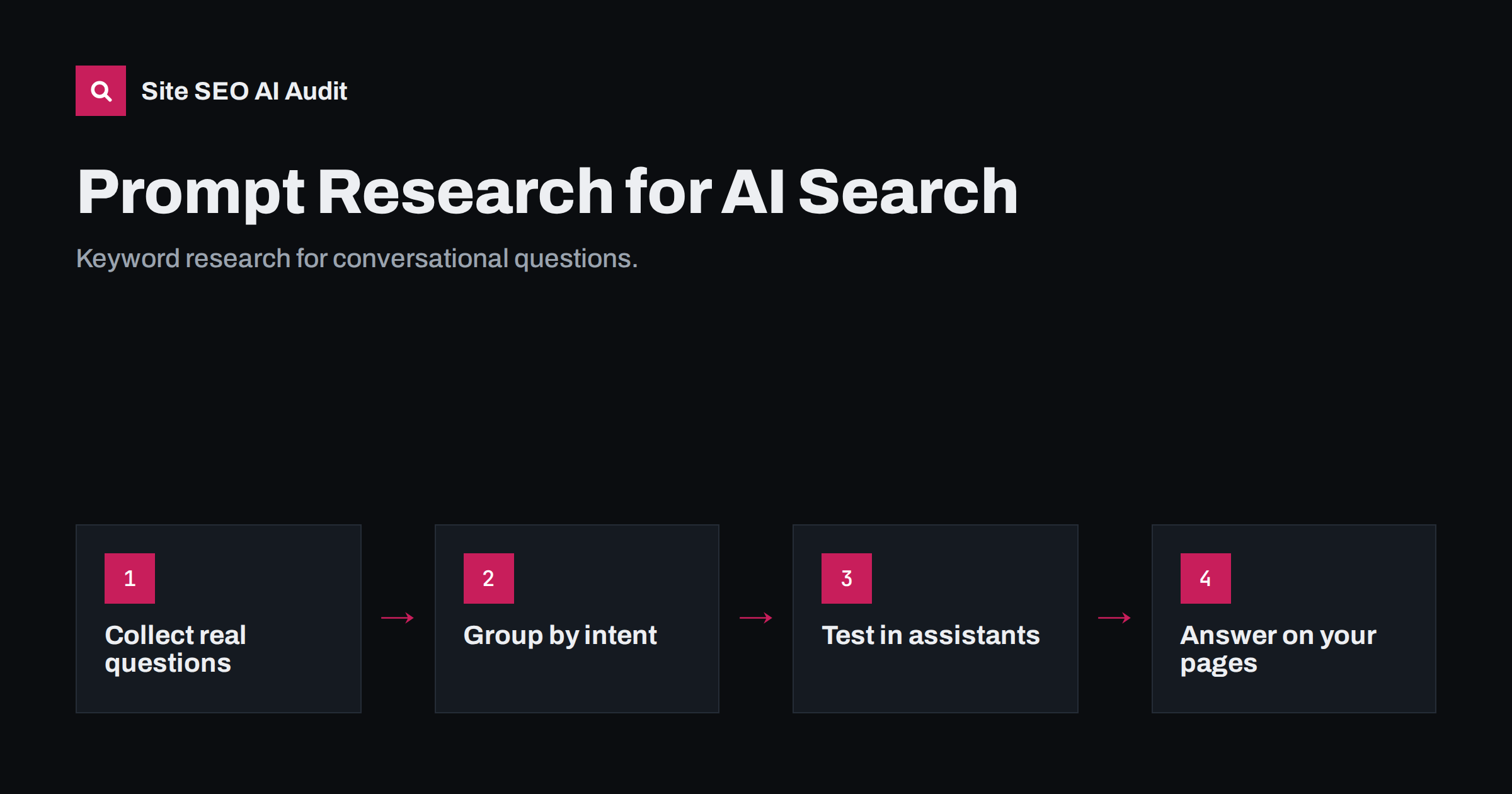
Short answer: prompt research is keyword research adapted to AI assistants: you collect the full questions people are likely to ask about your field, group them by intent, test a representative set in AI search tools, and record whether your brand is mentioned or your pages are cited. Because no tool offers reliable prompt volumes, the best sources are your own sales and support questions, long queries in Search Console, and public discussions. The output is a list of questions your pages should answer clearly.
What prompt research is and why it differs from keyword research
Classic keyword research starts from short phrases typed into a search box: “seo audit tool”, “hreflang errors”, “best crm small business”. People talking to AI assistants behave differently. They ask complete questions, add context about their situation and follow up with more questions in the same conversation:
- A search box query might be “accounting software freelancers”.
- A prompt might be “I’m a freelance designer in Germany with about 30 invoices a month. Which accounting software handles VAT and works with my bank, and what does it cost?”
The second version contains a location, a profession, a volume, requirements and a budget question. An AI assistant retrieves and combines information to answer all of it. If your pages only target the short phrase, they may never be the source that answers the specifics.
Prompt research therefore focuses on the questions, contexts and decision criteria behind a topic rather than on exact phrases. The keywords still matter, because AI search systems run ordinary web searches behind the scenes, but the unit of research becomes the question. If you want a refresher on how those systems retrieve pages, our explainer on how AI search engines find and rank sources covers it.
Where to find the questions people really ask
There is no public database of what people type into AI assistants, and tools that claim “prompt volume” rely on estimates or small panels. Treat such numbers as rough signals at most. The most reliable sources are the ones you already own or can observe directly:
- Sales calls and demo notes: the questions prospects ask before buying are exactly the ones they ask assistants too.
- Support tickets and live chat: recurring “how do I” and “why does” questions show real problems in real words.
- Search Console: filter the Performance report for queries with many words, or that start with how, what, why, which, can or should. Long queries are the closest public proxy for conversational questions.
- Your site search: what visitors type into your own search box reveals what they could not find.
- Forums and communities: threads on Reddit, Q&A sites and industry forums show how people describe problems and compare options.
- People Also Ask and related searches: these show the follow-up questions search engines already associate with a topic.
- The assistants themselves: ask an assistant what questions someone in a given situation would typically ask, then validate the list against the sources above. Never rely on this step alone.
Collect questions in a simple spreadsheet with the exact wording, the source, and any context the person gave, such as company size, location or budget.
How to group and prioritise prompts
A long list of questions is only useful once it is organised. Group each question by the intent behind it:
| Intent group | Example prompt | Page type that answers it |
|---|---|---|
| Learn | “What is hreflang and do I need it for a site in two languages?” | Explainer or guide |
| Diagnose | “Why did my traffic drop after moving to a new theme?” | Troubleshooting article |
| Compare | “Subfolders or subdomains for a multilingual shop?” | Comparison page |
| Choose | “Which SEO audit tool suits a small agency with 15 clients?” | Product, use-case or pricing page |
| Do | “How do I remove a page from Google quickly?” | Step-by-step how-to |
Then prioritise. Questions close to a purchase decision, such as “choose” and “compare”, often matter most commercially even when they are asked less often. Questions you hear repeatedly from customers deserve a place near the top regardless of any tool’s estimate. Finally, map each group to one page, following the same principle as in our guide to keyword mapping: one clear page per need, rather than many thin pages for slight variations.
How to test prompts in AI assistants
Testing shows how assistants currently answer your priority questions and whose content they rely on. Keep it simple and repeatable:
- Pick 20 to 50 representative prompts across your intent groups, not hundreds.
- Run each prompt in the assistants your audience uses, with web search enabled where it is optional.
- Record whether your brand is mentioned, whether your site is cited or linked, which competitors appear and which sources are cited.
- Note what the answer gets wrong or leaves out about your field or your business.
- Repeat the same set monthly or quarterly, using the same wording, so you can compare over time.
Expect variation. The same prompt can produce different answers from one day to the next, and answers can depend on location, account settings and conversation history. Look for patterns across many prompts rather than reacting to a single answer. Our guide on measuring your brand’s visibility in AI answers covers tracking in more depth.
Turning prompt research into content
The research pays off when it changes what you publish and how you write it. Practical ways to use it:
- Answer the exact question early. If prompts ask “which option for a shop with 5,000 products”, say so in the first paragraph of the relevant section, with a direct answer and the conditions.
- Cover the context people add. Prompts often include company size, country, budget or skill level. Add sections that address these situations explicitly.
- Use the customer’s words in headings, not your internal jargon.
- Add missing facts about your business where assistants got things wrong: supported countries, integrations, who the product is for.
- Build comparison and “best for” content honestly, including where alternatives may suit some readers better.
- Add an FAQ with real follow-up questions, answered in two to four sentences each.
Our guide on writing content that AI answers actually quote goes into structure and wording.
A simple example of the process
To make the steps concrete, imagine a small bookkeeping firm that works with freelancers. This is an illustration, not a case study, but it shows how the pieces fit together.
- Collect. The owner reviews three months of enquiry e-mails and finds the same questions again and again: whether freelancers need to register for VAT, what records to keep, how much bookkeeping costs, and whether switching accountants mid-year is a problem.
- Enrich. Search Console shows long queries such as “do i need an accountant as a freelancer in my first year”, and forum threads reveal worries about deadlines and penalties.
- Group. The questions fall into learn (VAT rules), do (records to keep), choose (what an accountant costs and what is included) and diagnose (a missed deadline).
- Test. Running 25 of these prompts in two assistants shows that answers cite government pages and a few large publishers, and the firm is never mentioned.
- Act. The firm writes one thorough guide per group, adds a clear services page that states who it serves and what is included, and repeats the same 25 prompts each quarter.
Nothing here needs special tools. The value comes from using real customer language and checking the same questions consistently.
Common prompt research mistakes
A few habits make prompt research less useful than it could be:
- Trusting invented volumes. Estimated prompt counts can look precise while being guesses. Prioritise by business value and repeated customer questions.
- Testing only branded prompts. Asking “what is [your brand]” says little about discovery. Most valuable prompts do not mention you.
- One test, big conclusions. A single run of a prompt is a sample, not a measurement.
- Writing a page per prompt. Near-duplicate pages for slight wording changes compete with each other and add little value.
- Ignoring technical access. If AI crawlers are blocked or content needs JavaScript to appear, good answers on your pages will not be used.
Make sure the answers can be read
Prompt research tells you what to write; technical checks decide whether AI systems can use it. Site SEO AI Audit checks whether AI crawlers may read your site in robots.txt, whether you have llms.txt, whether content is visible without JavaScript, and whether pages have the structure and dates that AI answers quote, alongside the classic SEO checks on every page. Run a free audit to see where your pages stand before you invest in new content.
Related reading
- Search Intent: How to Match Your Page to What Searchers Want
- FAQ Sections That Work for Readers and AI Answers
- Forums and Communities in AI Answers: What Businesses Can Do
The bottom line
Prompt research moves the unit of research from the keyword to the question. Collect real questions from customers, search data and communities, group them by intent, test a stable set in AI assistants over time, and answer the priority questions clearly on well-structured pages. Treat any prompt volume figures with caution and let customer evidence lead.
GYIK
Is prompt research different from keyword research?
It builds on it. Keyword research finds short phrases people type into search engines, while prompt research looks at the full questions and context people give AI assistants. Both are useful, and AI systems still run web searches using keywords.
Can I get search volume for AI prompts?
Not reliably. AI providers do not publish prompt data, so any volume figures are estimates from panels or models. Use them as rough hints and prioritise by customer evidence and business value.
How many prompts should I track?
For most small and mid-sized businesses, 20 to 50 representative prompts across intent groups is enough. Keep the wording fixed so that repeated tests can be compared over time.
Should I write a separate page for every prompt?
No. Many prompts share one underlying need. Group them and answer them on one strong page, using sections and an FAQ for the variations.
How often should I repeat prompt tests?
Monthly or quarterly is usually enough. AI answers vary from run to run, so look for trends across many prompts rather than reacting to one answer.