ENEnglish
 LTLietuviškai
 DEDeutsch
 FRFrançais
 RUРусский
 ESEspañol
 PLPolski
 ITItaliano
 UKУкраїнська
 CSČeština
 PTPortuguês
 JA日本語
JA日本語 LVLatviešu valoda
 ETEesti
 HUMagyar
 IDBahasa Indonesia
 TRTürkçe
 HIहिन्दी
 ELΕλληνικά
 ARالعربية
 THไทย
THไทย VITiếng Việt
 RORomână
 MSBahasa Melayu
 BNবাংলা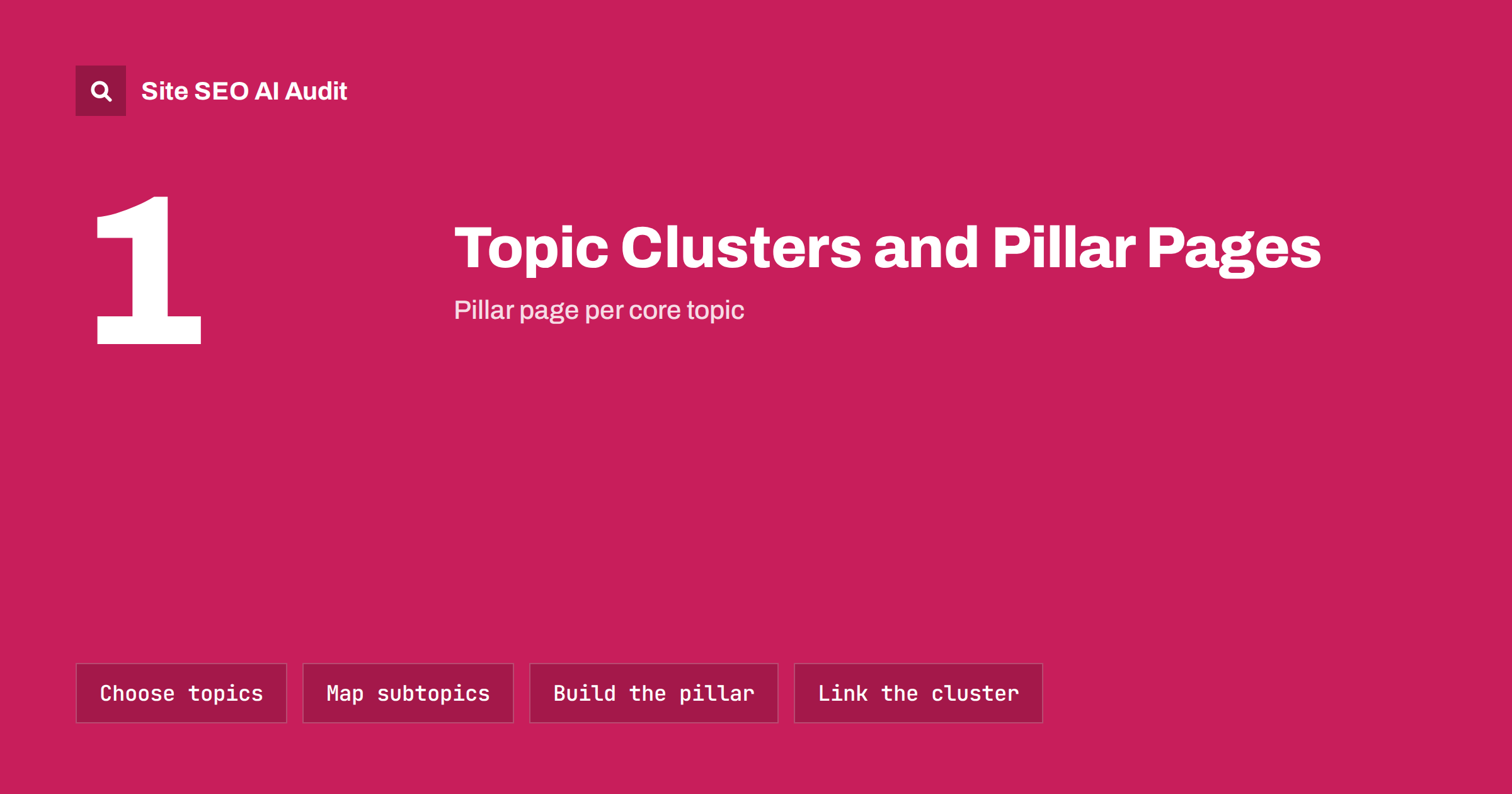
Short answer: A topic cluster is a group of pages about one subject: a broad pillar page that gives an overview of the topic, and several cluster pages that each cover one subtopic in depth, all linked to each other. The structure helps readers explore a subject, helps search engines see which page is the main resource and how the rest relate, and prevents several pages from competing for the same search. Start from how people search the topic, not from a template.
What topic clusters and pillar pages are
Most websites grow page by page: a blog post here, a guide there, a new service page when the business adds one. After a few years, the content on any given subject is scattered across many pages with no clear structure. Some overlap, some contradict each other, and important pages are linked from nowhere.
A topic cluster is a deliberate structure for a subject:
- The pillar page covers the whole topic at a useful level of detail, answers the main question, and links to every cluster page.
- Cluster pages each cover one subtopic or question thoroughly, and link back to the pillar page.
- Cluster pages link to each other where the subtopics connect.
For example, a pillar page “On-page SEO” might link to cluster pages on title tags, meta descriptions, H1 tags, heading structure, image alt text, internal linking and thin content. Each of those pages goes deep on its subject and links back to the overview.
Why the structure helps
For readers
Someone new to the topic can start with the pillar page and follow links to whatever they need next. Someone with a specific question lands on the cluster page that answers it and can step back to the overview for context. Either way, the next useful page is one click away.
For search engines
Consistent internal links make the relationships between pages explicit. Search engines can see which page is the broad resource, which pages cover subtopics, and that the site covers the subject in depth. The pillar page gathers internal links from every cluster page, which signals its importance.
For your own planning
A cluster gives each page a clearly defined job. Before writing anything new, you can see whether the subtopic already has a page. That makes keyword cannibalization much less likely, and it shows gaps: subtopics people search for that you have not covered.
Step 1: choose the core topics
Clusters work best for subjects that matter to your business and that people search for in many different ways. Good candidates:
- The main problems your product or service solves.
- The main categories of what you sell.
- Subjects where you have real expertise and can go deeper than competitors.
Most small and mid-sized sites need only a handful of clusters. Five well-built clusters are far more valuable than twenty half-finished ones.
Step 2: map the subtopics
List the questions and subtopics people search for within each core topic. Sources include Search Console queries, “People also ask” boxes, related searches, customer questions and keyword tools. Then group them:
- Questions that are really the same intent belong on the same page.
- Questions that need their own detailed answer become cluster pages.
- Short questions that do not need a full page can become sections or FAQ items on the pillar or a cluster page.
Record the result in a simple keyword map: one row per page, with its main topic, intent and the questions it answers.
Step 3: build or adapt the pillar page
A pillar page is not simply a long article that tries to cover everything in full. It is an overview that answers the main question well and then routes readers to the depth they need. A useful structure:
- A direct answer to the core question at the top.
- A short section for each major subtopic: what it is, why it matters, the key points, and a link to the cluster page for the full detail.
- A table or checklist that ties the subtopics together, where that helps.
- A clear next step: a service, a tool, a product category or a deeper guide.
You may already have a page that can become the pillar: an old “ultimate guide”, a category page, or a service page. Adapting an existing page with history is often better than starting from zero.
Step 4: create and connect the cluster pages
Each cluster page should be the best answer on your site to its specific question, and ideally one of the best on the web. Then connect it:
| Link | Where to place it | Anchor text |
|---|---|---|
| Pillar to cluster | In the section of the pillar that summarizes the subtopic | The subtopic name, e.g. “writing title tags” |
| Cluster to pillar | Early in the cluster page, where the broader topic is mentioned | The broad topic, e.g. “on-page SEO” |
| Cluster to cluster | Wherever one subtopic naturally leads to another | The linked subtopic, described naturally |
| Cluster to commercial page | Where the reader’s next step is a service or product | The service or product name |
Use descriptive anchor text, and add links in the body of the content rather than only in a sidebar box. Breadcrumbs or a small “part of our guide to…” note can also make the structure visible.
Step 5: fold in existing content
When you build clusters on an established site, you will find old pages that overlap with the new structure. Handle them deliberately:
- Pages that match a planned cluster page: update and adopt them rather than writing new ones.
- Several pages on the same subtopic: merge them into one and redirect the rest.
- Thin pages on minor questions: fold their content into a section of a stronger page and redirect.
- Pages outside every cluster: keep them if they are useful, but do not force them into a cluster they do not fit.
An example cluster for a small business
Imagine a bakery supply shop that sells ingredients and equipment online and wants to reach home bakers. One of its core topics is sourdough. A cluster might look like this:
- Pillar page: “Sourdough baking at home”, covering what sourdough is, what you need, the basic process, common problems and where to go next, with links to each cluster page and to the relevant product categories.
- Cluster page: “How to make a sourdough starter”, step by step, with a feeding schedule.
- Cluster page: “Why is my sourdough flat?”, a troubleshooting guide covering starter strength, proofing and shaping.
- Cluster page: “Best flour for sourdough”, comparing flour types, linking to the flour category.
- Cluster page: “Bannetons and proofing baskets explained”, linking to the equipment category.
- Cluster page: “Sourdough hydration explained”, with a simple calculation table.
Each page answers a question home bakers really ask, each links back to the pillar, and the troubleshooting page links to the starter and hydration pages where those are the likely causes. The commercial pages, flour and equipment categories, receive links from content that explains why a reader might need them. Nothing is forced, and every link helps someone take the next step.
Common mistakes with topic clusters
- Making the pillar page a wall of text that covers every subtopic in full, leaving cluster pages with nothing to add.
- Creating cluster pages that are too thin, just to have more links in the cluster.
- Forgetting the links, so the “cluster” exists only in a spreadsheet.
- Two pages targeting the same question within one cluster.
- Clusters built around keywords nobody searches for, or around topics unrelated to the business.
- Never maintaining the cluster: new posts on the topic are published without being linked into it.
An audit helps keep clusters healthy. Weakly linked pages, orphan pages, duplicate titles and thin content are typical symptoms of a cluster that has drifted. Site SEO AI Audit reports these across your whole site and ranks fixes by impact; see the plans or start with a free first audit.
Related reading
- Internal Linking Strategy: A Step-by-Step Guide for SEO
- Keyword Cannibalization: How to Spot It and Fix It
- What Is On-Page SEO? The Elements That Actually Matter
- Orphan Pages: How to Find Them and What to Do With Each
The bottom line
Topic clusters turn scattered content into a clear structure: a pillar page that gives the overview and routes readers onward, and cluster pages that each answer one subtopic in depth, all linked together with descriptive anchors. Choose a few core topics, map the subtopics from real searches, adapt existing pages where you can, merge overlaps, and keep linking new content into the cluster.
GYIK
How long should a pillar page be?
Long enough to answer the main question and summarize each subtopic usefully, which often means a substantial page. It should not try to cover every subtopic in full; that is what cluster pages are for.
How many cluster pages does a topic need?
As many as there are distinct subtopics people search for and that deserve a full answer. For many topics that is somewhere between five and twenty. Do not create thin pages just to make a cluster bigger.
Do topic clusters help rankings?
They help search engines understand how your pages relate and which is the main resource, strengthen internal links and reduce pages competing with each other. That supports rankings, but it does not guarantee them.
Can a category page be a pillar page?
Yes. On stores, a category page with a helpful introduction and links to buying guides often works as the pillar, with guides and subcategories as the cluster.
Should cluster pages be in a subfolder of the pillar?
It is not necessary. Internal links define the cluster; the URL structure can stay flat. Subfolders are fine if they reflect stable sections of your site.