ENEnglish
 LTLietuviškai
 DEDeutsch
 FRFrançais
 RUРусский
 ESEspañol
 PLPolski
 ITItaliano
 UKУкраїнська
 CSČeština
 PTPortuguês
 JA日本語
JA日本語 LVLatviešu valoda
 ETEesti
 HUMagyar
 IDBahasa Indonesia
 TRTürkçe
 HIहिन्दी
 ELΕλληνικά
 ARالعربية
 THไทย
THไทย VITiếng Việt
 RORomână
 MSBahasa Melayu
 BNবাংলা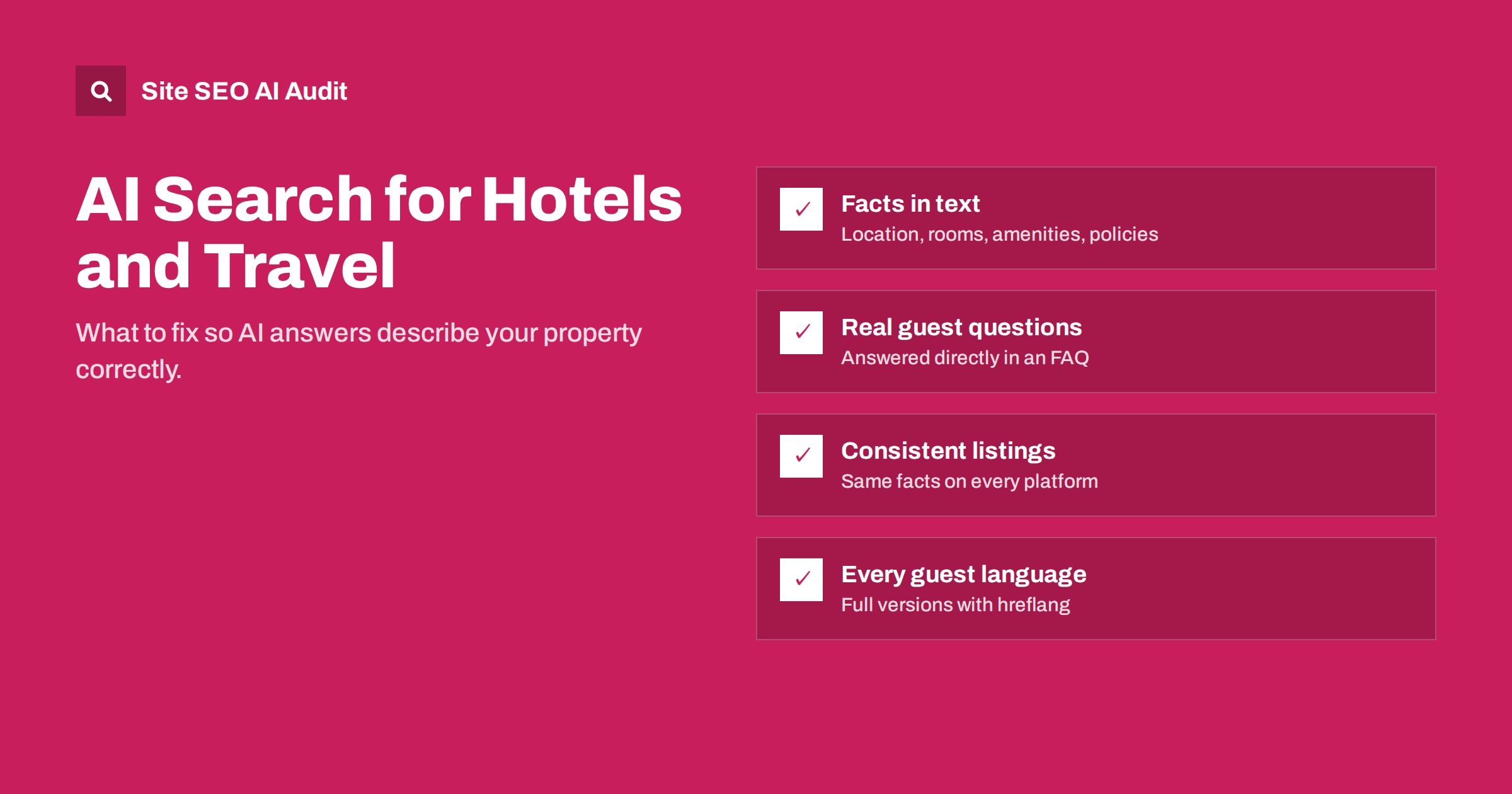
Short answer: AI assistants answer travel questions like “quiet family hotel near the old town with parking” by combining facts from hotel websites, booking platforms, maps listings, reviews and travel articles. Hotels and travel businesses are recommended more reliably when their own website states the key facts clearly in text: location and distances, room types, amenities, policies, prices or price ranges, languages and seasonal details, in every language they serve. Consistent listings elsewhere, genuine reviews and crawlable pages do the rest. No one can guarantee a mention, but missing or contradictory facts are the most common reason for being left out or described wrongly.
How travellers use AI for planning
Travel planning suits conversational search. Instead of typing “hotel Vilnius” and opening ten tabs, a traveller can describe what they want in one sentence and ask follow-up questions: which area is quieter, which hotel has a pool, whether breakfast is included, how to get there from the airport. AI assistants and AI features in search engines respond with a short list of options and reasons.
This changes what matters for a hotel or tour operator. The question is not only whether you rank for “hotel in [city]”, but whether an AI system can match you to specific needs: pet-friendly, wheelchair accessible, near the congress centre, late check-in, family rooms, quiet street, free cancellation. Those details decide whether you appear in the answer and how you are described. The general mechanics are covered in how AI search engines work.
Where AI answers get travel information
For a typical hotel, AI systems can draw on several kinds of sources:
- Your own website: descriptions, room pages, amenities, policies, location and FAQ.
- Online travel agencies and booking platforms, which list facilities, prices and guest ratings.
- Maps and business listings, with address, hours, photos and reviews.
- Review sites and forums, where guests describe their experience.
- Travel guides, blogs and news articles that mention the property or the area.
You control only the first directly, and partly the listings. That makes your website the best place to state facts accurately and completely, and the reference other sources can be checked against. When sources disagree, for example about whether parking is free, AI answers may repeat the wrong version or leave the point out. How reviews and reputation feed into recommendations is explained in reviews and reputation in AI recommendations.
Put the facts in text, on crawlable pages
Many hotel websites are built around large photos, booking widgets and short marketing slogans. The facts travellers ask about are often missing, hidden in images or only available inside the booking engine. Make sure the following appear as plain text on normal pages:
- Location: address, neighbourhood, walking or driving times to key places (old town, station, airport, beach, venue).
- Rooms: types, sizes, bed configurations, maximum occupancy, views, accessibility features.
- Amenities: parking (free or paid, on site or nearby), breakfast, Wi-Fi, pool, spa, gym, restaurant, EV charging, air conditioning.
- Policies: check-in and check-out times, late arrival, pets, children, cancellation principles, payment methods.
- Price information: at least typical ranges or “from” prices by season, if you can keep them accurate.
- Languages spoken at reception and on tours.
- Seasonality: opening months, seasonal activities, what changes in winter or summer.
Check that these pages load without JavaScript and are not blocked for crawlers. Booking engines and room pages hosted on third-party domains or inside iframes often contain the richest details, but they are not attributed to your site. Our guide on why AI crawlers miss JavaScript content explains the checks.
Answer the questions travellers actually ask
A good travel FAQ is not a list of generic questions. It collects the real questions guests ask by email, phone and at reception, and answers them directly:
- “Is there parking, and how much does it cost?”
- “Can we check in after midnight?”
- “How do we get from the airport without a car?”
- “Is the hotel suitable for a wheelchair user?”
- “Do you have rooms for a family of five?”
- “Is the tour suitable for children under eight?”
Write each answer so it stands on its own, with the specific fact first, and keep answers current. Your reception team is the best source of questions. How to format FAQ sections so both readers and AI systems can use them is covered in FAQ sections that work for readers and AI answers.
Area guides written from real local knowledge also help: the best walking routes from the hotel, where locals eat nearby, what to do on a rainy day. They answer planning questions that often lead to accommodation recommendations, and they show first-hand experience that generic travel content lacks.
Structured data for hotels and tours
Structured data will not make an AI assistant recommend you, but it states facts in a precise, machine-readable form. Useful schema.org types include:
Hotel,BedAndBreakfast,HostelorLodgingBusinessfor the property, with address, geo coordinates, telephone, check-in and check-out times, and amenity features.HotelRoomfor room types, with occupancy and bed details where your setup supports it.TouristTriporEventfor tours and scheduled experiences, with dates and locations.Organizationdetails such as logo and official profiles insameAs.
Keep the markup consistent with the visible page, and translate the text values on each language version. The rules for multilingual markup are in structured data on multilingual sites, and a realistic view of what markup does for AI answers is in does structured data help in AI search.
Consistency across listings
AI answers are more confident when sources agree. For travel businesses, inconsistencies are common because listings are created once and forgotten:
- Old phone numbers or email addresses on platforms you no longer use.
- Different room counts, star ratings or amenity lists on different platforms.
- Outdated opening seasons or check-in times.
- A previous name after a rebrand or change of ownership.
Make a list of every listing, update each to match the website, and repeat the check at least once a season. If an AI answer already states something wrong about your business, the steps in when AI gets your business wrong apply.
Serve every language your guests speak
Travel is international by nature. A traveller in Germany may ask an assistant in German about a hotel in Lithuania or Portugal. If your site only exists in the local language and English, the answer has to rely on translations of other sources, which may be incomplete.
- Offer full language versions for your main source markets, not only a translated home page.
- Translate the practical facts first: rooms, amenities, policies, directions and FAQ.
- Connect language versions with hreflang and keep them equally up to date.
- Use the measurement units, date formats and terms your guests expect.
Common mistakes on travel websites
- Facts only in photos and PDFs. Room brochures and price lists as PDFs or images are hard for machines to use.
- Everything behind the booking engine. If amenities and policies only appear in a third-party booking flow, your own site says very little.
- Vague marketing text. “An oasis of comfort in the heart of the city” answers no question. “Five minutes’ walk to the cathedral, quiet courtyard rooms, free parking for 20 cars” does.
- Stale seasonal information. Last year’s opening dates or prices are worse than none.
- AI crawlers blocked by accident. Security settings on some hosting and CDN plans block unknown bots. Check what your robots.txt and firewall actually allow.
Site SEO AI Audit includes an AI visibility area that checks which AI crawlers may read the site, whether an llms.txt file exists, and whether content is readable without JavaScript and dated in a way answers can quote. It also covers structured data validity, language versions and the usual technical and on-page issues, weighted by how many pages each affects. You can start with a free audit of your hotel or tour website.
Related reading
- AI search for local businesses: what to fix first
- Organization schema: telling AI systems who you are
- Content dates and freshness: why AI answers care
The bottom line
AI assistants recommend hotels and tours by matching specific needs to specific facts. Put those facts on your own website in plain, crawlable text, in every language you serve: location, rooms, amenities, policies, prices and seasonal details. Answer real guest questions, keep listings consistent, add accurate structured data and make sure AI crawlers can read the site. Then check regularly how assistants describe you.
GYIK
Can a hotel pay to appear in AI travel answers?
Organic AI answers are not sold like ads. Some platforms offer advertising near or inside AI features, but the answers themselves are based on available information, so accurate, complete facts on your site and listings matter most.
Do booking platforms matter more than my own website?
They are important sources, but they describe you in their own format. Your website is where you can state every fact completely and correctly, which helps AI answers resolve conflicts between sources.
Should hotels publish prices on their website?
If you can keep them accurate, typical price ranges or “from” prices by season help travellers and AI answers match budgets. Outdated prices do more harm than none.
Which schema type should a small guesthouse use?
BedAndBreakfast or the general LodgingBusiness type both work. Include address, geo coordinates, contact details, check-in and check-out times and amenities that match the visible page.
How do I see what AI assistants say about my hotel?
Ask several assistants the questions your guests would ask, in the languages they speak, and note which facts are right, wrong or missing. Repeat this every few months and after major changes.