ENEnglish
 LTLietuviškai
 DEDeutsch
 FRFrançais
 RUРусский
 ESEspañol
 PLPolski
 ITItaliano
 UKУкраїнська
 CSČeština
 PTPortuguês
 JA日本語
JA日本語 LVLatviešu valoda
 ETEesti
 HUMagyar
 IDBahasa Indonesia
 TRTürkçe
 HIहिन्दी
 ELΕλληνικά
 ARالعربية
 THไทย
THไทย VITiếng Việt
 RORomână
 MSBahasa Melayu
 BNবাংলা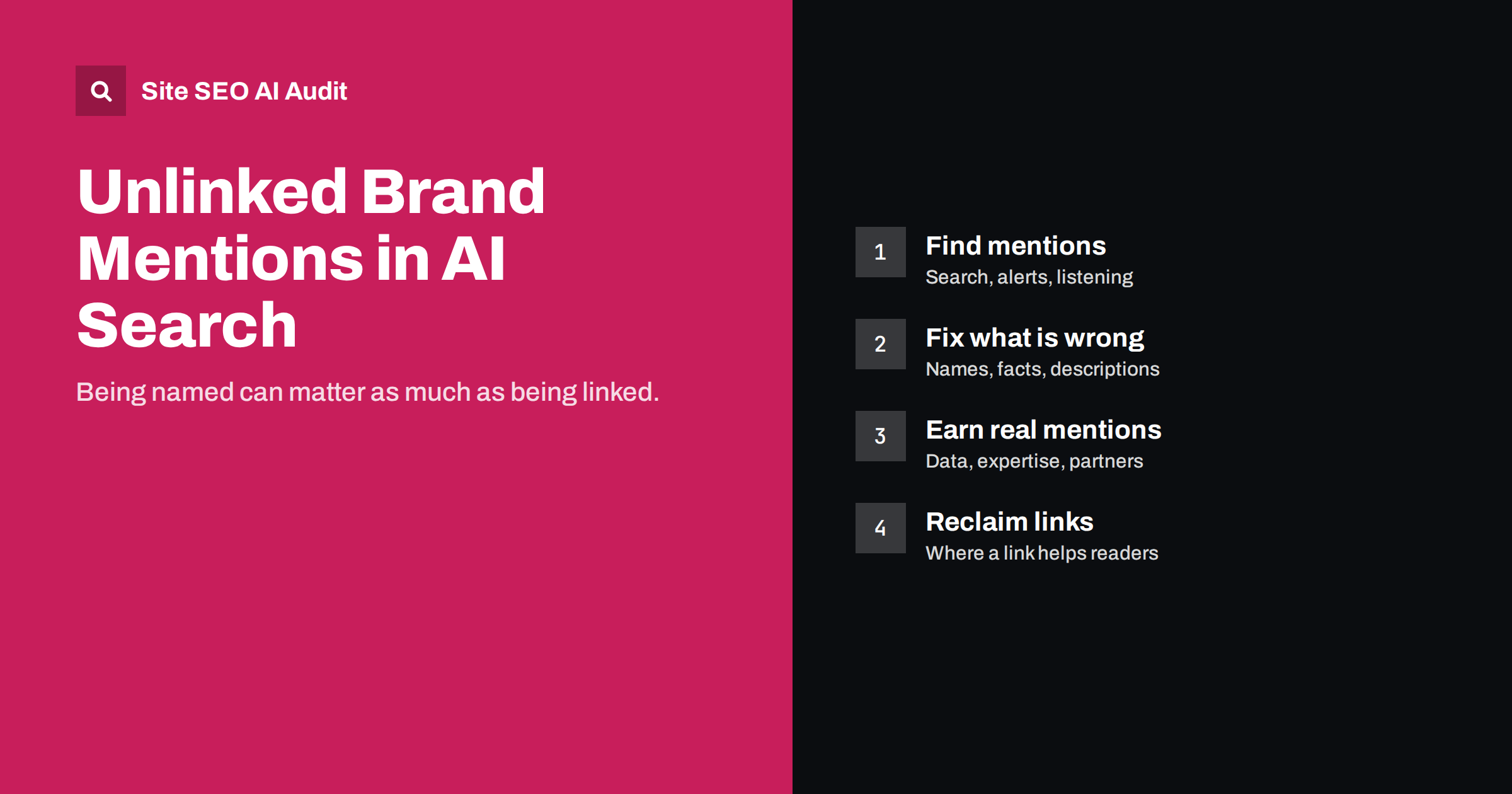
Short answer: an unlinked brand mention is a place on the web where your company or product is named without a hyperlink to your site. In classic SEO, links carried most of the weight, but AI assistants build answers from text: they learn which brands are associated with which topics and quote third-party pages that name brands in comparisons, reviews and discussions. Being mentioned often, accurately and in the right context can therefore influence whether an AI answer recommends you, link or no link. The practical work is to find mentions, correct inaccurate ones, earn new ones honestly and ask for a link where it genuinely helps readers.
What counts as an unlinked brand mention
Any text that names your business without linking to it counts. Common examples:
- A “best tools for X” article that lists your product with a short description but no link.
- A forum or community thread where someone recommends your service by name.
- A news report or trade article quoting your founder or citing your data.
- Podcast show notes, conference agendas and webinar descriptions naming your company.
- Reviews on marketplaces or review sites that mention your brand in the text.
- Directory and association listings that show your name and address but not your URL.
The context around a mention matters as much as the mention itself. “We switched to Brand X for invoicing because it handles multi-currency VAT well” tells a reader and an AI system something specific: the brand, the category and a strength. A bare name in a long list says much less.
Consistency matters too. If some sites call you “Acme Books”, others “AcmeBooks” and others “Acme Bookkeeping Ltd”, people and machines may not connect the mentions. Pick one main brand name, use it the same way on your own site and profiles, and when you contact partners or editors, give them a short standard description of what you do and who you serve. Small details such as the same spelling, the same one-line description and the same city or market make scattered mentions add up to one clear picture.
Why mentions matter more in AI search
Traditional search ranking has long relied on links as votes of confidence, and links still matter. AI search adds a layer that works with language rather than link graphs:
- Associations in training data. Language models learn which names appear alongside which topics. A brand repeatedly described as “a payroll tool for small restaurants” becomes associated with that need, whether or not the sentences contained links.
- Retrieval of third-party pages. When an assistant searches the web to answer “which payroll tool suits a small restaurant”, it often retrieves comparison articles, reviews and discussions. If your brand is named there, it can appear in the answer, even when your own site is not retrieved.
- Consensus across sources. Answers that recommend options tend to reflect what several sources agree on. A brand named positively in many independent places is more likely to be included than one that only describes itself.
This is why entity clarity matters: AI systems need to recognise that mentions across the web refer to the same business. Our guide on entity SEO for AI search explains how to make your brand unambiguous.
A note of honesty: nobody outside the AI companies knows exactly how much weight mentions carry in any given system, and it differs between assistants. What is clear from observation is that AI answers frequently name brands based on third-party pages, so being present and accurately described on those pages is worth the effort.
How to find where you are mentioned
You cannot improve mentions you have not seen. Useful methods, from free to paid:
- Search operators: search for
"Your Brand" -site:yourdomain.comand variations with product names, founders’ names and common misspellings. - Alerts: set up free web alerts for your brand and product names to catch new mentions as they appear.
- Brand monitoring tools: social listening and media monitoring tools track mentions across news, blogs, forums and social platforms.
- Backlink tools with mention tracking: some SEO suites report pages that mention your brand without linking.
- AI answers themselves: ask assistants about your category and look at which sources they cite when they name competitors or you.
Record what you find in a simple sheet: URL, type of site, the sentence around the mention, whether it is accurate, and whether it links.
Correct inaccurate and outdated mentions first
An inaccurate mention can do more harm than no mention, because AI systems may repeat it. Prioritise fixes like these:
- Old product names, discontinued plans or features you no longer offer.
- Wrong category descriptions, such as calling a B2B tool a consumer app.
- Wrong locations, markets or languages served.
- Confusion with a similarly named company.
- Outdated comparisons that list limitations you have since removed.
Contact the site owner or author with a short, polite note: what is outdated, the correct information and a source they can verify. Most editors appreciate accurate updates. Make sure your own site states the correct facts clearly too, on an about page and relevant product pages. If AI assistants are already repeating errors, our article on fixing wrong information about your business in AI answers covers the next steps.
Earn new mentions in the right places
Mentions that carry weight are the ones you cannot simply buy or post yourself. Honest ways to earn them:
- Publish original data. Surveys, benchmarks and analyses of your own anonymised data give journalists and bloggers something to cite. Our guide on original data and first-hand experience explains why these get quoted.
- Offer expert commentary. Respond to journalist requests and contribute practical, specific insight in your field.
- Be useful in communities. Answer questions in forums and groups where your customers are, disclosing your affiliation and focusing on helping rather than promoting.
- Work with partners. Integration partners, suppliers and associations often list or describe the businesses they work with.
- Make reviewers’ work easy. Provide clear product information, trial access and accurate descriptions to people who write comparisons.
- Encourage genuine reviews. Ask real customers to share their experience on relevant platforms, without incentives that break platform rules.
Focus on the places your buyers actually read. For a local service business that may be regional news, local associations and review platforms; for software it may be comparison articles, integration directories and developer communities. A handful of mentions on sources your audience trusts usually outweighs dozens on sites nobody visits.
When to ask for a link
Links still help search engines discover and evaluate your pages, and they help readers. Asking a site to turn an existing mention into a link, often called link reclamation, is reasonable when:
- The mention refers to a specific resource on your site, such as a study, tool or guide.
- Readers would clearly benefit from being able to click through.
- The site links to other brands in the same list and yours was simply missed.
Keep the request short and focused on the reader’s benefit, and accept a no gracefully. Do not ask for specific anchor text or offer payment for links, which breaks search engine spam policies. A good mention without a link is still valuable.
What not to do
Because mentions matter, it is tempting to manufacture them. These tactics tend to backfire:
- Posting self-promotional comments in forums under fake identities.
- Buying placements in low-quality “best of” lists that exist only to sell spots.
- Writing fake reviews or paying for positive ones.
- Mass-producing articles on other sites that praise your brand.
Communities remove and remember spam, review platforms filter it, and AI systems increasingly favour sources that show real experience. A smaller number of genuine, specific mentions is worth far more.
Measuring the effect
There is no report that counts mentions and their effect on AI answers. Combine a few signals over time: the number and quality of new mentions you find each quarter, branded search impressions in Search Console, direct and referral traffic from AI assistants, and a fixed set of category prompts tested regularly to see whether your brand appears. Our guide on measuring brand visibility in AI answers describes a simple tracking routine.
Your own site is the other half of the picture. Mentions lead people and AI systems to look you up, and your pages need to be readable when they do. Site SEO AI Audit checks whether AI crawlers may read your site, whether you have llms.txt, and whether your content works without JavaScript, together with structured data such as Organization markup. Start with a free audit to make sure the source behind your mentions holds up.
Related reading
- Reviews and Reputation: How They Shape AI Recommendations
- Forums and Communities in AI Answers: What Businesses Can Do
- Organization Schema: Telling AI Systems Who You Are
The bottom line
In AI search, being named in the right context can influence recommendations as much as being linked. Find where your brand is mentioned, correct anything inaccurate, earn new mentions through data, expertise and genuine community help, and ask for links only where readers benefit. Avoid shortcuts that manufacture mentions; they rarely last.
GYIK
What is an unlinked brand mention?
It is any page that names your company or product without linking to your website. Examples include lists of tools, forum recommendations, news quotes and directory entries.
Do unlinked mentions help SEO?
For classic rankings, links remain the stronger signal. For AI search, mentions in relevant context appear to matter more, because assistants learn associations from text and quote third-party pages that name brands.
Should I ask every site to add a link?
No. Ask when the mention refers to a specific resource or when readers would clearly benefit from a link. Never pay for links or demand specific anchor text.
How do I find brand mentions for free?
Use search operators such as your brand name in quotes excluding your own domain, set up free web alerts, and look at the sources AI assistants cite when answering questions about your category.
Can wrong mentions hurt my brand in AI answers?
Yes. AI systems can repeat outdated or incorrect descriptions from third-party pages. Correct the source where possible and state accurate facts clearly on your own site.