ENEnglish
 LTLietuviškai
 DEDeutsch
 FRFrançais
 RUРусский
 ESEspañol
 PLPolski
 ITItaliano
 UKУкраїнська
 CSČeština
 PTPortuguês
 JA日本語
 LVLatviešu valoda
 ETEesti
 HUMagyar
 IDBahasa Indonesia
 TRTürkçe
 HIहिन्दी
 ELΕλληνικά
 ARالعربية
 THไทย
 VITiếng Việt
 RORomână
 MSBahasa Melayu
 BNবাংলা
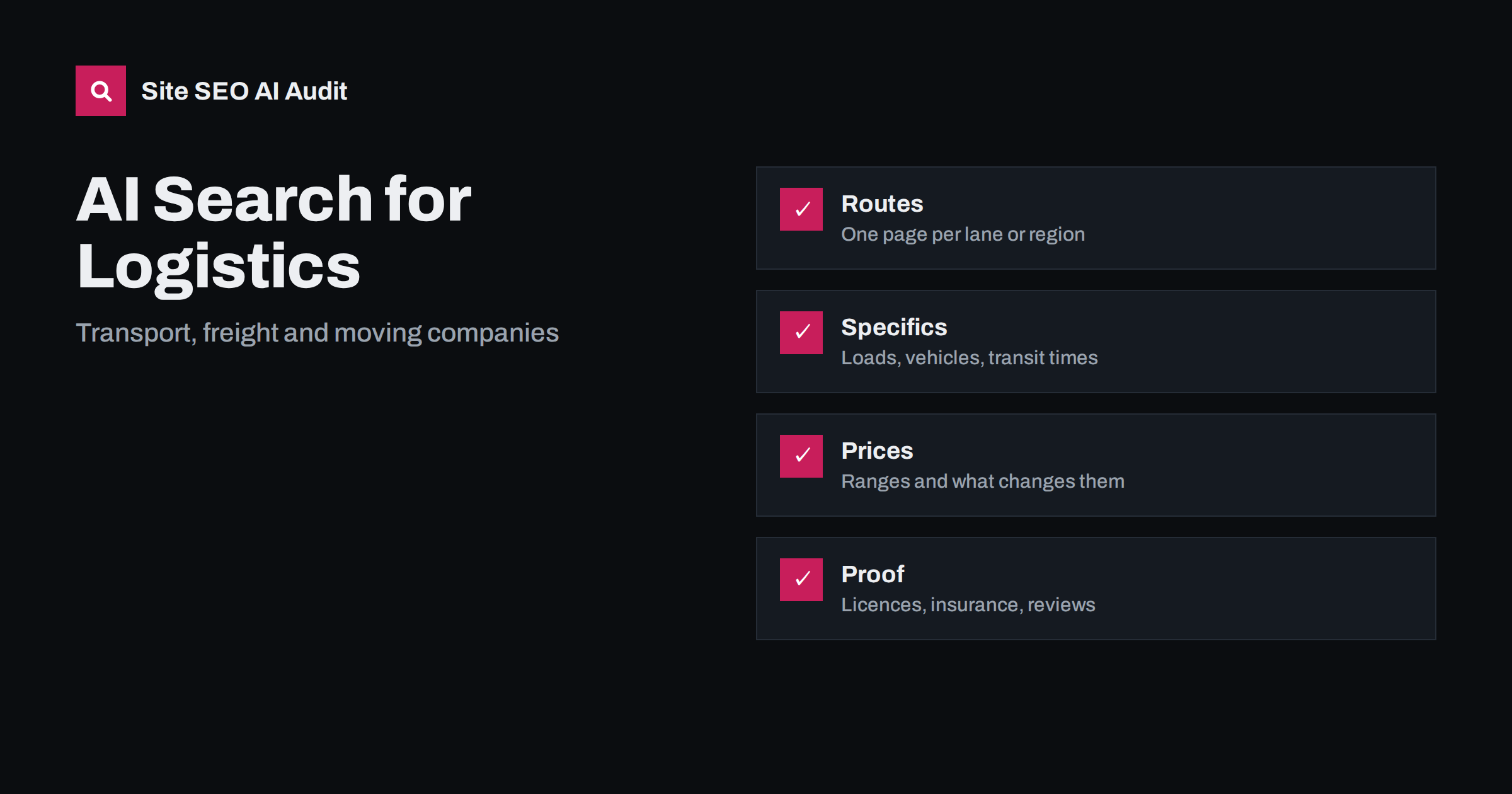
Short answer: When someone asks an AI assistant who can ship a pallet from Germany to Lithuania, move a three-bedroom house across town or deliver temperature-controlled goods, the assistant looks for companies whose pages state exactly that: the routes or areas served, the types of load and vehicle, transit times, price ranges, licences and insurance. Logistics websites that describe themselves in general terms are skipped in favour of competitors and directories that give specifics. The fix is a set of clear service pages per route, load type and region, factual answers to common questions, visible proof of licensing and insurance, and consistent business details that assistants can verify.
Transport and logistics is a business of specifics. A buyer does not want “reliable logistics solutions”; they want to know whether you run groupage to Scandinavia twice a week, whether your vans fit a piano, whether you handle customs documents, and roughly what it costs. AI assistants answer these questions by extracting facts from web pages and naming the companies behind them. This guide shows freight forwarders, hauliers, couriers, warehousing companies and removal firms how to write pages that get extracted, how to show the trust signals that matter in this industry and how to avoid the technical blocks that keep crawlers out. The general mechanics are in how AI search engines work.
What logistics buyers ask assistants
The questions cluster into a few types. Route questions: “freight from Rotterdam to Vilnius”, “weekly groupage to Spain”, “cross-border courier to Switzerland”. Load questions: “who transports oversized machinery”, “refrigerated transport for pharmaceuticals”, “moving a piano”. Service questions: “customs clearance for imports from the UK”, “fulfilment warehouse near Berlin”, “packing service for an office move”. Price questions: “how much does it cost to move a two-bedroom flat 300 km”. Trust questions: “is this company licensed”, “do they have cargo insurance”, “reviews of a moving company”. Each type needs a page or a section that answers it in plain language, because assistants quote the page that states the fact, not the one that implies it. The approach to discovering these questions is described in prompt research for AI search.
Service pages by route, load and region
The most effective structure is a page per route or lane for transport companies, a page per load type for specialised carriers, and a page per city or region for movers and couriers. Each page should state what is offered, the schedule or lead time, vehicle types, weight and size limits, documentation handled, tracking options and a price range or the factors that set the price. Use a consistent template so that the facts appear in the same place on every page and are easy to extract. Avoid creating hundreds of near-identical pages that only swap a city name; that pattern is thin content and will be ignored, as described in location pages SEO. Write a page only where you genuinely operate and can add real detail, such as depots, partners, typical transit times and local rules.
Freight forwarders with many lanes can organise pages by region with a table of main routes and transit times, and dedicated pages for the lanes that bring the most enquiries. Removal companies should separate domestic, international and office moves, and list what is included in each.
Price information without a quote form
Most logistics sites hide prices entirely behind “request a quote”. Assistants then quote whichever competitor or marketplace published a number. You do not have to publish a price list, but you can publish how prices are built and typical ranges: the factors for a road freight quote, an example price for a standard pallet on a main lane, an indicative range for a local move by flat size. Mark the examples with a date and the conditions. Pages like this are among the most cited in the industry because they answer the question people actually ask. Guidance on structuring such pages is in pricing page SEO.
Trust signals for transport companies
Logistics buyers check licences, insurance and track record, and assistants weigh the same signals. Show the operator licence or authorisation number, membership of trade associations, cargo and liability insurance details, certifications such as quality or food-safety standards, fleet size and age, and years in operation. Publish an about page with the management team and the depots. Collect reviews on platforms buyers use and display them with the business name, and add Organization or LocalBusiness structured data with the same name, address and phone as on the page and in your business profiles. Consistency across these sources is what lets an assistant attach the facts to your company with confidence; the steps are in organization schema for AI search and reviews and reputation in AI recommendations.
Content that answers operational questions
Beyond service pages, write short factual articles for the operational questions customers ask: what documents are needed for a shipment to a non-EU country, how to pack fragile items, how dimensional weight is calculated, what a CMR document is, how long customs clearance usually takes, what happens if goods are damaged in transit. These pages earn citations because the answer is specific and the author is an operator, not a generic content site. Use a direct answer in the first paragraph, clear headings and a FAQ with the follow-up questions. For removal companies, checklists and timelines for a move work well. Glossary entries for industry terms help both buyers and assistants, as described in glossary pages SEO, and the writing method in how to write content that AI answers quote.
Local and multi-country presence
Movers and couriers are local businesses in the eyes of search engines and assistants. Keep a complete business profile for each depot or branch with the correct service area, hours and categories, and a matching page on the site. Transport companies operating across borders should have language versions for the countries where they sell, with hreflang and local contact details, since a Polish shipper searching in Polish will not be shown an English-only page. The structure for several countries is covered in multi-country local SEO. For a cross-border carrier, a page in the destination language that explains the service to the receiving party, such as customs and delivery procedures, is also a source of enquiries.
Measuring whether it works
Set a baseline before changing anything. Ask the main assistants the twenty questions that matter most to your business, such as your top lanes, load types and cities, and note which companies are named. Repeat the test monthly. In analytics, separate referrals from AI assistants from other traffic, and tag enquiry forms so that you can see which service pages produce quotes. Watch Search Console for impressions on long, question-like queries, since those usually grow first when the new pages are being extracted. Expect route and price pages to move within weeks and trust-related mentions to take longer, because they depend on reviews and references accumulating. The method and the tools are described in measuring brand visibility in AI answers and tracking AI referral traffic.
Technical blocks to remove
Logistics sites commonly have three technical problems. Tracking portals and quote tools are built as script-only applications with no readable content, so the pages that attract the most interest give assistants nothing. Firewalls configured for a company intranet block unknown crawlers, including AI crawlers that fetch pages for answers; check the server logs and allow the ones you want, following AI crawlers and robots.txt. And legacy sites run slowly on old hosting with heavy fleet photos, which hurts both rankings and the patience of a buyer on a phone at a loading dock. Keep key facts in HTML, compress images and make sure the public pages load fast.
A site audit finds these issues quickly: unreadable pages, blocked crawlers, missing structured data, duplicate route pages and slow templates, ranked by how many points each fix adds. Site SEO AI Audit scores seven areas including AI visibility, and the first audit of up to 200 pages is free; larger fleets of pages are covered on the pricing page.
Related reading
- AI Search for Manufacturers and Industrial Companies
- Local Businesses in AI Search
- An AI Search Plan for Small Businesses
- Location Pages SEO
The bottom line
Transport and logistics companies get named in AI answers when their pages are as specific as their customers’ questions: routes, loads, vehicles, transit times, price factors, licences and insurance, written in plain HTML with consistent business details. Replace generic “solutions” language with facts, publish the operational answers your staff give by phone every day, and remove the technical blocks that keep crawlers out.
FAQ
Should a freight forwarder publish prices?
Not a full tariff, but indicative examples and the factors that set the price. Pages that explain pricing are cited far more often than quote forms.
How many route pages should we create?
One for each lane or region where you genuinely operate and can add real detail. Avoid templated pages that only change the city name.
Do reviews matter for B2B logistics?
Yes. Assistants and buyers both look for independent reviews and case references. Collect them on platforms buyers use and show them with your business name.
Our tracking and quote tools are script-based. Is that a problem?
Only if the surrounding page has no readable content. Add plain HTML descriptions, service details and FAQs around the tools so that the page can be understood without running them.
Which language should a cross-border carrier use?
The language of each market you sell in, with hreflang and local contact details. An English-only site is rarely shown to buyers searching in their own language.