ENEnglish
 LTLietuviškai
 DEDeutsch
 FRFrançais
 RUРусский
 ESEspañol
 PLPolski
 ITItaliano
 UKУкраїнська
 CSČeština
 PTPortuguês
 JA日本語
 LVLatviešu valoda
 ETEesti
 HUMagyar
 IDBahasa Indonesia
 TRTürkçe
 HIहिन्दी
 ELΕλληνικά
 ARالعربية
 THไทย
 VITiếng Việt
 RORomână
 MSBahasa Melayu
 BNবাংলা
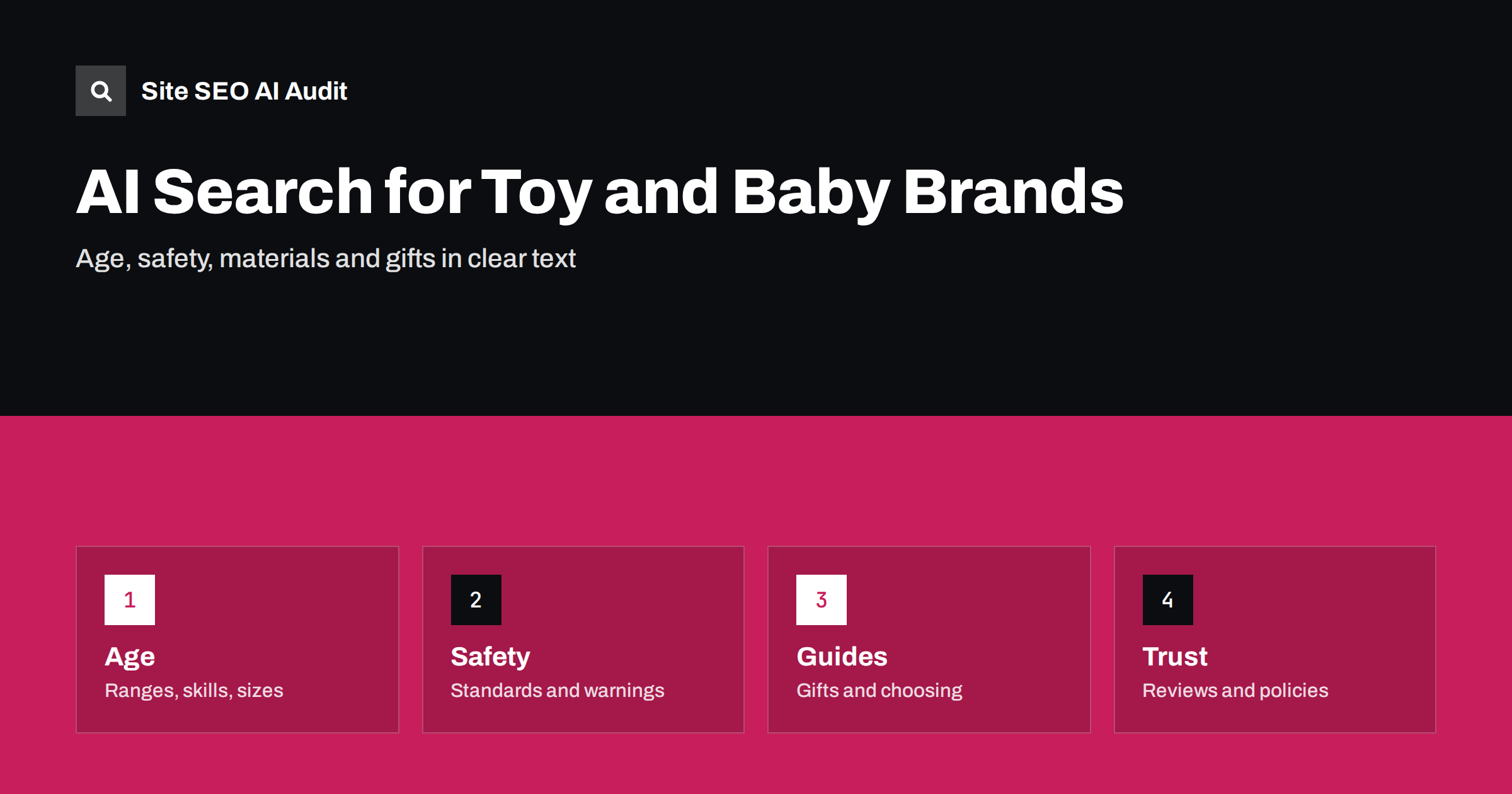
Short answer: Toy, kids and baby brands are cited by AI assistants when their pages state clearly who a product is for and how it is made: recommended age, skills it supports, dimensions, materials, battery and small-part warnings, applicable safety standards, care instructions, price, delivery and returns. Add gift and age guides, show real reviews, keep safety and recall information current, mark up products with data that matches the page and make sure the crawlers you want can read the site. Vague marketing copy gives assistants nothing safe to repeat.
Parents and gift buyers ask very specific questions. Which toy suits a three-year-old who loves trucks? Is this teether made of safe material? What is a good present for a six-year-old under a certain price? Which pram folds small enough for a car boot? When the question concerns a child, people want a precise and careful answer, and assistants are cautious about whom they quote. Brands that publish exact, honest information are in a strong position, while those that rely on cute descriptions are passed over. This guide explains how to prepare pages for both shoppers and assistants. For the mechanics behind citations, see how AI search engines work.
Understand how people shop for children
The buyer is often not the user. Parents, grandparents, relatives and friends shop for a child, usually by age, interest, occasion and budget instead of by brand. Their questions are about suitability, safety, durability, size, ease of cleaning, how long a child will use the item and whether it can be passed on. Collect actual questions from customer service, reviews, social comments and searches inside your own shop. Group them into age, skill, safety, gift, care and policy topics, and write a page or section for each. Add the seasons that drive demand, such as birthdays, holidays and back to school, and publish guides before the peak, as in seasonal pages and SEO.
State age, size and skills on every product page
The first facts parents look for are the age range and what the product does for a child. Write them in text near the top of the page, for example the recommended age, the number of pieces, the finished size, the weight, whether adult assembly is needed and which skills it supports, such as fine motor control, counting or imaginative play. For baby gear, state weight and height limits, the age or stage, folded and unfolded dimensions and compatibility with other items. Do not hide these details in images or in a downloadable manual alone. Use the same wording across the shop so that category filters, descriptions and feeds agree. General advice is in the product page guide.
Be precise about safety, materials and standards
Safety information deserves the most care. State the materials in plain terms, mention small parts and choking warnings, battery type and compartment security, paint and finish details, and washing or cleaning instructions. If a product meets a recognised safety standard or carries a required marking in your market, name it exactly and show the details of the document, and never imply approval that you do not have. Use only claims that you can prove, since an assistant may repeat them and a regulator may check them. Publish a page that explains how you test products and how to report a problem, and keep recall or safety notices easy to find. Because this is a sensitive area, read YMYL topics and AI search for the level of care expected.
Create age, gift and activity guides
Many questions begin without a product in mind. Build guides organised by age, such as toys for one-year-olds, by interest, such as building and science, by occasion and by budget, each linking to real products and written with practical advice. Explain what a child at each age can usually do, what to avoid and how to match a toy to a child’s interests, without promising developmental results you cannot support. Add short activity pages with ideas for play, which attract searches and keep customers engaged. Name the author, preferably someone with relevant experience, such as an early years educator, and add the date of the last review, which supports E-E-A-T signals. Keep a single stable address for each guide and update it yearly.
Think also about the grown-up who has to live with the product. Parents want to know how loud a toy is, how large the box is, whether the pieces can be stored easily, how many batteries are included and whether replacements are sold separately, whether it can be washed, how it looks after a month of use and whether it can be handed down to a younger child. Answer these in a short list called “Good to know” on each page. Such practical details are exactly what assistants pull into a recommendation, and they reduce returns.
Use reviews, photos and real-life details
Parents trust other parents. Collect reviews from verified buyers and show them with the child’s age range, how long the product lasted and how easy it was to clean. Show photos that include a sense of scale, since a toy’s size is hard to judge from a single image, and describe the images with accurate alt text. Reply to complaints in public, and fix issues. Never publish reviews that you wrote, and never mark up ratings that visitors cannot see. Do not show images of identifiable children without clear permission, and follow the rules that apply in your market. For further advice, see reviews and reputation in AI recommendations.
Publish delivery, returns and warranty terms
Gift purchases are often urgent, so shipping details matter. State delivery times and cut-off dates for holidays, gift wrapping, how returns work after a birthday party, the condition in which opened items can be returned, the warranty and how to claim it, and where to find spare parts and manuals. Add a page for each policy and a short summary on product pages. For baby products, include guidance on registration for safety notices when relevant. Keep the pages current, because an old holiday cut-off quoted by an assistant creates disappointment. If you sell through marketplaces as well, keep the names, sizes and prices consistent across channels, as in AI search for marketplaces and directories.
Educational and licensed products need special care with wording. If a toy is described as educational, say what it practises and for which age and avoid exaggerated promises about intelligence or development. If it is linked to a film, a series or a character, state this plainly and make sure you have the right to use the names and images. Honest descriptions protect the brand, and they are also easier for assistants to summarise correctly.
Add structured data and manage variants
Mark up products with name, image, description, brand, price, currency, availability and identifiers, and only with values that appear on the page. Toys and baby gear have many variants, including colours, sizes and bundles, so decide which deserve their own pages by looking at how people search, as explained in the product variants guide. Add organization data for your brand, using organization schema for AI search, and test the markup after each change. Make sure prices and stock match between page, feed and markup. Finally, check that your firewall and bot protection allow the crawlers that you want, using the AI crawlers and robots.txt guide.
Measure, review and keep it current
Every month, ask a fixed list of parent-style questions in several assistants, such as the best gift for a given age or whether a type of product is safe, and record which sources appear and how your brand is described. Compare the details with your pages and correct anything wrong at the source. Give each product a review date, retire discontinued items carefully using the out-of-stock product guide and update the guides as products change. Watch for inaccurate claims about your products and respond quickly, following what to do when AI gets your business wrong. Steady maintenance of facts matters more than any one-off campaign.
Site SEO AI Audit crawls your shop like a search engine, checks titles, structured data, status codes, images, orphan pages and speed on each page, and lists the fixes ranked by the points they add. The first audit of up to 200 pages is free; larger sites can see the pricing page.
Related reading
- AI Search for Fashion and Apparel Stores
- AI Search for Furniture and Home Decor
- Product Pages for AI Shopping
- FAQ Sections for AI Answers
The bottom line
Toy, kids and baby brands win citations by stating age, size, materials, safety information and policies precisely, backed by guides, honest reviews and matching product data. Be careful with claims, keep information current and review the answers each month.
FAQ
Should I show the recommended age in the product title?
Yes, when it helps buyers choose, for example in a short phrase. Also state it in the first lines of the description and keep it consistent in feeds.
How do I write about safety without overpromising?
State facts you can prove, such as materials, warnings and the exact standard met. Avoid words like completely safe, and link to your testing and contact pages.
Do gift guides help with AI answers?
Yes. Many questions begin with an age, occasion and budget. Guides that link to real products and explain choices are easy to cite.
Can I use photos of children on product pages?
Only with clear permission and in line with the rules in your market. Product photos that show scale are often enough and avoid privacy concerns.
What if an assistant lists an old or recalled product?
Update or retire the page, publish a clear notice and make sure the current information is easy to find. Then check the answers again after a few weeks.