ENEnglish
 LTLietuviškai
 DEDeutsch
 FRFrançais
 RUРусский
 ESEspañol
 PLPolski
 ITItaliano
 UKУкраїнська
 CSČeština
 PTPortuguês
 JA日本語
JA日本語 LVLatviešu valoda
 ETEesti
 HUMagyar
 IDBahasa Indonesia
 TRTürkçe
 HIहिन्दी
 ELΕλληνικά
 ARالعربية
 THไทย
THไทย VITiếng Việt
 RORomână
 MSBahasa Melayu
 BNবাংলা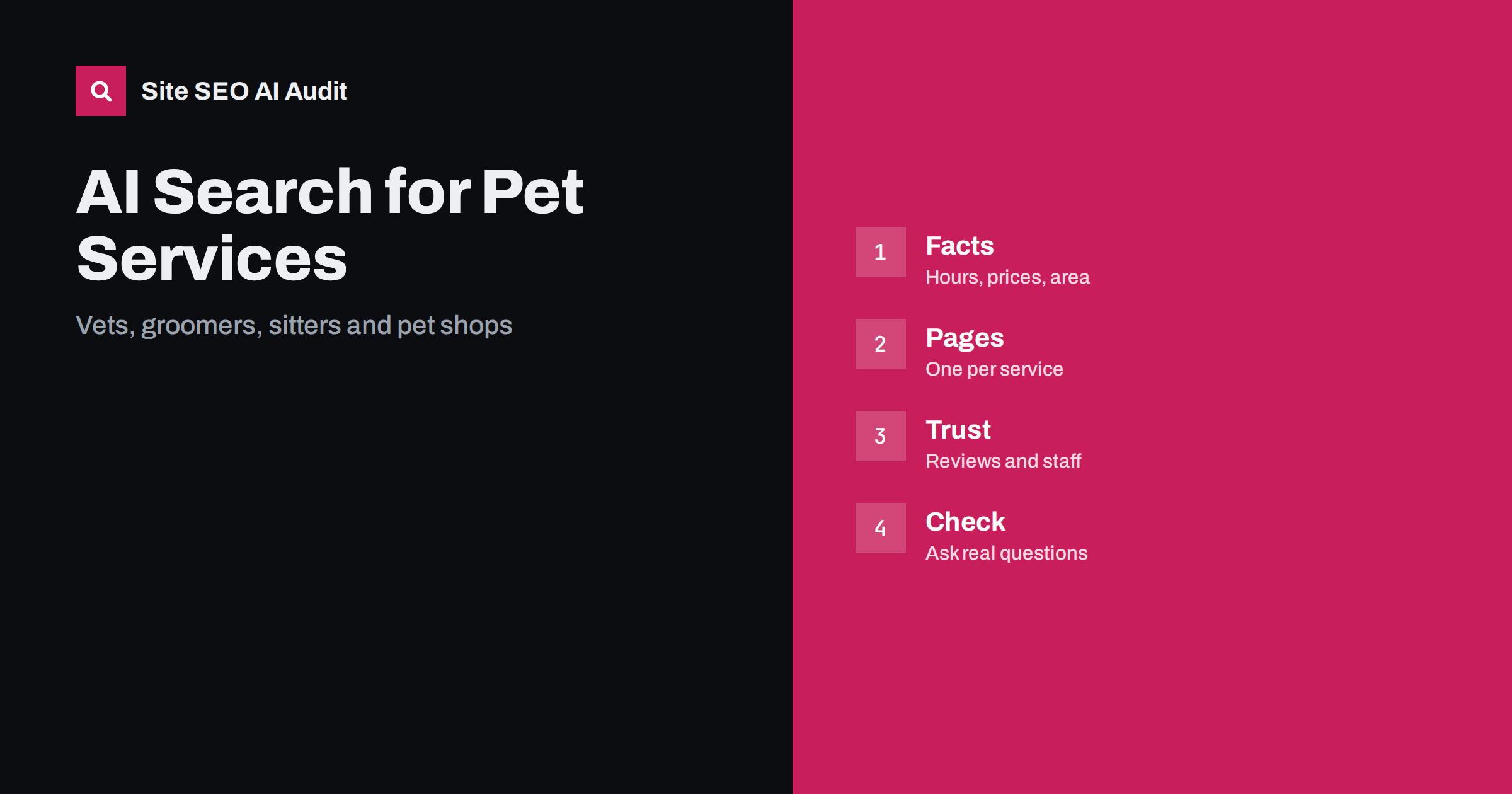
Short answer: Pet owners ask AI assistants things like “emergency vet near me”, “who grooms large dogs” or “cat boarding for two weeks”. To appear in the answers, publish clear service pages, keep your address, hours, prices and coverage area accurate everywhere, show who your team is, and answer common questions in plain language. Keep medical advice careful and always point to a qualified vet for diagnosis.
Pets are family members, and the people who own them search with urgency and emotion. A dog that has eaten something odd at ten in the evening, a cat that needs a sitter for a holiday, a puppy that needs its first grooming appointment: each of these moments starts with a question. More and more of those questions are typed or spoken to AI assistants and AI-powered search, and the assistant replies with a short answer that names a few businesses. If your clinic, salon or pet shop is not in that short list, the customer never sees you. This guide explains how to make your site easy for both people and machines to understand, with a focus on small pet businesses.
How pet owners ask AI assistants
Pet questions are often specific and local. Typical examples include “vet open on Sunday near the station”, “mobile dog groomer for anxious dogs”, “how much does a puppy vaccination cost”, “cat-friendly boarding”, “dog walker for a big dog” and “pet shop with raw food”. The assistant must combine three things: what the person needs, where they are, and which businesses match. It can only name businesses whose details it can read and trust. Vague home pages that say “we love animals” give it nothing to work with.
Also notice the split between two kinds of question. Local, service-based questions need accurate business information. Care questions, such as feeding or behaviour, need helpful, careful content. You can win in both, but they need different pages. For more on how these systems find and pick sources, read how AI search engines work.
Get the basic facts exactly right
The first job is not clever writing, but accuracy. AI systems compare your site with other sources, such as maps listings, directories and social profiles. If these disagree, the assistant is less likely to name you, or it may give the wrong phone number or hours. Check the following on your own site and on every profile you control:
- Business name written the same way everywhere.
- Address and area served. A mobile groomer or a dog walker should state the towns or districts they cover, not only a postcode.
- Opening hours, including holiday hours and out-of-hours arrangements. For a clinic, say clearly what to do in an emergency and where the nearest emergency service is, if you do not provide one.
- Services and species. State whether you treat dogs, cats, small animals, birds or exotic pets.
- Prices or price ranges where you can. “From” prices and clear conditions help assistants answer cost questions.
- How to book, by phone, form or online calendar, with the same details on every page.
Put this information in text on the page, not only in images, and repeat the essentials in the footer and on a contact page. The article on AI search for local businesses explains the local checklist in more detail.
Build one clear page for each service
A single “Services” page that lists ten things in short bullets is hard for an assistant to quote. Instead, create a page for each main service: vaccination, dental care, neutering, puppy grooming, cat boarding, dog walking, training classes. Each page should have a clear title, a short opening answer, and sections that cover who the service is for, what is included, how long it takes, what it costs, how to prepare and how to book.
Start the page with a two or three sentence answer that stands on its own. For example: “We offer full grooming for small and medium dogs, including bath, brush, nail trim and ear cleaning. Appointments take about two hours and cost from the price listed below. Please book at least two days ahead.” This style matches how answers are built, and it helps human visitors too. See answer-first introductions for more examples. Page structure for service businesses is covered in service page SEO.
Answer real questions on your site
Your front desk already knows the questions customers ask most. Turn them into short, honest answers on the relevant pages. Good examples for a pet business are: how often should my dog be groomed, what vaccinations does a kitten need, what should I bring to a boarding stay, what happens at a first visit, do you accept walk-ins, and how do you handle nervous animals. Keep each answer short, factual and specific to your practice.
A tidy FAQ section helps, and it can be marked up so that machines understand the questions and answers. Our guide to FAQ sections that work for readers and AI answers explains how to write them without filler.
Be careful with health and safety content
Pet health is not the same as human health, but the stakes can still be high for the animal and the owner. Treat care advice with the same care as other sensitive subjects; the article on health, money and trust topics in AI search explains why sources with clear expertise are preferred. Practical rules:
- Have care content written or reviewed by a qualified person, and show who that is, with their role and training.
- Avoid giving a diagnosis or dosage online. Describe typical signs and say when to call a vet, and when to go to an emergency service immediately.
- Date your content and update it when guidance changes. Old advice about food, medicines or vaccination schedules can do harm.
- Separate marketing from information. A page on dental care should explain the topic first and offer your service second.
Do not make promises you cannot keep, such as guaranteed results or claims of “the best vet in town” without evidence. Specific facts, such as years of experience, certifications and equipment, are stronger and easier to verify.
Seasonal needs deserve their own content. Summer brings questions about heat, ticks and travel with pets; autumn brings fireworks anxiety and boarding for school holidays; winter brings questions about cold paws, salt and festive hazards. Publish a short, practical page ahead of each season, keep the same address every year, and refresh it rather than creating a new page. This gives assistants a current, trustworthy source at the moment when owners are asking.
Show your team, your premises and your reviews
Trust matters a great deal in pet care. People want to know who will handle their animal. Create a page for your team with names, roles, qualifications and a few lines about each person. Add real photos of the premises, the grooming area, the kennels or the consulting room. Photos with descriptive alt text help visual and AI search read your site; see how to write image alt text.
Reviews are another strong signal. Ask satisfied customers to leave an honest review on the platforms where you are listed, reply to feedback politely, and never write or buy fake reviews. Assistants often draw on review summaries when they recommend one business over another. The article on reviews and reputation in AI recommendations covers this in depth.
Help machines read your business details
Structured data is a way of labelling the facts on your page, such as your name, address, opening hours and services, so that software does not have to guess. For a pet business, use the organisation or local business types and keep the values identical to what visitors see. See organization schema and an honest look at structured data in AI search. Structured data does not guarantee mentions, but it reduces mistakes. Also make sure your pages load fast, work on phones and are not blocked to crawlers by mistake.
Check what assistants say about you
Every month, ask several assistants the questions your customers would ask, with your town in the question. Write down whether you appear, what they say, and which sources they show. Look for wrong hours, missing services or confusion with a business of a similar name. Fix the cause on your site or your listings, not just the symptom. The AI search visibility checklist gives a longer list of things to check.
A technical audit helps you find the basics that block visibility: pages that cannot be crawled, missing titles, broken links, slow pages and missing structured data. Site SEO AI Audit scores your site across seven areas, including AI visibility, and the first audit of up to 200 pages is free. See the pricing page for re-checks.
Related reading
- AI Search for Local Businesses: What to Fix First
- AI Search for Clinics and Health Practitioners
- AI Search for Salons, Gyms and Wellness Studios
- An AI Search Plan for Small Businesses: The First 90 Days
The bottom line
For pet businesses, AI visibility starts with accurate basics: name, address, area, hours, prices and booking details. Add a page for each service, answer the questions owners really ask, show your team and your reviews, and handle health content with care. Then test real questions every month and fix what you find.
FAQ
Do small pet businesses really need to think about AI search?
Yes. Pet owners ask conversational, local questions, and assistants name only a few businesses. Clear, accurate pages give you a chance to be one of them.
What is the most important thing to fix first?
Make your name, address, hours, services and prices accurate and consistent on your site and on every listing. Wrong details cost more visits than any missing keyword.
Can I publish care advice on my site?
Yes, if it is accurate, reviewed by a qualified person and clear about when to call a vet. Avoid diagnoses and dosages, and keep pages up to date.
Should I have a separate page for each service?
Yes. A page per main service, with a short answer at the top, is easier for visitors and for assistants to understand and quote.
How can I check if assistants mention my business?
Ask several assistants the questions your customers ask, with your town included, and record the results each month. Note any wrong details and fix their source.