ENEnglish
 LTLietuviškai
 DEDeutsch
 FRFrançais
 RUРусский
 ESEspañol
 PLPolski
 ITItaliano
 UKУкраїнська
 CSČeština
 PTPortuguês
 JA日本語
 LVLatviešu valoda
 ETEesti
 HUMagyar
 IDBahasa Indonesia
 TRTürkçe
 HIहिन्दी
 ELΕλληνικά
 ARالعربية
 THไทย
 VITiếng Việt
 RORomână
 MSBahasa Melayu
 BNবাংলা
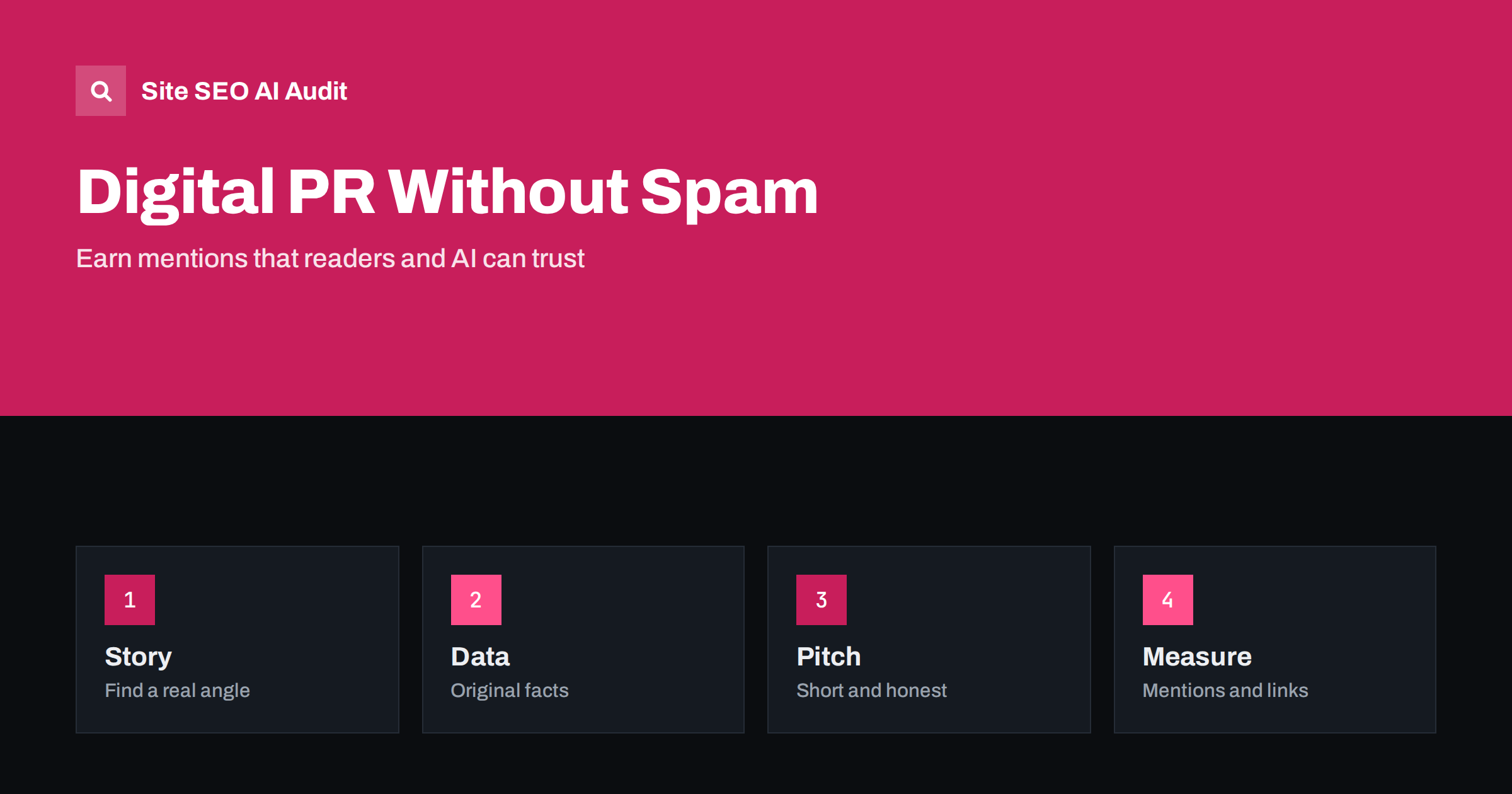
Short answer: Digital PR is the practice of earning coverage, links and brand mentions on respected websites by giving journalists, creators and editors something worth citing: original data, expert comment, useful tools, news or a clear point of view. It differs from buying links or mass outreach. It works best when the story is real, the pitch is short and relevant, and the results are measured by quality of mentions, referral visits and brand searches, not by the number of links alone.
Links remain one of the signals that help search engines judge which pages deserve attention, and brand mentions help AI assistants decide which names to trust. Both are earned, in the long run, by being useful and visible to people who write and publish. Digital PR is the discipline that connects a business to those people. It borrows from traditional public relations, but its target is the online publication, the newsletter, the podcast or the community, and its output includes a link. This guide explains how to do it without shortcuts that can harm you. For the basics of links, see the guide to link building for small sites.
What digital PR is and is not
Digital PR is the creation of something newsworthy or useful and the effort to bring it to the attention of the people who might cover it. The result is a story, a quote, a feature, a mention in a roundup or a reference to your data. It is not the purchase of links, not article swaps arranged only for links and not the distribution of low-quality content to many sites. Google’s spam policies treat links that are bought or exchanged to manipulate rankings as a violation, as described in the guide to Google spam policies.
The difference also lies in the aim. In digital PR the first goal is to be useful to the publication and its audience. The link is a normal result of being cited, not the purpose of the story. This attitude improves the quality of the pitch, and it makes the results more lasting.
Find stories worth telling
A story needs a reason for someone else to care. Look for angles that you can support: a surprising result from your own data, a trend that you see in your work, a local event, a seasonal tip with real substance, an expert opinion on the news, a case with a human side or a practical tool that solves a problem. Ask what a journalist in your field would be proud to write, and whether their readers would learn something new.
Start with what you have. Customer questions, support patterns, sales figures in aggregate, survey results, product tests and internal expertise all contain stories. The method of discovering questions is described in the guide to turning site search and support questions into content. Check that the topic is not already covered in the same way by others. Where it is, find a new angle or better data.
Create assets that earn citations
Journalists and bloggers link to sources that are clear, trustworthy and easy to use. Good assets include original research with a clear method and honest limits, a short report with charts and downloadable figures, a calculator or a checklist that people use, a glossary of an unclear subject, a visual explainer and a collection of expert quotes on a current theme. Publish each asset on a stable page with a clear title, a summary of the main findings, the method, the date and the author, so that anyone can cite it correctly.
Provide material that makes coverage easy: charts that can be embedded with credit, short quotes, a contact person and permission rules for images. The value of original data for citations is explained in the guide to original research and AI citations, and the use of tools for links in the guide to free tools and calculators.
Pitch with respect
A good pitch is short, personal and relevant. Read what the journalist or editor writes. Refer to a recent piece, explain in two or three sentences what you offer and why it suits their readers, and give the most important number or fact at once. Offer an interview with a named expert, or a data set, and say when you are available. Do not attach large files, do not send the same text to hundreds of people and do not chase with many follow-ups. One polite reminder after a few days is enough.
Respond quickly when someone is interested, and give accurate information. If you do not know something, say so. Never exaggerate figures, and never claim expertise that you do not have. Reputation with editors is a long-term asset, and one careless claim can close a door for years. Services where journalists request expert sources can be useful, as long as you answer only when you truly fit the request.
Links, nofollow and brand mentions
Not every mention will include a link, and not every link will pass the same signals. Publishers may use nofollow or sponsored attributes for various reasons, and that is acceptable. A mention of your brand in a respected publication still builds awareness, produces branded searches and gives AI systems evidence about who you are. The role of mentions is explained in the guide to unlinked brand mentions and the guide to entity SEO.
When a publication mentions you without a link, a polite message to the writer asking if a link to the source is possible can help, but it is not guaranteed and should not be demanded. For the meaning of the link attributes, see the guide to nofollow, sponsored and UGC links.
Practices to avoid
Avoid paid placements without disclosure, link exchanges arranged in bulk, networks of sites that exist only to link and articles written only to carry a link with a commercial anchor. Avoid fake data, invented experts and misleading headlines, which damage trust. Avoid mass automated outreach with generic text, which is likely to be ignored and may harm your reputation. Be careful with press releases distributed through services, because their links are often not worth much and they do not replace real coverage.
Be careful with sponsored content. If you pay for an article, it should be labelled and the links should carry the right attribute, as covered in the guide to guest posting. If you are unsure whether a tactic is safe, think about whether you would be comfortable explaining it openly to the publication’s readers.
Measure the right things
Do not judge a campaign only by the number of links. Record each piece of coverage with the publication, the date, the type of mention, whether there is a link and its attribute, the page that it points to and the visits it brings. Add the changes in branded searches, direct visits and in the mentions that AI assistants make when asked about your field, as in the guide to measuring brand visibility in AI answers. A few mentions in highly relevant, trusted places are worth more than many in low-quality sites.
Check the pages that receive the links. If they are weak, the benefit is smaller, so keep them accurate, fast and useful, and lead visitors to a next step. Monitor lost links and broken targets, and fix them, as in the guide to reclaiming lost backlinks.
A sustainable routine
Treat digital PR as a habit and not as a campaign that ends. Plan one or two strong assets per quarter, keep a list of relevant journalists and creators with notes on what they cover, share expert comments on current topics and build relationships by being useful before you ask for anything. Support the work with a well-prepared about page, expert profiles and a press page, in line with the guide to press and newsroom pages. Over time, a business that is helpful to the press becomes a source people think of first.
Here is a short example. A small software firm analysed anonymous, aggregated data on how its customers used a feature and published a short report with three charts and a plain explanation of the method. It sent a personal note to a handful of writers who had covered the topic, offering an interview with the analyst. Two trade publications and a newsletter cited the data, and the report page became the source that others linked to.
Site SEO AI Audit crawls your website and checks status codes, titles, descriptions, broken links, structured data and AI visibility settings, which helps you keep the pages that earn links fast, working and correct. It does not find journalists or measure outside coverage. The first audit of up to 200 pages is free, and larger sites can see the pricing page.
Related reading
The bottom line
Earn coverage with real stories, honest pitches and useful assets, and measure the quality of what you win.
FAQ
Is digital PR the same as link building?
It overlaps, but digital PR starts with a story or asset worth citing. Links are a result, not the only goal.
Do I need a big budget?
No. Small businesses can use their own data, local knowledge and expertise. Time and honesty matter more than money.
Are nofollow links worth having?
Yes. They bring visitors and mentions and support your reputation, even if they pass fewer signals.
How often should I pitch the same journalist?
Only when you have something relevant. One brief follow-up is fine, but repeated chasing harms the relationship.
Can AI assistants see my mentions?
They draw on many sources, and mentions on respected sites can help them identify and describe your brand.