ENEnglish
 LTLietuviškai
 DEDeutsch
 FRFrançais
 RUРусский
 ESEspañol
 PLPolski
 ITItaliano
 UKУкраїнська
 CSČeština
 PTPortuguês
 JA日本語
JA日本語 LVLatviešu valoda
 ETEesti
 HUMagyar
 IDBahasa Indonesia
 TRTürkçe
 HIहिन्दी
 ELΕλληνικά
 ARالعربية
 THไทย
THไทย VITiếng Việt
 RORomână
 MSBahasa Melayu
 BNবাংলা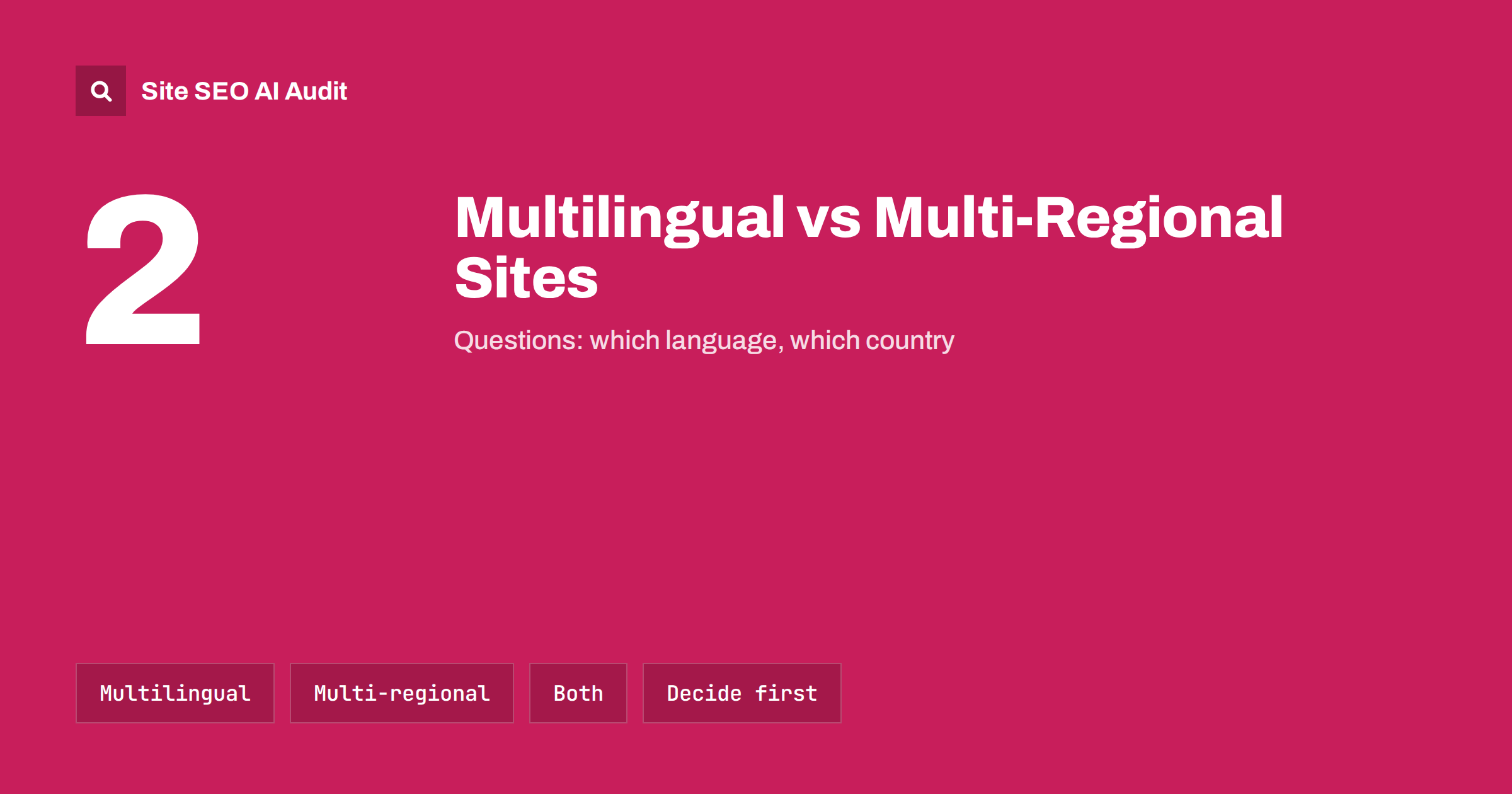
Short answer: A multilingual site offers the same content in several languages, for example English, German and French versions for anyone who reads those languages. A multi-regional site targets different countries, usually because prices, products, delivery or legal terms differ, even if the language is the same. Many international sites are both. The difference decides your URL structure, your hreflang codes and how much localization each version needs.
Two different questions
Every international website has to answer two questions about each visitor: which language do they read, and which country are they in? The answers are not the same. A German speaker might live in Germany, Austria, Switzerland or anywhere else in the world. A visitor in Switzerland might read German, French, Italian or English.
A multilingual site answers the first question. It offers content in several languages and lets the reader choose. The offer, prices and terms are the same for everyone; only the language changes.
A multi-regional site answers the second question. It offers different versions for different countries, because something about the offer depends on location: price, currency, product range, delivery options, legal requirements or local contact details. The language may be the same across several versions, as with English for the US, the UK and Australia.
Google’s guide to managing multi-regional and multilingual sites treats these as related but distinct situations, and so should you.
Examples of each type
| Type | Example | Typical versions | hreflang codes |
|---|---|---|---|
| Multilingual | SaaS tool with one global price | /en/, /de/, /fr/, /es/ | en, de, fr, es |
| Multi-regional | Retailer selling in English-speaking countries | /us/, /uk/, /au/ | en-us, en-gb, en-au |
| Both | European shop with country stores and languages | /de-de/, /de-at/, /de-ch/, /fr-ch/, /fr-fr/ | de-de, de-at, de-ch, fr-ch, fr-fr |
| Neither (yet) | Local business with international visitors | One version | None needed |
The last row matters. Having visitors from other countries does not automatically mean you need an international set-up. Many sites serve foreign visitors well with a single version, especially if the offer is not location-dependent.
How the choice affects URL structure
For a multilingual site, language folders such as /de/ and /fr/ on one domain are the natural fit. They are easy to add, share the domain’s authority and make it clear which language each section is in.
For a multi-regional site, you can use country folders such as /uk/ or /de-at/, subdomains, or country-code domains such as example.co.uk and example.at. Country domains carry the strongest location signal but multiply maintenance. Folders are simpler and work well when combined with hreflang and local content.
For sites that are both, a combined folder pattern such as /de-at/ or /at/de/ keeps the structure readable. Pick one pattern and use it consistently. Mixing /de/, /de-at/ and /at/ across the site creates confusion for users, editors and search engines alike.
How the choice affects hreflang
hreflang codes follow the same logic as the site:
- Multilingual: language codes only, such as
deandfr. Adding country codes where content does not differ by country only makes clusters bigger. - Multi-regional in one language: language plus country, such as
en-usanden-gb, plus a fallback for the rest, either a plainenversion or x-default. - Both: language plus country for each store, such as
de-chandfr-ch, and plain language fallbacks where useful, such asdefor German speakers outside your listed countries.
Remember that a country code alone, such as ch, is not valid. hreflang always starts with a language.
How the choice affects localization effort
A multilingual site mostly needs good translation and local keyword research. The offer stays the same, so product information, prices and policies are simply translated.
A multi-regional site needs more: local currency and pricing, country-specific shipping and returns, local legal pages, local contact details, sometimes a different product range. Each country version needs its own maintenance, even if the language is shared. That is the price of genuinely serving different markets, and it is why multi-regional set-ups should be chosen deliberately.
Sites that are both carry both kinds of work. A Swiss store in German and French needs Swiss prices and terms in two languages, in addition to German and French stores for Germany and France.
How to decide what your site needs
Work through these questions for each market you plan to serve:
- Does anything about the offer change by country? Price, currency, availability, delivery, legal terms, contact details. If yes, you need country versions.
- Do people in that market need a different language? If yes, you need a language version.
- Can one version serve several countries? Often a single German version can serve Germany and Austria if prices and delivery are the same.
- Can you maintain it? Each extra version needs updates when products, prices or policies change. Unmaintained versions become liabilities.
Your own data can answer most of these questions. Look at where orders, enquiries and sign-ups come from today, and what those customers ask about. If support keeps answering questions about delivery to Austria or prices in Swiss francs, that is a country signal. If they keep receiving emails in Spanish from many different countries, that is a language signal.
Start with the smallest structure that serves your real markets. You can split a language version into country versions later when the business requires it; merging versions later is harder.
How the model changes as a business grows
Few sites start with the final structure. A typical path looks like this, and knowing it in advance helps you choose URLs that will not need changing later.
- One version. A single-language site serves the home market and some foreign visitors.
- First language versions. The business adds German or Spanish because customers ask for it. The site becomes multilingual, with folders such as /de/ and /es/.
- First country differences. The business starts shipping physical products to Austria, or pricing differs in Switzerland. Now some content depends on the country, and the site starts to become multi-regional.
- Mature structure. Country stores in several languages, with a fallback per language and x-default for everyone else.
The step from language-only to language-plus-country is where URL changes usually happen. If you expect to reach it, consider a URL pattern that can grow, for example keeping /de/ as the general German version and later adding /de-at/ and /de-ch/ alongside it, rather than renaming /de/ to /de-de/. That way, existing URLs keep their history and hreflang simply gains new members.
Growth also changes who maintains what. A multilingual site can often be run by one content team with translators. A multi-regional site usually needs someone responsible for each market’s prices, offers and legal content. Planning for that ownership early prevents country versions from quietly going out of date.
Common mistakes when the two are confused
- Country codes for language-only content. Tagging the only German version as de-de makes it look Germany-specific, when it is meant for all German speakers.
- Language versions used as country stores. A French version is treated as “the store for France”, while French-speaking customers in Belgium, Switzerland and Canada find prices and delivery that do not apply to them.
- Flags for languages. A French flag in the language switcher suggests the version is for France, confusing French speakers elsewhere.
- Geo-redirects on a multilingual site. Redirecting by country on a site that is really organised by language sends people to the wrong language, for example Swiss visitors all to German.
- Cloned country versions with no differences. Several near-identical country versions of a site that does not actually differ by country create duplicates without benefit.
Checking whether your set-up matches your intent
Once you have decided what the site should be, check that its signals say the same thing. hreflang codes should match the model (language-only or language plus country), URL patterns should be consistent, lang attributes should match each page’s language, and country versions should really differ where they claim to.
Site SEO AI Audit crawls a site the way a search engine does and checks its Languages area on every page, including hreflang return links, x-default, broken language versions and lang attributes. On-page checks such as duplicate titles also reveal country versions that are identical in practice. You can run a free first audit to compare your site’s signals with your plan.
Related reading
- Same language, different countries: how to target en-US and en-GB
- ccTLD vs subdomain vs subfolder for international sites
- How to target a specific country in Google Search today
The bottom line
Multilingual means serving several languages; multi-regional means serving several countries with different offers. Decide which one your site is, or whether it is both, before choosing URLs and hreflang codes. Use language codes for language versions, language plus country codes for country versions, keep one consistent URL pattern, and localize as much as each version’s differences require.
FAQ
Can a site be both multilingual and multi-regional?
Yes. Many international shops and service providers have country versions in several languages, such as German and French versions for Switzerland alongside versions for Germany and France.
Do multilingual sites need country codes in hreflang?
No. If content is the same for all speakers of a language, use language codes only, such as de or fr. Add country codes only when versions really differ by country.
Is a multi-regional site the same as local SEO?
No. Local SEO helps a business appear for searches in a specific city or area. A multi-regional site targets whole countries with different versions of its content.
Which is easier to maintain?
A multilingual site is usually easier, because the offer is the same everywhere and only language changes. Multi-regional sites need separate prices, terms and details per country.
Should I redirect visitors by country on a multilingual site?
No. On a site organised by language, location does not reliably indicate language. Let visitors choose, suggest a version with a banner and use hreflang for search engines.