ENEnglish
 LTLietuviškai
 DEDeutsch
 FRFrançais
 RUРусский
 ESEspañol
 PLPolski
 ITItaliano
 UKУкраїнська
 CSČeština
 PTPortuguês
 JA日本語
 LVLatviešu valoda
 ETEesti
 HUMagyar
 IDBahasa Indonesia
 TRTürkçe
 HIहिन्दी
 ELΕλληνικά
 ARالعربية
 THไทย
 VITiếng Việt
 RORomână
 MSBahasa Melayu
 BNবাংলা
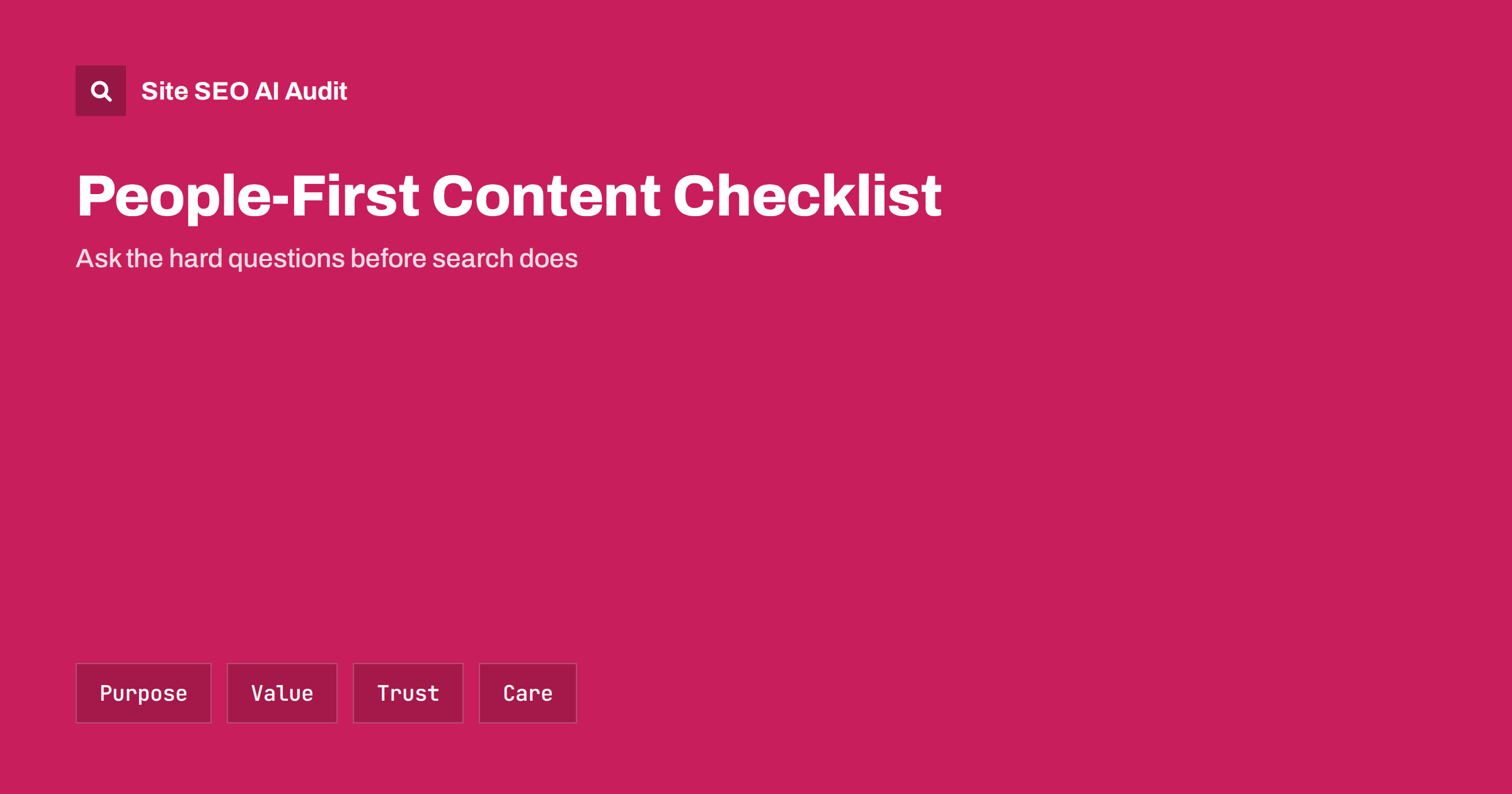
Short answer: People-first content is made to help a real reader reach a goal, not to attract clicks from search engines. To assess a page, ask whether it has a clear purpose and audience, adds something original, shows real experience and expertise, is honest about its sources and limits, answers the question completely, is easy to read and is kept up to date. If a page fails several of these questions, improve it, merge it or remove it.
Search engines repeat the same advice year after year: write helpful, reliable content made for people. The advice is simple to say and hard to apply to your own pages, because every author believes their text is helpful. A checklist makes the review more objective. This guide gives you questions to ask about any page, explains what each one means in practice and suggests what to do with the answers. It does not promise rankings, because many factors affect them, but it describes content that readers value and search systems are designed to reward. For the wider context, see the guide to E-E-A-T and AI search.
Purpose and audience
Start with the reason the page exists. Can you describe in one sentence who it is for and what they will be able to do or understand after reading it? If the honest answer is that the page exists to rank for a phrase, rewrite its purpose or drop it. Check that the page matches the intent behind the search that should lead to it: a visitor who wants to compare options needs a comparison, not a sales pitch, and someone who wants a quick fact needs an answer in the first lines. The intent is explained in the guide to search intent.
Also check whether the audience is defined realistically. A page written for everyone usually helps no one. A page that names its reader, such as a small shop owner or a first-time buyer, tends to use better examples and a better level of detail.
Original value
Ask what the page adds that the reader would not find in the first five results. It might be your own data, a test you ran, a real example, a clear explanation of a hard point, a tool, a picture you made or a conclusion based on experience. Pages that rephrase what others have said, or combine several sources without adding judgement, offer little. This is also what makes pages weak when automated tools write them at scale, as discussed in the guide to AI-assisted content and SEO.
If you cannot name the added value, find it. Interview a colleague, add a worked example, run a small survey or document a process with real screenshots. For the strongest form, see the guide to original research and AI citations.
Experience and expertise
Does the page show that the author knows the subject first-hand? Signs include specific details that only someone who did the work would know, photos or results from real use, correct handling of edge cases and honest statements about what did not work. Show who wrote the page, what qualifies them and when it was last reviewed. For sensitive topics such as health, money or safety, involve a qualified reviewer and say so. See the guide to author pages and bylines.
Avoid inflated claims about expertise. A modest, accurate description of your experience is more convincing than a long list of titles. Where you are not an expert, point to sources that are, and explain how you checked them.
Honesty and sources
Check the facts. Are the numbers current, and can you show where they come from? Do you separate facts from opinion and say when something is uncertain? Link to primary sources where they help the reader, and describe the method behind any figures you use. Guidance for this is in the guide to citing sources.
Be open about your interests. If you sell the product you discuss, say so and still be fair about alternatives. If a link is paid or affiliate, mark it correctly. Pages that hide commercial motives or promise results they cannot support lose trust quickly, and the rules on spam are summarised in the guide to spam policies.
Completeness
A helpful page answers the main question and the obvious follow-up questions. Read the page as a newcomer and note what is still unclear. Does it explain terms, give a next step and cover common exceptions? On the other hand, completeness does not mean length. Padding, repeated points and generic introductions lower quality. If a short page answers the question fully, leave it short, as discussed in the guide to word count.
Check the page against the questions your customers or support team receive. These are the real gaps. Add them as sections or as a short FAQ, in the way described in the guide to FAQ sections.
Presentation and ease of use
People read on phones, in a hurry. Check that the first screen tells them they are in the right place, that headings describe what follows, that paragraphs are short and that lists and tables are used where they make comparison easier. Images should explain something, not decorate. Avoid pop-ups, ads or banners that hide the text. Make sure the page loads fast and can be read without zooming. See the guide to formatting with lists and short paragraphs and the guide to readable writing.
Check navigation as well. A reader who finishes the page should find a clear next step: related guides, a contact option or the product page. Dead ends are a sign that the page was made for traffic, not for the reader.
Upkeep
Old pages can mislead. Check the date, the figures, the screenshots, the links and the advice. Mark the date of the last meaningful review, and update the page when facts change, not just the date. A routine for this is in the guide to refreshing old posts. Pages that cannot be kept accurate, or that serve no purpose any more, should be merged or removed, as described in the guide to content pruning.
Also check duplication inside your own site. Several pages that answer the same question compete with each other and confuse readers. Choose the best one, improve it and redirect the others.
Scoring and acting
Turn the questions into a simple score. For each of the seven areas, rate the page as strong, acceptable or weak, and note one action for every weak area. Pages with several weak areas are candidates for a rewrite, a merge or removal. Review your most important pages first, such as those with the most traffic, the highest business value or the most links, then sample the rest. The method is similar to the guide to scoring every page in a content audit.
Have a second person do the review for important pages. Authors are poor judges of their own work. Keep the results in a shared sheet and revisit it each quarter so that improvements are visible.
Common objections
Teams often say that they have no time to review content, that every page needs to target a keyword or that readers do not care who wrote a page. Each objection has a practical answer. Reviews can start with the twenty pages that matter most and grow from there. A target keyword is useful as long as the page also serves a person who searches for it. And readers do care about trust: when they have a choice between two similar pages, they pick the one that shows who is behind it and how it was checked.
Another objection is that the checklist is subjective. It is, to a degree, which is why a second reviewer and a written note of each decision help. Over time, you will see which questions reveal the most problems on your site, and you can add questions that fit your field, such as legal checks for finance pages or safety checks for health content.
Here is a short example. A software company had a blog with dozens of articles written to match keywords, each about a thousand words of general advice. A review using this checklist showed that most had no original value, no named author and out-of-date examples. The team merged related posts, rewrote the top ten with real screenshots and customer questions, added named authors and removed the weakest pages. Traffic stayed stable while leads from the blog increased, which suggested that the remaining readers were more relevant.
A second example is a clinic that added a medical reviewer and a review date to each health article, and removed claims it could not support. Readers trusted the pages more, and the clinic felt more comfortable with what it published.
Site SEO AI Audit crawls your website and checks titles, descriptions, headings, thin and duplicate content, broken links, structured data and AI visibility settings, which helps you find weak or duplicated pages to review with this checklist. It cannot judge originality or expertise. The first audit of up to 200 pages is free, and larger sites can see the pricing page.
Related reading
The bottom line
Judge each page by purpose, original value, expertise, honesty, completeness, presentation and upkeep, and then improve, merge or remove it.
FAQ
What does people-first content mean?
It means pages made to help a real reader reach a goal, rather than pages made mainly to attract search traffic.
Does using this checklist guarantee rankings?
No. It describes content that readers value and search systems aim to reward, but rankings depend on many other factors.
How often should I review my content?
Review your most important pages every quarter or half-year, and the rest on a rolling basis or when facts change.
Should I delete weak pages?
Improve them if they have a purpose, merge them if they duplicate others and remove them if they serve no one.
Can I use AI tools for drafts?
You can, but a person must add original value, check the facts and take responsibility for the result.