ENEnglish
 LTLietuviškai
 DEDeutsch
 FRFrançais
 RUРусский
 ESEspañol
 PLPolski
 ITItaliano
 UKУкраїнська
 CSČeština
 PTPortuguês
 JA日本語
JA日本語 LVLatviešu valoda
 ETEesti
 HUMagyar
 IDBahasa Indonesia
 TRTürkçe
 HIहिन्दी
 ELΕλληνικά
 ARالعربية
 THไทย
THไทย VITiếng Việt
 RORomână
 MSBahasa Melayu
 BNবাংলা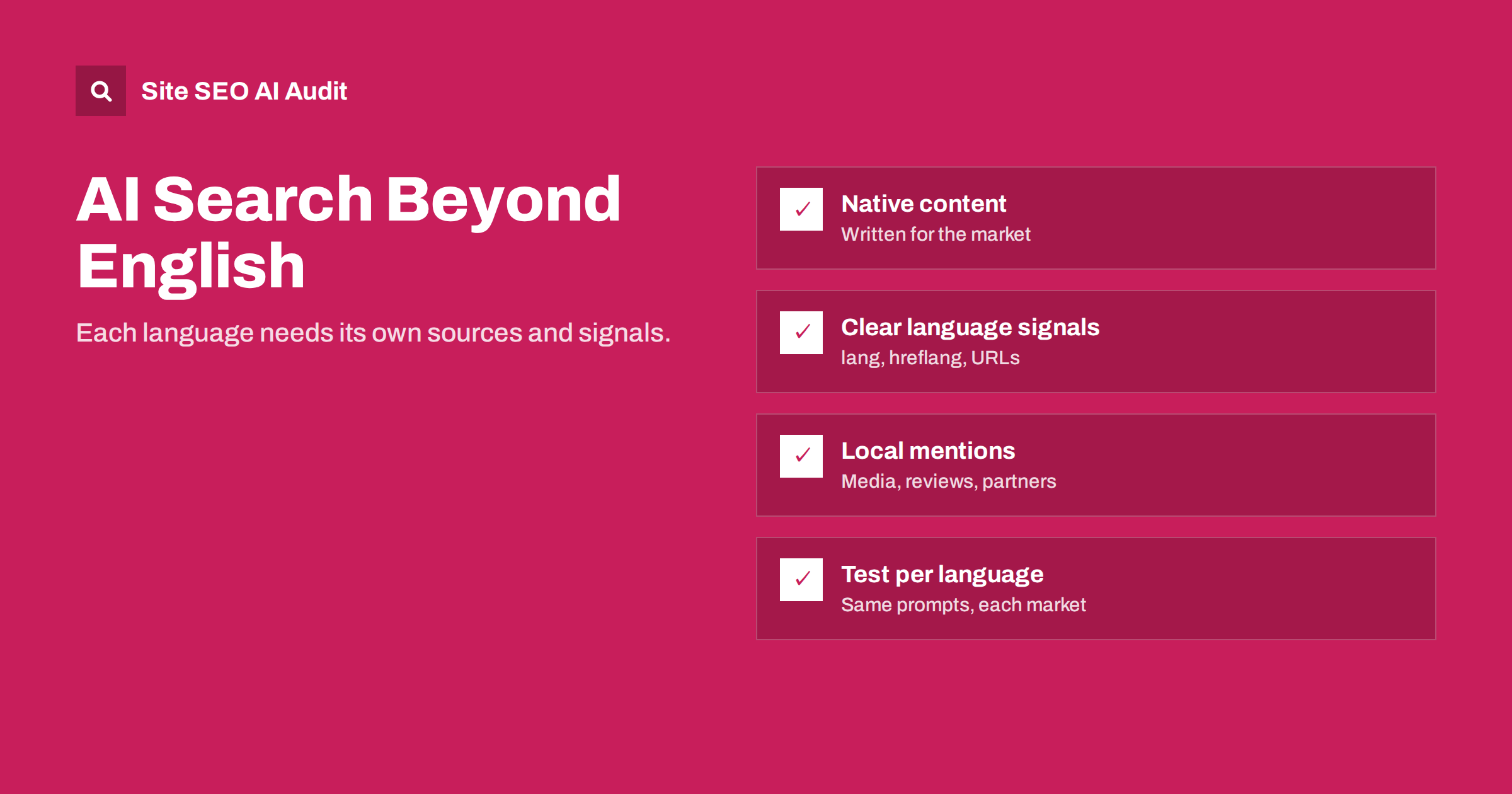
Short answer: AI assistants answer in many languages, but the sources behind those answers depend on what exists in each language and what their search systems can retrieve. In smaller languages there are often fewer good sources, so assistants may lean on English pages and translate, or on a handful of local sites. To be visible, each language version needs native-quality content that crawlers can read, clear language signals such as lang and hreflang, local mentions and reviews, and regular testing with prompts written in that language.
How AI assistants handle non-English questions
When someone asks an assistant a question in Polish, Portuguese or Lithuanian, several things can happen behind the scenes, and the exact process differs between products and is not fully documented:
- Answering from the model’s knowledge, learned from training data in many languages, where larger languages are much better represented than smaller ones.
- Searching the web in the question’s language, retrieving local pages and summarising them in the same language.
- Searching in English or mixing languages, especially when local sources are thin, then translating the result into the user’s language.
The practical consequence is that your visibility in one language says little about another. A brand that is well described in English may be missing or wrongly described in German answers, while a local competitor with a strong German presence is named instead. If you want to understand the general retrieval process first, read our explainer on how AI search engines work.
Why smaller languages are both harder and easier
For languages with fewer speakers and fewer websites, the picture has two sides.
It is harder because training data and indexes are thinner, assistants may make more mistakes, and some answers come from translated English content that ignores local context such as regulations, prices or brands available in that country.
It is easier because there is less competition for being a good source. In a market where only a few sites explain a topic clearly and accurately in the local language, a well-written local guide has a real chance of being retrieved and cited. Businesses that invest in proper local content often face a much less crowded field than in English.
There is a timing element too. Once a few local sources become the usual references for a topic, they tend to be retrieved and cited again and again, and other sites start linking to them. Being early with a clear, well-maintained local guide can therefore pay off for a long time, while arriving late means competing with sources that are already established in both search results and AI answers.
Native content beats translated content
Machine translation has improved a lot, and it is a useful starting point. But content that exists only as a direct translation often lacks what makes a page worth citing in that market:
- Local terminology that people actually use in questions, which may differ from the literal translation.
- Local facts: laws, tax rules, standards, delivery conditions, local competitors and prices.
- Examples, units, formats and references that feel natural to local readers.
- Answers to the questions people in that market ask, which are not always the same as in English.
AI answers favour pages that answer the question directly and specifically. A translated page that answers an American version of the question will lose to a local page that answers the local version. Our guide on what is safe to publish with machine translation explains where review is essential.
Clear language signals for crawlers
AI systems use the same technical foundations as search engines to decide which page serves which language. Make those signals unambiguous:
- One language per URL, with separate URLs such as
/de/or/pl/for each language, rather than switching language on the same URL with cookies or scripts. - The
langattribute on thehtmlelement set correctly for each version. Our article on the HTML lang attribute covers the details. - hreflang annotations linking equivalent pages across languages, so search systems can pick the right version for each user.
- Translated titles, headings and descriptions, not English metadata on local pages.
- Content in HTML, not loaded by JavaScript after the page loads, because many AI crawlers do not run JavaScript.
- Consistent robots.txt rules across language versions, so an AI crawler allowed on the English site is not blocked on a country domain.
Local search engines and AI systems
AI search does not look the same everywhere. Assistants with web search rely on underlying search indexes, and those differ by product and market. Some rely on Bing, some on their own crawlers, and in several countries local platforms play a large role, such as Naver in South Korea, Yandex in Russia and Baidu in China, each with its own AI features.
For most businesses this means two practical steps: make sure every language version is indexed in Bing as well as Google, and, if a market is dominated by a local search engine, follow that engine’s webmaster guidelines for that version. Our guides to why Bing indexing matters for AI search and to search engines beyond Google go into both.
Local mentions, reviews and entities
AI answers that recommend products or services draw heavily on third-party sources. In each language, those sources are different: local news sites, local review platforms, local comparison articles and communities. A brand that is discussed only in English sources may be invisible when someone asks in Spanish.
- Encourage genuine reviews on the platforms that matter in each country.
- Pitch local media with local data and local spokespeople.
- Make sure partners and distributors in each market describe you accurately, in their language.
- Use the same brand name and a consistent local description across local profiles.
- State in each language version which markets you serve, with local addresses or contact details where you have them.
Testing visibility in each language
Because behaviour differs by language, test each one separately:
- Write 15 to 30 prompts per language, based on questions local customers actually ask, not on translations of your English prompts. Our guide to prompt research explains how to collect them.
- Run them in the assistants popular in that market, ideally with the interface set to that language and, where possible, from that country.
- Record whether your brand appears, which of your pages are cited, and which local and English sources appear.
- Note errors specific to that market, such as wrong prices, unavailable products or outdated local information.
- Repeat on a schedule and compare over time, language by language.
Ask a native speaker to review the results. Subtle problems, like an answer that uses an outdated brand name or a term local customers never use, are easy for non-native reviewers to miss.
Where to start if you have limited resources
Few businesses can produce excellent content in every language at once. A realistic order of work:
- Pick the markets that matter commercially, based on sales, enquiries and growth plans, not on the number of languages your plugin supports.
- Fix the technical basics everywhere, since correct lang attributes, hreflang and crawler access cost little and apply to all versions.
- Localise the core pages first: home page, main product or service pages, pricing and contact, reviewed by native speakers.
- Add a few local guides that answer the most common local questions, especially where local rules or conditions differ.
- Build local mentions gradually through partners, reviews and local media, then test and adjust.
This approach avoids spreading effort thinly across many weak versions and concentrates it where AI visibility can turn into customers.
Checking every language version technically
Language versions often drift apart: one has a different robots.txt, another relies on JavaScript, a third has broken hreflang. Site SEO AI Audit crawls all language versions and checks hreflang return links, broken language versions, x-default and lang attributes, together with AI crawler access in robots.txt, llms.txt and content that needs JavaScript. Run a free audit to see whether each language version is readable for AI systems.
Related reading
- Multilingual Keyword Research: Finding Real Local Search Terms
- How Google Detects the Language of a Page, and Why It Matters
- How to Measure Your Brand’s Visibility in AI Answers
The bottom line
AI visibility has to be earned language by language. Publish native-quality content that answers local questions, give every version clear technical language signals, make sure each version is indexed and readable without JavaScript, build local mentions and reviews, and test with prompts in each language. In smaller languages the competition for being a trusted source is often lighter, which makes the effort especially worthwhile.
FAQ
Do AI assistants use English sources to answer questions in other languages?
Sometimes. When local sources are thin, assistants may draw on English pages and translate the answer. Strong local content gives them a better option in the user’s own language.
Is machine-translated content enough for AI search?
It is a starting point, but rarely enough. Pages that include local terminology, facts, prices and examples answer local questions better and are more likely to be used as sources.
Do I need hreflang for AI search?
hreflang is a search engine signal, and AI systems that rely on search indexes benefit from it indirectly. Together with correct lang attributes and separate URLs, it helps the right language version be retrieved.
Should I test AI visibility in every language?
Yes, for every market that matters to your business. Results in one language say little about another, so use prompts written by native speakers and review answers with them.
Can a small business compete in AI answers in its local language?
Often more easily than in English. In many smaller languages there are few clear, accurate sources on a topic, so a well-written local page has a real chance of being cited.