ENEnglish
 LTLietuviškai
 DEDeutsch
 FRFrançais
 RUРусский
 ESEspañol
 PLPolski
 ITItaliano
 UKУкраїнська
 CSČeština
 PTPortuguês
 JA日本語
JA日本語 LVLatviešu valoda
 ETEesti
 HUMagyar
 IDBahasa Indonesia
 TRTürkçe
 HIहिन्दी
 ELΕλληνικά
 ARالعربية
 THไทย
THไทย VITiếng Việt
 RORomână
 MSBahasa Melayu
 BNবাংলা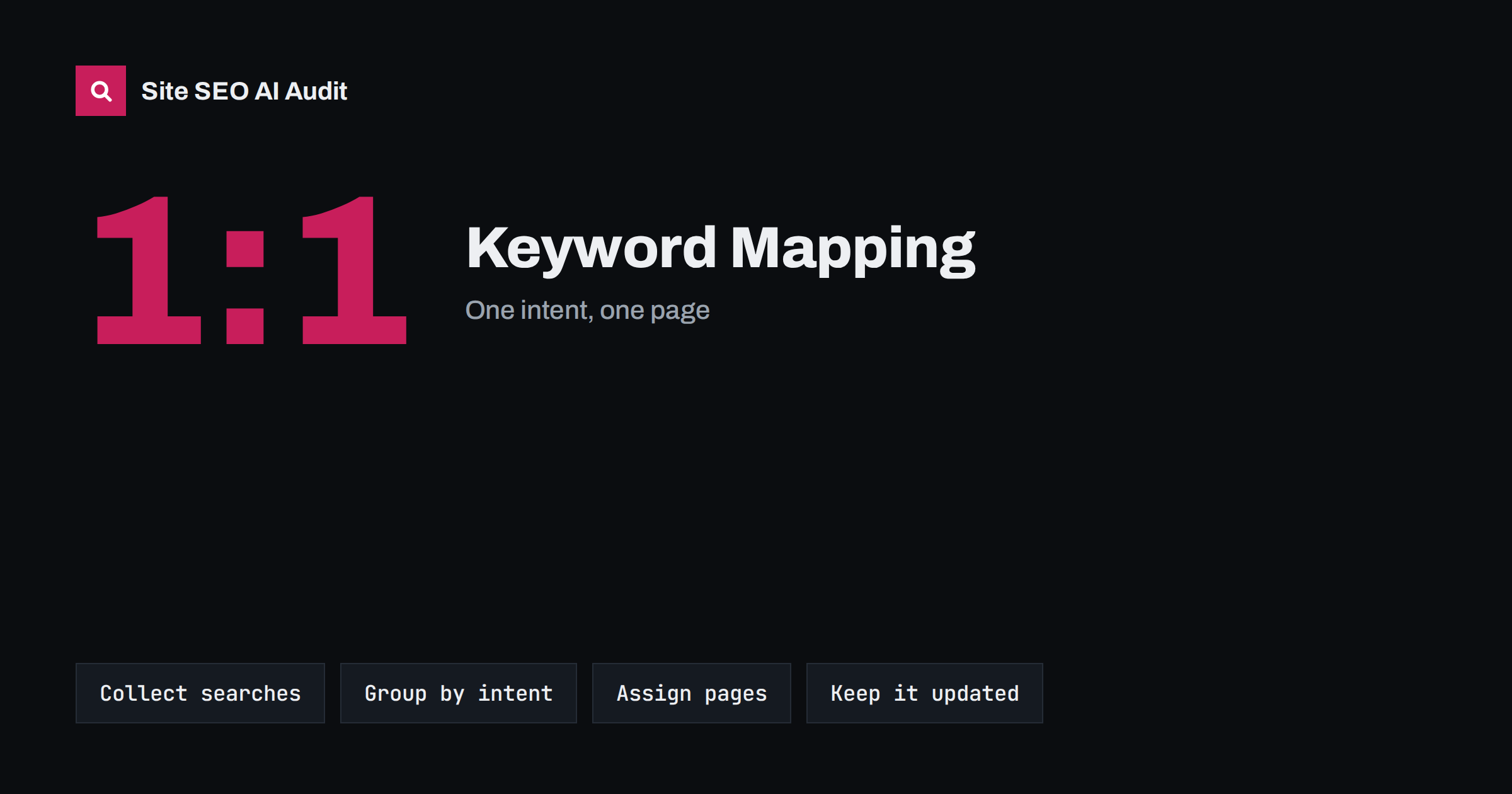
Short answer: Keyword mapping means assigning each important search topic to exactly one page on your site, and recording it in a simple table: URL, main topic, search intent, supporting questions and status. The map stops your own pages from competing, shows which searches have no page yet, and tells writers whether to update an existing page or create a new one. Build it from real queries, group them by intent, and keep it updated as you publish.
What a keyword map is
A keyword map is a document, usually a spreadsheet, that connects search topics to pages. Each important page gets one row, with the main topic it targets and the related questions it answers. Each topic appears on only one row.
It sounds like administration, and in a sense it is. But it solves several problems that otherwise quietly hold sites back:
- Cannibalization: two or more pages targeting the same search and splitting signals.
- Gaps: topics your customers search for that no page on your site covers.
- Wasted effort: writers creating new pages on topics that existing pages already cover.
- Unclear pages: pages that try to target several unrelated topics and serve none of them well.
- Weak internal links: no clear view of which page should receive links for which topic.
Step 1: collect the searches
Start with what people actually search for in your area. Useful sources:
- Google Search Console: queries that already bring impressions to your site, with the pages that receive them. This is the most valuable list because it reflects real demand for your site.
- Customer language: questions from emails, calls, chats, reviews and sales conversations.
- Search suggestions: autocomplete, “People also ask” and related searches for your main topics.
- Competitor pages: the topics that pages ranking in your field cover.
- Keyword tools: for extra ideas and a rough sense of relative volume. Treat volume figures as estimates.
At this stage, collect generously. You will group and trim in the next step.
In Search Console, the Performance report lets you export queries together with the pages that receive impressions for them. Sort by impressions and look for two things: queries where your page ranks on page two or three, which are opportunities to improve an existing page, and queries where several of your URLs appear, which hint at overlap you will want to resolve in the map. Keep the export; it becomes the raw material for the rows of your map.
Step 2: group searches by intent
The key idea of mapping is that one page should serve one search intent, not one exact phrase. Many different phrasings share an intent and belong on the same page:
- “how to write a meta description”, “meta description tips”, “writing meta descriptions” and “good meta description examples” are one intent: learning to write them.
- “meta description length” might be part of the same page or its own, depending on how the search results treat it.
- “buy running shoes online” and “running shoes guide” are different intents and need different pages.
A reliable test: search two phrases. If the same pages rank for both, they probably share an intent and belong on one page. If the results are clearly different, they need separate pages.
Step 3: assign each group to a page
For each intent group, decide which page should own it:
- An existing page already fits. Assign the group to it, even if the page needs improving.
- Several existing pages fit. Choose the strongest one; plan to merge or refocus the others.
- No page fits. Mark it as a gap and a candidate for a new page.
- The intent does not match your business. Drop it. Not every search is worth a page.
Match the page type to the intent. Commercial and transactional groups usually belong to service, product or category pages; informational groups usually belong to guides and articles.
Step 4: build the map
| Column | Example |
|---|---|
| URL | /meta-description-writing-guide/ |
| Page type | Guide |
| Main topic | How to write meta descriptions |
| Intent | Informational |
| Supporting questions | Length, examples, why they get rewritten, templates |
| Links to | Title tag guide, duplicate titles guide |
| Status | Live, updated March |
| Notes | Merge old “snippet tips” post into this page |
Keep it simple enough that people actually use it. A shared spreadsheet with these columns is enough for most sites. Add rows for planned pages too, marked as gaps.
Step 5: act on the map
The map is only useful if it drives changes:
- Align page elements. Make sure each page’s title, H1 and opening paragraph clearly reflect the main topic assigned to it.
- Fix overlaps. Merge competing pages into the chosen owner and redirect the others, or rewrite one to serve a genuinely different intent.
- Fill gaps. Plan new pages for the most valuable uncovered intents.
- Plan internal links. Use the map to decide which page should receive links for each topic, with anchor text that matches.
- Brief writers. Every new piece of content starts by checking the map.
Do the fixes in order of value. Merging two competing pages about your main service is worth more than filling a gap for a rare informational question. The map makes these trade-offs visible, which is one of its most practical benefits: it turns a vague sense that “our content is messy” into a concrete, ranked list of changes.
A small worked example
Imagine a web design studio that finds these queries in Search Console and customer emails: “wordpress website design”, “small business website cost”, “how much does a website cost”, “website redesign”, “website maintenance plans”, “wordpress maintenance”, “do I need a new website”, “website redesign checklist”.
Grouped by intent, they become:
- Service page: WordPress website design, owning “wordpress website design” and similar commercial searches.
- Service page: website redesign, owning “website redesign”.
- Service page: website maintenance, owning “website maintenance plans” and “wordpress maintenance”, which search results treat as the same need.
- Guide: how much a website costs, owning both cost queries, which share an informational intent, and linking to the design service and pricing.
- Guide: signs you need a new website, owning “do I need a new website” and linking to the redesign service.
- Guide: website redesign checklist, a practical list, linking to the redesign service.
Eight queries, six pages, each with a clear job. The studio also discovers it had two old blog posts about website costs; the map shows they should be merged into the cost guide.
Mapping for different types of sites
- Local service businesses: map each service to one page, and each genuinely served location to one page or a section. Informational questions go to a small set of guides.
- Online stores: map broad product-type searches to category pages, model searches to product pages, and research questions to buying guides. Decide which filter combinations deserve their own mapped page.
- Software companies: map feature searches to feature pages, comparison searches to comparison pages, and problem searches to guides that lead to the product.
- Publishers and blogs: map topics to clusters, with an overview page per topic and detailed articles for subtopics.
Keeping the map alive
A keyword map decays like any other document. Review it every few months against Search Console data: new queries appear, some pages start ranking for topics they were not mapped to, and intents shift. When a page begins to receive impressions for a topic owned by another page, that is an early warning of overlap.
Give the map an owner. On small teams that may be the person who publishes content; on larger ones, the SEO or content lead. Without an owner, maps are created with enthusiasm and forgotten within a quarter, and the old problems of overlapping pages and missed topics return.
Site-wide checks help too. Duplicate titles and near-duplicate content often reveal pages that compete for the same topic. Site SEO AI Audit flags both across every crawled page, along with weakly linked pages that may be missing links from related content. You can run a free first audit as a starting point for your map.
Related reading
- Keyword Cannibalization: How to Spot It and Fix It
- Search Intent: How to Match Your Page to What Searchers Want
- Topic Clusters and Pillar Pages: How to Structure Content
The bottom line
A keyword map gives every important search one clear owner on your site. Collect real searches, group them by intent, assign each group to the right type of page, and record it in a simple table. Use the map to align titles and headings, merge overlaps, plan new pages and internal links, and brief writers. Review it regularly so it keeps reflecting how people search.
FAQ
How many keywords should each page target?
One main topic or intent, with its many phrasings and related questions. A page often ranks for dozens or hundreds of queries that share the same intent. Unrelated topics belong on separate pages.
Do small websites need a keyword map?
A small site can use a very simple one: a list of pages with the main topic of each. Even that prevents most overlap and shows gaps. The larger the site and team, the more valuable a proper map becomes.
How do I know if two keywords belong on the same page?
Search both. If the same pages rank for each, they usually share an intent and belong on one page. If the results differ clearly, create separate pages.
What tools do I need for keyword mapping?
A spreadsheet and Google Search Console are enough to start. Keyword tools add ideas and rough volume estimates, and a site crawl helps find overlapping pages.
How often should I update the map?
Every time you publish or merge a page, and in a fuller review every few months using fresh Search Console data.