ENEnglish
 LTLietuviškai
 DEDeutsch
 FRFrançais
 RUРусский
 ESEspañol
 PLPolski
 ITItaliano
 UKУкраїнська
 CSČeština
 PTPortuguês
 JA日本語
JA日本語 LVLatviešu valoda
 ETEesti
 HUMagyar
 IDBahasa Indonesia
 TRTürkçe
 HIहिन्दी
 ELΕλληνικά
 ARالعربية
 THไทย
THไทย VITiếng Việt
 RORomână
 MSBahasa Melayu
 BNবাংলা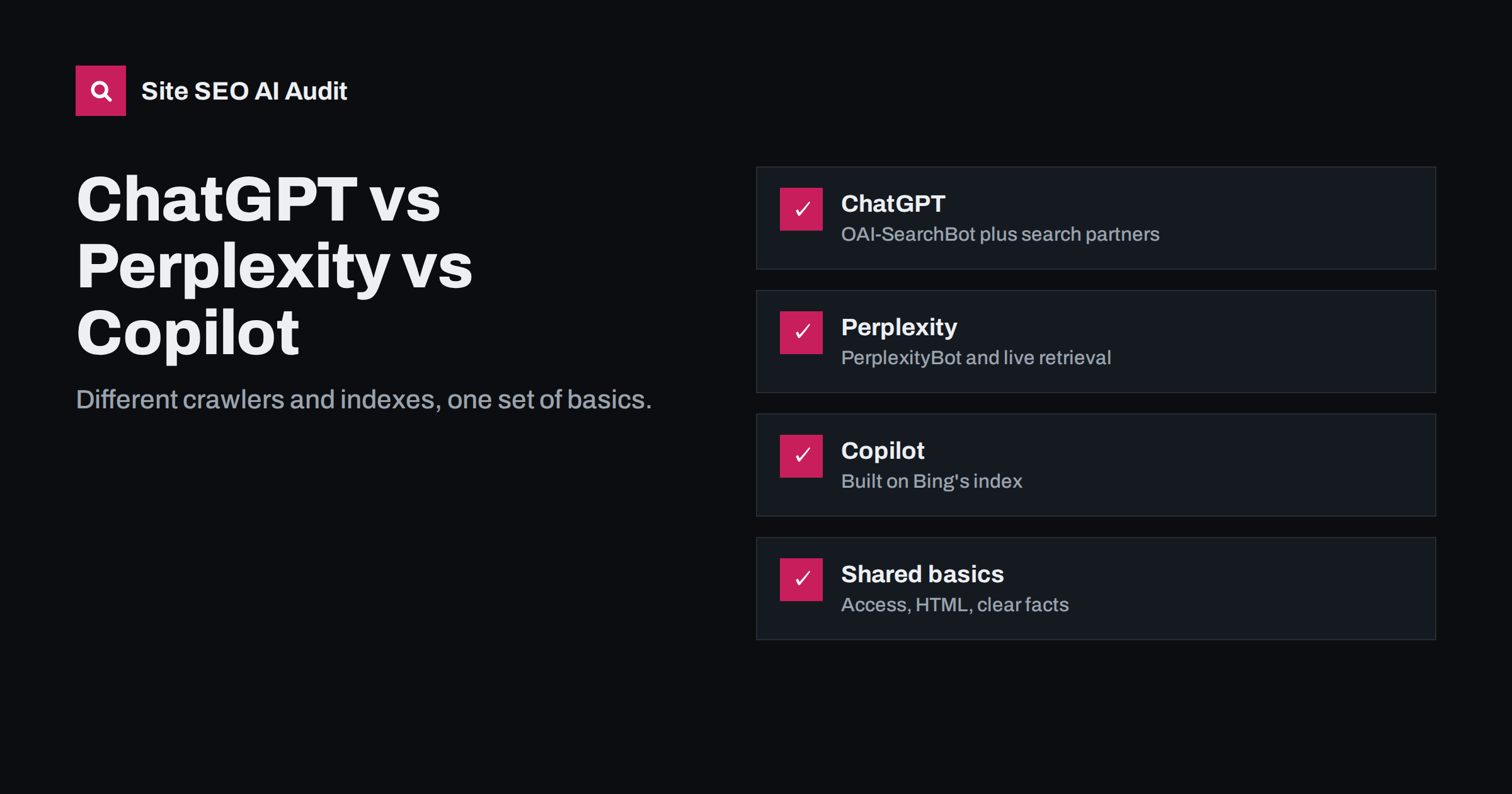
Short answer: ChatGPT search combines OpenAI’s own crawler, OAI-SearchBot, with third-party search providers; Perplexity runs its own crawler, PerplexityBot, and searches the web for every question with prominent numbered citations; Microsoft Copilot grounds its answers in Bing search. Each therefore depends on different access rules and indexes, but all three reward the same basics: pages that their crawlers may reach, content in plain HTML, direct and specific answers, and a consistent brand. Check robots.txt, your CDN and Bing indexing, then write for passages.
Think of each assistant as a separate route to your content. Most routes share the same road surface, your pages, but each has its own gate and its own map.
Why compare them
When people talk about “AI search”, they often treat assistants as one thing. For site owners, the differences matter, because each product reaches your content through different crawlers and indexes. A site that is well indexed in Google but blocks OAI-SearchBot, or has never been checked in Bing, may be visible in one assistant and invisible in another.
The details below are based on what the operators have published and on how the products behave publicly. Products change often, so treat this as a snapshot and check the official documentation of each operator when making decisions.
Their audiences differ as well. ChatGPT has a very broad user base asking everything from recipes to business research. Perplexity is popular with people who want sources they can check, including researchers, journalists and professionals. Copilot reaches many users through Windows, Edge and workplace software, so it often appears in work contexts. Your customers may favour one over the others, which is worth knowing when you prioritise.
Side by side
| Aspect | ChatGPT search | Perplexity | Microsoft Copilot |
|---|---|---|---|
| Main crawler for search | OAI-SearchBot | PerplexityBot | bingbot |
| User-triggered fetcher | ChatGPT-User | Perplexity-User | Not separately documented in the same way |
| Training crawler | GPTBot (separate control) | Perplexity says PerplexityBot is not for training foundation models | Governed by Microsoft’s own policies |
| Index behind answers | Own crawling plus third-party search providers | Own index plus live web retrieval | Bing search index |
| How sources are shown | Inline citations and a sources panel | Numbered citations, sources shown prominently | Linked citations in the answer |
| Where to check your status | robots.txt, logs, referrals from chatgpt.com | robots.txt, logs, referrals from perplexity.ai | Bing Webmaster Tools, referrals from copilot.microsoft.com |
Read the table as a map of dependencies. If a row shows a crawler you block or an index you have never checked, that is where visibility in that assistant is most likely to fail. Everything else in this article follows from those dependencies.
ChatGPT search
ChatGPT decides when to search the web, either automatically for questions that need current information or when the user asks it to. OpenAI has said that its search uses a combination of third-party providers and its own crawler, and it documents its bots separately: OAI-SearchBot for search, GPTBot for training and ChatGPT-User for user-requested fetches.
- Access: allow OAI-SearchBot if you want to be cited. Blocking GPTBot affects training, not search.
- Indexes: being well indexed in major search engines, including Bing, is a sensible precaution given the use of third-party providers.
- Measurement: links typically carry
utm_source=chatgpt.com, which makes referrals easy to identify in analytics. - Content: conversational questions are often long and specific, so pages that cover a topic and its follow-ups do well.
A practical way to see how ChatGPT describes your business is to ask it directly, with search enabled, and look at which pages it cites. If it cites third-party directories rather than your own site, check whether OAI-SearchBot can reach your pages and whether your pages state the relevant facts clearly.
Perplexity
Perplexity is built around search. It retrieves sources for nearly every question and shows them clearly, which makes citations unusually visible and easy to check. Perplexity documents PerplexityBot, which it says respects robots.txt and indexes sites for its answers, and Perplexity-User, which fetches pages for specific user requests and which Perplexity says generally does not follow robots.txt.
- Access: allow PerplexityBot; check CDN and firewall logs for blocks.
- Freshness: live retrieval gives recent, well-dated content a real chance on changing topics.
- Depth: its research modes read many sources, which can favour specialist pages with precise information.
- Measurement: referrals usually arrive from perplexity.ai; manual checks are easy because sources are displayed.
Because Perplexity shows its sources so clearly, it is also a useful diagnostic tool. Ask your most important customer questions and note which sites are cited. The pattern often reveals which publications, directories or competitors shape answers in your category, and where your own pages fall short.
Microsoft Copilot
Copilot appears in several places: its own app and website, Windows, the Edge browser and Microsoft 365. For web questions, Microsoft grounds Copilot’s answers in Bing search. That makes Bing the key dependency: pages that Bing has not indexed, or has indexed with outdated content, are unlikely to be used.
- Access: make sure bingbot is not blocked by robots.txt, crawl-delay settings or firewall rules.
- Indexing: verify your site in Bing Webmaster Tools, submit a clean sitemap and review excluded pages.
- Freshness: IndexNow lets you notify Bing of changes immediately, which helps updated facts reach answers sooner.
- Controls: Bing has said its noarchive and nocache directives affect how content can be used in its AI chat answers.
What about Google and Gemini?
Google is not part of this comparison, but it is the most important search environment for most sites, so a brief note helps complete the picture. Google’s AI Overviews and AI Mode are features of Google Search. They draw on Google’s index, follow Googlebot crawling rules and are limited by snippet controls such as nosnippet. There is no separate AI crawler to allow for them, and the Google-Extended token does not affect them.
Google’s Gemini app is a separate product. Whether your content may be used for Gemini training and for grounding answers in the Gemini app is controlled by the Google-Extended token in robots.txt, not by Googlebot rules. This split means that a site can stay fully visible in Google Search, including AI Overviews, while opting out of Gemini use, or the other way round.
In practical terms, a site that is healthy in Google Search, well indexed in Bing, and open to OAI-SearchBot and PerplexityBot is reachable by every major AI search experience available today.
What they have in common
Despite different plumbing, the three products share the same basic needs from your site:
- Permission and access: their crawlers must be allowed and not blocked downstream.
- Readable HTML: none of them can rely on content that appears only after complex scripts run.
- Indexed pages: each draws on an index, whether its own, Bing’s or a partner’s.
- Quotable passages: direct answers, descriptive headings and specific facts.
- Trust: clear authorship, dates, consistent brand facts and genuine reputation.
That is why a single, well-executed set of fixes improves visibility in all of them at once, and why chasing one assistant’s quirks rarely pays off.
The differences matter mainly for diagnosis. When you are missing from one assistant but present in others, the cause is usually specific to that assistant’s crawler or index, which narrows the search considerably.
A practical checklist per assistant
- ChatGPT: OAI-SearchBot allowed; GPTBot policy decided; pages indexed in major engines; chatgpt.com referrals tracked.
- Perplexity: PerplexityBot allowed; no CDN challenges; content dated and current; perplexity.ai referrals tracked.
- Copilot: bingbot allowed without heavy crawl-delay; site verified in Bing Webmaster Tools; sitemap submitted; IndexNow set up; copilot.microsoft.com referrals tracked.
- All: content in HTML; answer-first pages; consistent business facts; regular question checks.
Review this checklist every quarter, and after any change to your CDN, security plugin or hosting. Those are the moments when access rules change without anyone intending it, and a crawler that was allowed last month may be blocked today.
How Site SEO AI Audit helps
Site SEO AI Audit checks the shared foundations across your whole site. Its AI visibility area reports which AI crawlers your robots.txt allows, whether content depends on JavaScript and whether pages carry the structure and dates AI answers quote, while other areas cover indexing, canonicals, sitemaps and links that affect every index. You can run a free audit to see what all three assistants can reach.
Related reading
- How to Get Your Website Cited in ChatGPT Search
- Perplexity SEO: How Websites Get Cited in Perplexity Answers
- Why Bing Indexing Matters for AI Search Visibility
The bottom line
ChatGPT, Perplexity and Copilot reach your content through different crawlers and indexes: OAI-SearchBot and search partners, PerplexityBot and live retrieval, and Bing. Check access for each, make sure Bing knows your site, keep content in HTML and write clear, specific answers. The same fundamentals serve all three, so fix them once and measure each assistant separately.
DUK
Which crawler should I allow for ChatGPT search?
OAI-SearchBot. It is the crawler OpenAI uses for search features. GPTBot is a separate training crawler, and blocking it does not remove you from ChatGPT search.
Does Copilot use Google results?
No. Microsoft grounds Copilot’s web answers in Bing search. Being well indexed in Bing is therefore the key requirement for Copilot visibility.
Why does Perplexity cite different sites than ChatGPT?
They use different crawlers, indexes and ranking methods, and answers vary with wording and time. Different citations across assistants are normal.
Do I need different content for each assistant?
No. All three favour accessible, clear, specific and trustworthy pages. Differences are mainly in access rules and indexes, not in the kind of content they prefer.
How can I see traffic from each assistant?
Create an AI channel in analytics and break it down by source: chatgpt.com, perplexity.ai and copilot.microsoft.com. Remember that some visits arrive without a referrer.