ENEnglish
 LTLietuviškai
 DEDeutsch
 FRFrançais
 RUРусский
 ESEspañol
 PLPolski
 ITItaliano
 UKУкраїнська
 CSČeština
 PTPortuguês
 JA日本語
JA日本語 LVLatviešu valoda
 ETEesti
 HUMagyar
 IDBahasa Indonesia
 TRTürkçe
 HIहिन्दी
 ELΕλληνικά
 ARالعربية
 THไทย
THไทย VITiếng Việt
 RORomână
 MSBahasa Melayu
 BNবাংলা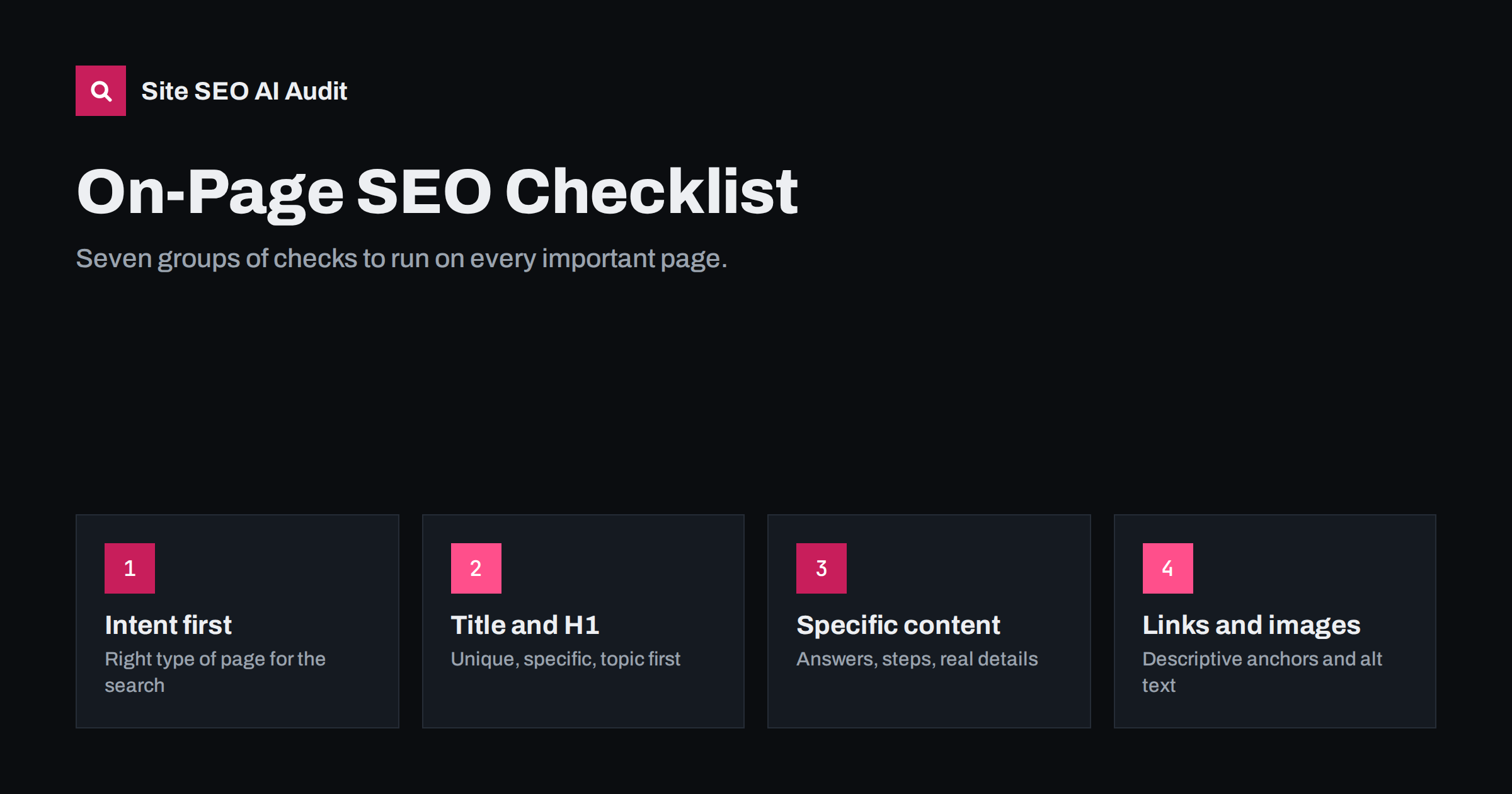
Short answer: An on-page SEO checklist covers five areas for every important page: the search intent and topic, the HTML elements (title, meta description, H1, headings, URL), the content itself, images, and internal links. Run it before publishing new pages and when reviewing existing ones. The checklist below lists each item, why it matters and what “done” looks like, so you can work through it in about fifteen minutes per page.
How to use this checklist
Checklists are useful because the basics are easy to forget, not because SEO is a matter of ticking boxes. A page can pass every item and still not rank if it is not the best answer to the search, and a page can miss a few items and still do well. Use the list to catch mistakes and gaps, then use your judgment about the content.
Two ways to use it:
- Before publishing a new page, go through every section. It takes a few minutes and prevents most on-page problems at the source.
- When reviewing existing pages, start with your most important pages: those that make money, generate leads, or already rank on page one or two where small improvements can matter.
For a whole site, checking page by page is too slow. Run a crawl first to find which issues affect many pages, fix those at the template level, and then use the checklist for individual high-value pages.
1. Topic and search intent
- The page has one clear main topic. You can state in one sentence what search it targets and who it is for.
- The page type matches the intent. Look at what currently ranks: guides, product listings, comparison pages, tools, local results. Your page should be the same kind of answer.
- No other page on your site targets the same intent. If one does, decide which page should own the topic before publishing another.
- You know the related questions. Check “People also ask”, related searches and your own customer questions. The page should answer the obvious next questions.
This section comes first because it decides everything else. A perfectly optimized page of the wrong type rarely ranks.
A quick way to check intent is to search for your main phrase in a private browser window and note the first eight or ten results. If most of them are step-by-step guides, a sales page will struggle. If most are product listings, a long essay will struggle. If the results are mixed, the intent is mixed too, and a page that serves both needs, for example a buying guide with product recommendations, may fit best. Write down what the top results have in common and what they all miss; the gap is often your best angle.
2. Title tag and meta description
- The title is unique across the site. No other page uses the same title.
- The main topic appears near the start of the title. It should survive if the end is cut off.
- The title is roughly 50 to 60 characters. Long enough to be specific, short enough to display fully in most results.
- The title is honest and specific. It promises what the page delivers, without clickbait or keyword lists.
- The meta description exists and is unique. One or two sentences, about 120 to 160 characters, summarizing what the page offers and why it is worth opening.
- Only one title and one description tag are present. Themes and plugins sometimes both output them; check the page source.
3. URL and headings
- The URL is short and descriptive. Lowercase, hyphenated, three to five words, no dates that will age.
- There is one H1. It names the page topic in plain words and is close in meaning to the title tag.
- H2 headings describe the main sections. Someone reading only the headings would understand what the page covers.
- Heading levels follow order. H3 under H2, no levels skipped for styling.
- Question headings are answered immediately. The first sentence after a question heading gives the answer.
4. Content quality
- The opening answers the main question. Readers and search features both benefit when the key answer is in the first paragraph, not buried halfway down.
- The main topic phrase appears naturally in the first paragraph and a few times where it fits, along with related terms. No repetition for its own sake.
- The content is specific. It includes steps, examples, numbers that can be backed up, trade-offs and details that show real knowledge. Generic statements are replaced with concrete ones.
- The content is original. Not copied from manufacturers, competitors or other pages on your own site.
- The content is accurate and current. Facts, prices, screenshots and references are up to date. If the page shows a date, it reflects a real update.
- The page is easy to scan. Short paragraphs, lists for steps and options, a table where a comparison helps, and bold text used sparingly for key points.
- Authorship and trust are clear where relevant. Who wrote it, what experience they have, and how to contact the business. This matters most for topics involving money, health or safety.
- There is a clear next step. What should the reader do after reading: contact, buy, read the next guide, try a tool?
5. Images and media
- Meaningful images have descriptive alt text. One sentence describing what the image shows and why it is there.
- Decorative images have empty alt attributes (
alt="") so screen readers skip them. - Linked images have alt text describing the destination. Otherwise the link has an empty anchor.
- File names are descriptive.
trail-running-shoe-grey.jpg, notIMG_4032.jpg. - Images are compressed and sized sensibly. Served at roughly the size they are displayed, in a modern format where possible.
- Width and height are set so the layout does not jump while images load.
6. Internal and external links
- The page links to related pages on your site where it helps the reader continue.
- Related pages link to this page. New pages especially need links from existing content, not only from menus and sitemaps.
- Anchor text is descriptive. It names the destination’s topic rather than “click here”.
- No broken links and no internal links that pass through redirects.
- External links point to credible sources where you reference facts or tools, and open no surprises.
- The page is within a few clicks of the home page, through navigation, category pages or hub pages.
7. Final technical sanity checks
Strictly speaking these are technical rather than on-page, but they decide whether all the work above counts:
- The page returns a 200 status code and is not accidentally redirected.
- It is not set to noindex unless you intend that, and it is not blocked in robots.txt.
- The canonical tag points to itself (or to the intended main version).
- It works well on a phone. Text is readable, buttons are tappable, nothing overflows the screen.
- It loads reasonably fast. No huge images or scripts slowing the first view.
- Structured data, if used, is valid and matches the visible content.
Checking the whole site at once
This checklist works well for one page at a time. On a site with hundreds or thousands of pages, the same issues tend to repeat across templates: every product missing a description, every archive with a duplicate title, every linked logo without alt text. Those are best found with a full crawl.
Site SEO AI Audit crawls your whole site and checks about 50 things on every page, across seven areas including on-page, links, crawling and indexing, speed and structured data. Each issue is weighted by how many pages it affects, and the fix list is ordered by how many points each fix adds, so you know which template to fix first. On WordPress sites every issue comes with the steps in wp-admin and your SEO plugin. You can run the first audit free and then use this checklist on your most important pages.
Related reading
- What Is On-Page SEO? The Elements That Actually Matter
- How to Write Title Tags: Length, Wording and Examples
- Internal Linking Strategy: A Step-by-Step Guide for SEO
- What Is Technical SEO? A Plain Guide for Site Owners
The bottom line
Start with intent: one clear topic, the right type of page, no competing page on your own site. Then check the title, description, URL and headings, make the content specific and easy to scan, describe images, and connect the page with internal links. Finish with a quick technical sanity check. Run the full list on new pages before they go live and on your most important existing pages, and use a site-wide crawl to catch problems that repeat across templates.
DUK
How long does an on-page SEO check take?
For a single page, about ten to fifteen minutes once you are used to the checklist. Fixing what you find can take longer, especially if the content needs rewriting. Site-wide issues are faster to fix at the template level.
What is the most important item on the checklist?
Matching search intent. If the page is the wrong type of answer for the search, the other items cannot make up for it. After that, a unique and specific title tag has the biggest effect.
How often should I review existing pages?
Review your most important pages at least once or twice a year, and whenever their traffic drops or the topic changes. Run a site-wide crawl every few months to catch new template problems.
Does passing the checklist guarantee rankings?
No. The checklist removes common problems and makes the page clear to search engines and readers. Rankings also depend on competition, the quality of the answer, links and many other factors.
Should I use an SEO plugin score instead of a checklist?
Plugin scores are a helpful reminder for titles, descriptions and keyword use, but they only check a few mechanical items. They cannot judge intent, accuracy or usefulness, which matter more. Use them alongside a checklist, not instead of one.