ENEnglish
 LTLietuviškai
 DEDeutsch
 FRFrançais
 RUРусский
 ESEspañol
 PLPolski
 ITItaliano
 UKУкраїнська
 CSČeština
 PTPortuguês
 JA日本語
JA日本語 LVLatviešu valoda
 ETEesti
 HUMagyar
 IDBahasa Indonesia
 TRTürkçe
 HIहिन्दी
 ELΕλληνικά
 ARالعربية
 THไทย
THไทย VITiếng Việt
 RORomână
 MSBahasa Melayu
 BNবাংলা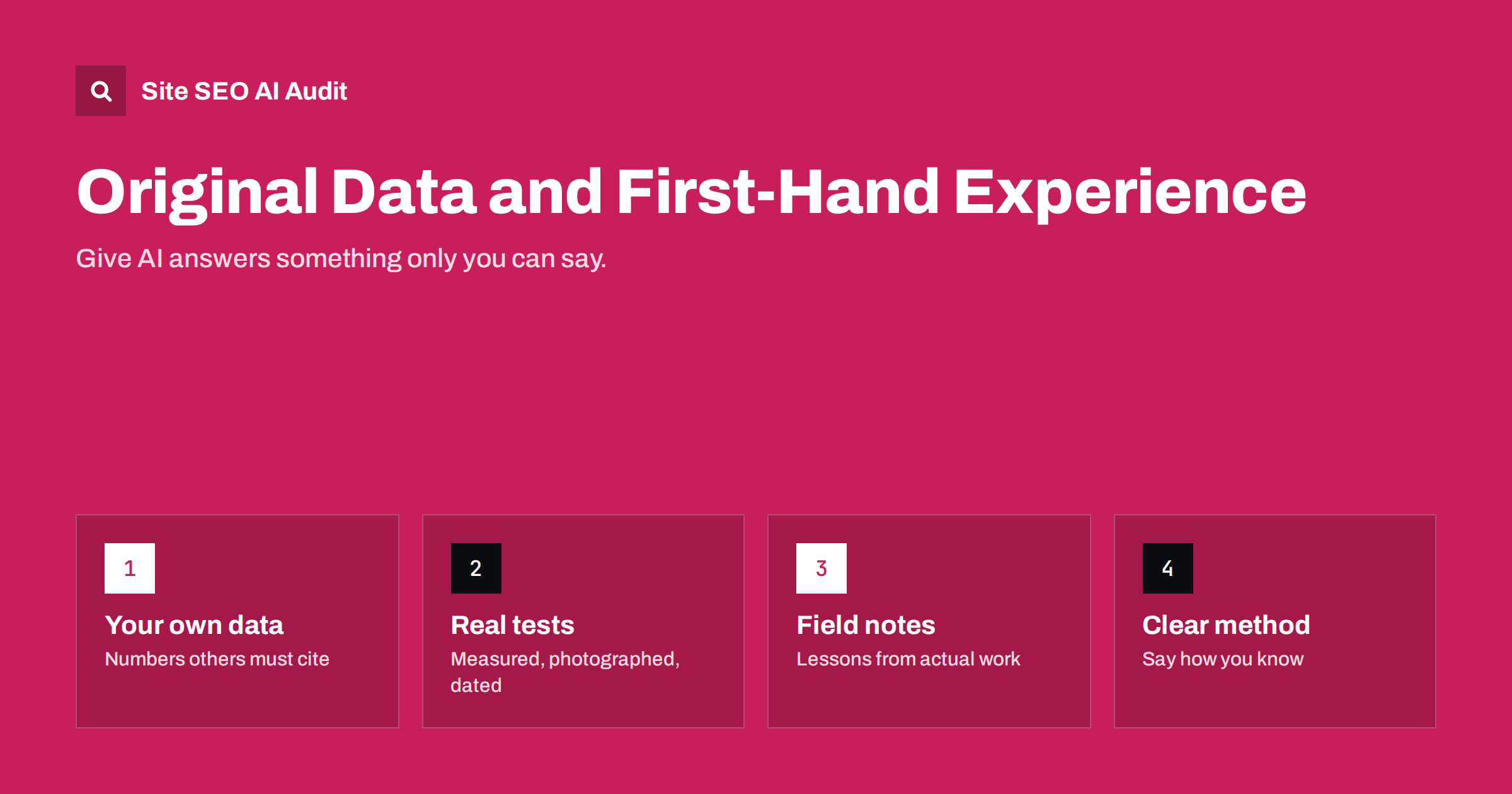
Short answer: AI answers are built from sources, and when many pages say the same generic thing, the pages with something unique are the ones worth citing. Original data, real tests, measurements, photos and lessons from actual work give a system facts it cannot get elsewhere, and they naturally carry your brand into the answer. Small businesses can create this kind of content from their own operations, customers and projects, as long as they explain their method and never invent numbers.
Why generic content struggles in AI search
A large share of web content repeats what other pages already say. Ten articles about “how to choose a web host” often list the same factors in slightly different words. For a person, that is tedious. For an AI system, it means any one of those pages is interchangeable. The answer can be written from the common knowledge they share, and it hardly matters which page is cited, or whether any is.
AI writing tools have made this worse. It is now cheap to produce plausible, generic articles at scale, so the supply of interchangeable content has grown enormously. Search engines have responded by emphasising helpful, people-first content that shows experience and expertise, and AI answer engines face the same pressure to find sources that add something.
Original information breaks the tie. If your page contains the only data on a question, the only test of a product under certain conditions, or a lesson nobody else has published, an answer that uses that fact has a reason to cite you.
Original content also protects you from the zero-click problem. When an answer uses a generic fact, the user has no reason to visit any particular site. When it uses your data or your test, it usually names you, and readers who want the detail know exactly where to go.
Types of original content you can create
| Type | Example | Effort |
|---|---|---|
| Aggregated business data | Average project timelines, common failure causes, seasonal demand patterns from your own records | Medium |
| Product or method tests | Measured battery life, load times, durability under defined conditions | Medium to high |
| Customer surveys | What your customers value, with sample size and method stated | Medium |
| Case notes | Anonymised descriptions of real problems and how they were solved | Low |
| Price and cost breakdowns | What a typical project actually costs and why | Low to medium |
| Photos and screenshots | Before and after, settings screens, real installations | Low |
| Expert commentary | Your team’s view on a change in rules or technology, with reasoning | Low |
Not every business can run large studies, but almost every business has records, projects and customers that contain unique insight.
Turning your own operations into data
Many businesses sit on useful data without realising it. A few examples of questions your records might answer:
- A web agency: how long do WordPress migrations typically take, and what causes delays?
- A repair shop: which faults are most common on which appliance brands?
- An online shop: which sizes are returned most often, and why?
- A bakery: how far ahead do customers order wedding cakes, and in which months?
- A consultancy: which compliance issues come up most often in first audits?
To turn records into publishable data, define the question, pull the relevant records, remove personal information, count and summarise, and write down how you did it. Even a simple finding such as “in the 120 site migrations we handled last year, the most common delay was waiting for DNS access from the client’s previous provider” is original, useful and quotable.
Start small. One well-defined question answered with your own data is better than an ambitious report that never gets finished. Once the first piece is published, it is much easier to repeat the process every quarter or year and build a series that others come to rely on.
Running honest tests
Tests are powerful because they replace opinion with observation. To make them credible:
- Define the conditions: what was tested, with which settings, for how long, by whom.
- Measure consistently: use the same method for every item compared.
- Record results fully, including the ones that do not flatter your product.
- Show evidence: photos, screenshots or raw figures.
- Date the test, and note when products or versions change.
- State limitations: small sample, one location, one set of conditions.
A limited test described honestly is far more valuable than a broad claim without evidence. Readers trust it, and systems looking for grounded facts can use it.
Writing up first-hand experience
Experience does not need to be quantified to be valuable. Some of the most useful content on the web is practical knowledge from people who have done the work. When writing it up:
- Describe the situation specifically: what kind of client, what constraints, what goal.
- Explain what you tried, what worked, what did not and why.
- Include details only practice reveals: the setting that is easy to miss, the step that takes longer than expected.
- Name the author and their role, so readers know whose experience it is.
- Protect client confidentiality; anonymise unless you have permission.
Encourage the people who do the work to contribute. Technicians, consultants and support staff often have the most valuable observations, even if they are not writers. A short interview turned into an article by someone who can write is often the most efficient way to capture that knowledge.
Making original content easy to cite
Unique information only helps if systems and people can find and quote it:
- State the key finding in the first paragraph, in one or two plain sentences, with your brand name: “Example Agency’s analysis of 120 migrations found that…”
- Put numbers in text, not only in charts. Add a caption with the main figure to every chart.
- Explain the method in a short section: sample, period, how data was collected.
- Use a clear, stable URL and keep the page up, so citations do not break.
- Update with new data and show the date of each update, or publish yearly editions with clear dates.
- Make it shareable: journalists and bloggers who cite your data create more references that AI systems see.
Getting your findings referenced elsewhere
AI systems notice original information more easily when other trusted sources refer to it. A finding that appears only on your blog is useful; a finding that an industry publication, a partner and a few respected blogs have cited becomes part of how the web describes the topic. A few practical ways to earn those references:
- Send a short summary to journalists and editors who cover your field, with the key finding, the method and a contact for questions.
- Offer the data to partners and associations that publish newsletters or reports for your industry.
- Present findings at local events or webinars, which often lead to write-ups and links.
- Answer questions in professional communities with a link to the relevant finding, where it genuinely helps.
- Make it easy to reuse: provide a clear chart, a one-sentence summary and a suggested citation.
Keep the tone factual. Outreach that exaggerates findings tends to backfire, while a modest, well-documented result is often welcomed by editors looking for real data.
What to avoid
- Invented or inflated statistics. They damage trust permanently when discovered and can spread through AI answers as false facts.
- Surveys without method. A percentage without sample size and question wording is not credible.
- Fake experience. Stories that did not happen, or reviews of products you never used.
- Cherry-picking. Reporting only the results that support your product.
- Burying the finding deep in a long post or a PDF.
How Site SEO AI Audit helps
Original content still needs a technically sound home. Site SEO AI Audit checks that your pages can be crawled and indexed, that AI crawlers are allowed, that content does not depend on JavaScript, and that pages carry the structure and dates AI answers tend to quote. It also flags thin and duplicate content, which helps you find generic pages worth improving with your own data. You can run a free audit to get started.
Related reading
- E-E-A-T and AI Search: Showing Real Expertise on the Page
- How to Write Content That AI Answers Actually Quote
- How to Write Comparison Pages That AI Answers Trust
The bottom line
In a web full of interchangeable pages, original information is the strongest reason for an AI answer to cite you. Mine your own records for data, run honest tests, write up real experience, explain your methods and state findings plainly with your brand attached. Never invent numbers. Content built this way earns trust from readers, journalists and AI systems alike.
DUK
Do AI answers really prefer original content?
AI systems try to ground answers in reliable sources, and unique facts give them a specific reason to use and cite a page. When many pages repeat the same information, any one of them is less likely to be credited.
Can a small business produce original data?
Yes. Your own records, projects, customer questions and tests contain unique insights. Summarised carefully, with personal data removed and the method stated, they make valuable content.
How should I present a survey?
State the number of respondents, who they were, when the survey ran and how questions were worded. Present the main findings in text, with charts as support.
Is first-hand experience enough without data?
Often yes. Specific, practical lessons from real work are valuable even without numbers, as long as they are true and clearly attributed to the person who had the experience.
How often should original research be updated?
It depends on how quickly the subject changes. Many businesses publish yearly updates with clear dates, keeping earlier editions available for comparison.