 ENEnglish
 LTLietuviškai
 DEDeutsch
 FRFrançais
 RUРусский
 ESEspañol
 PLPolski
 ITItaliano
 UKУкраїнська
 CSČeština
 PTPortuguês
 JA日本語
 LVLatviešu valoda
 ETEesti
 HUMagyar
 IDBahasa Indonesia
 TRTürkçe
 HIहिन्दी
 ELΕλληνικά
 ARالعربية
 THไทย
 VITiếng Việt
 RORomână
 MSBahasa Melayu
 BNবাংলা
#Site architecture
Site architecture is the way pages are organised and linked together. Articles tagged here cover click depth, internal linking, orphan pages, navigation, pagination and faceted filters. They explain how structure affects which pages crawlers find and how importance is shared across a site. Each guide shows how to measure structure with a crawl. You will learn how to flatten deep sections and connect forgotten pages. A clear architecture helps both visitors and search engines find what matters.
 2026-11-16 · Skaitymo laikas: 7 min.
Orphan and Deep Pages: Fixing Weak Structure in Your Report
How Site SEO AI Audit finds orphan pages, pages buried more than three clicks deep and pages with a single internal link, and how…
 2026-11-15 · Skaitymo laikas: 8 min.
Auditing Large Websites: Up to 10,000 Pages per Check
How to use Site SEO AI Audit on a large website: what up to 10,000 pages per check means, how long a crawl takes…
 2026-11-14 · Skaitymo laikas: 8 min.
The Page List in Your SEO Report: What Each Column Means
How to read the page list in a Site SEO AI Audit report: status, indexable, depth, links in, words, title length and sitemap, and…
 2026-11-12 · Skaitymo laikas: 7 min.
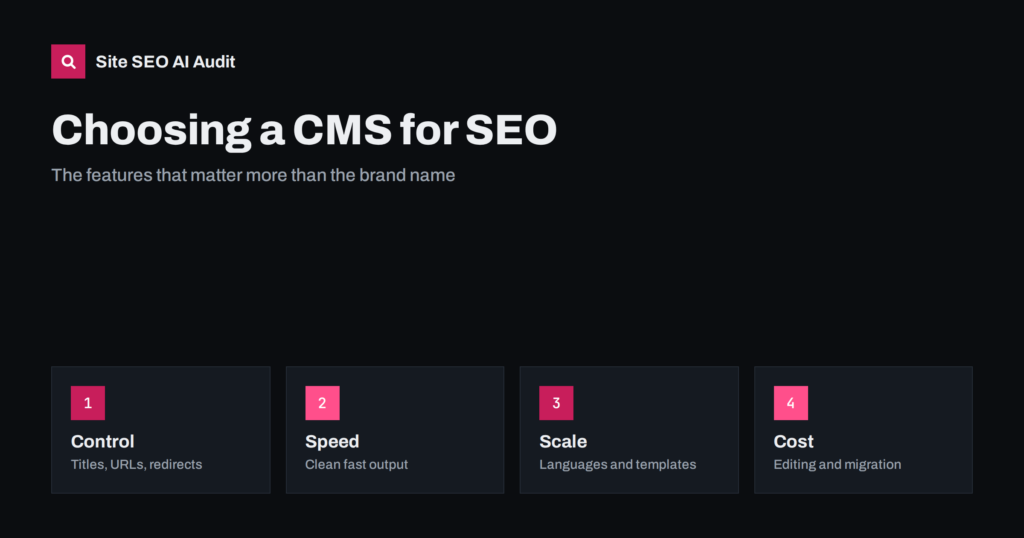
Choosing a CMS for SEO: What Really Matters in 2026
How to choose a CMS for SEO: control over titles, URLs and redirects, speed, structured data, languages, editing workflow and the cost of a…
 2026-11-08 · Skaitymo laikas: 8 min.
Changelog and Release Notes Pages: An SEO Guide
How to build product changelog and release notes pages that help users, search engines and AI assistants: structure, dates, URLs, links and upkeep.
 2026-11-08 · Skaitymo laikas: 8 min.
Integration and Partner Pages: SEO for SaaS Products
How SaaS companies can build integration and partner pages that rank and convert: a hub, useful pages, honest setup steps and no thin templates.
 2026-11-08 · Skaitymo laikas: 8 min.
Booking and Reservation Pages: SEO That Converts
How to build booking and reservation pages that people and crawlers can use: indexable service pages, widget checks, crawl traps and mobile speed.
 2026-11-05 · Skaitymo laikas: 8 min.
Reverse Proxy for a Blog in a Subfolder: SEO Setup
How to serve a blog from a subfolder of your main domain with a reverse proxy, and avoid the SEO traps: canonicals, redirects, sitemaps,…
 2026-11-03 · Skaitymo laikas: 8 min.
Crawl Traps: Calendars, Session IDs and Endless URLs
A crawl trap is a set of URLs with no natural end. Learn how calendars, session IDs and loops create them, how to find…
 2026-11-02 · Skaitymo laikas: 8 min.
robots.txt for Subdomains, CDNs and Multiple Domains
Each host and protocol needs its own robots.txt. See how subdomains, CDN domains, staging hosts and multi-domain setups are covered and how errors hit…
 2026-11-01 · Skaitymo laikas: 8 min.
Separate Mobile URLs (m-dot) and SEO: Risks and Fixes
Some sites still serve phones from an m-dot address. Learn the risks of separate mobile URLs, the annotations they need and when to move…
 2026-10-26 · Skaitymo laikas: 8 min.
Internal Link Equity: How Authority Flows Through Your Site
Links pass signals from page to page, so your own link structure decides which pages look important. Learn how internal link equity flows and…