ENEnglish
 LTLietuviškai
 DEDeutsch
 FRFrançais
 RUРусский
 ESEspañol
 PLPolski
 ITItaliano
 UKУкраїнська
 CSČeština
 PTPortuguês
 JA日本語
 LVLatviešu valoda
 ETEesti
 HUMagyar
 IDBahasa Indonesia
 TRTürkçe
 HIहिन्दी
 ELΕλληνικά
 ARالعربية
 THไทย
 VITiếng Việt
 RORomână
 MSBahasa Melayu
 BNবাংলা
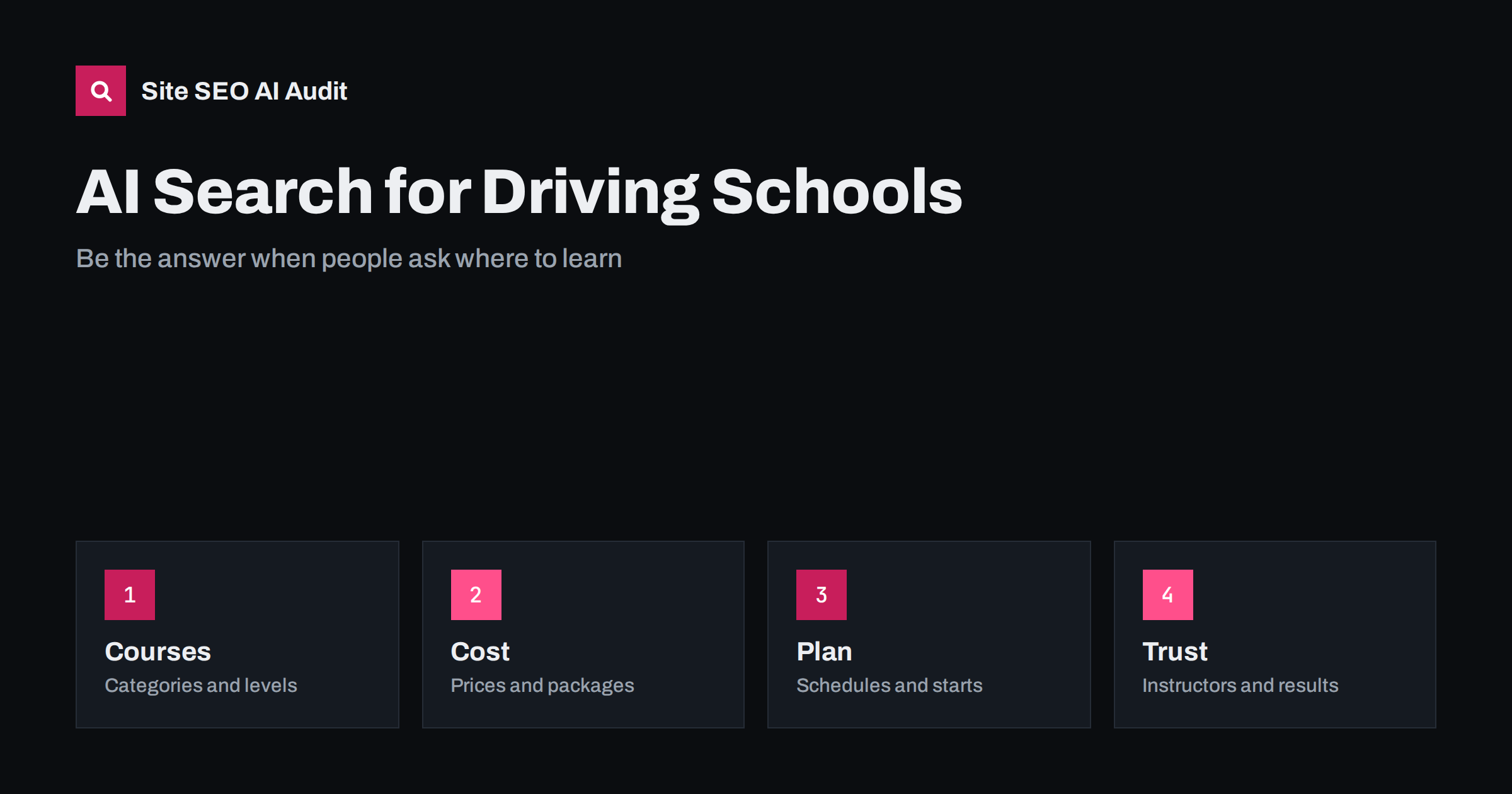
Short answer: People now ask assistants “how much do driving lessons cost near me”, “how long does it take to get a licence” or “which centre offers forklift certification on weekends”. To be named, a driving school or training centre needs a clear page for every course, exact prices and what they include, start dates and schedules, instructor qualifications, pass information stated honestly and accurate local details. Plain text and consistent facts beat promotional slogans.
Learners choose a school after comparing a handful of practical points: what the course covers, how many lessons are usually needed, what it costs, when it starts and whether other students are satisfied. Assistants try to answer the same questions in a single reply, so they favour sites that state these facts clearly. This guide shows how to organise a driving school or training centre website so that it can be understood, quoted and trusted. For the broader approach to local businesses, read the guide to local business AI search.
What learners ask before they enrol
Typical questions are “what is the minimum age for category B”, “how many lessons do I need”, “do you offer automatic cars”, “is the theory course online”, “what documents must I bring”, “can I pay in instalments” and “how soon can I take the test”. For vocational centres, questions look different: accreditation, certificate recognition, length of the course, exam fees, language of instruction and employer requirements.
Collect these from calls, messages, social comments and the questions instructors hear on the first lesson. Write the answers in the learner’s words. Where rules depend on the country or region, name the country and cite the official body so that the answer is accurate for the person who asks.
Create one page for every course and category
Each course needs its own page with a clear name, who it is for, entry requirements, content, number of lessons or hours, format, language, price and what happens at the end. For driving schools, separate pages for each licence category, for refresher lessons, for intensive courses and for theory preparation make sense. For training centres, create pages for each certificate, with the awarding body and the level.
Begin each page with a two-sentence summary, such as who the course suits and how long it usually takes. Then add a short table that lets readers and machines compare options at a glance.
| Course | Entry requirement | Typical length | Price |
|---|---|---|---|
| Category B standard | Minimum age and documents set by the authority | Theory plus practical lessons | Show the package price |
| Refresher lessons | Existing licence | Chosen by the learner | Price per lesson |
| Forklift certificate | Age and medical rules | Hours and exam date | Course and exam fee |
Fill the table with your real data. Avoid claiming a guaranteed pass or a guaranteed number of lessons, because results depend on the learner. If lessons vary in length, say how long a lesson lasts, and whether the instructor picks the learner up from home, school or work.
Show prices and what is included
Be explicit about which costs are yours and which belong to the authorities, because learners compare totals, not headline figures.
Price is one of the first things people want to know, and a site that hides it gives assistants nothing to quote. List the price of each package, the price of a single lesson, exam or registration fees paid to the authority, fuel and car hire for the test, theory materials and any deposit. Explain what happens if a lesson is cancelled and how late a cancellation can be made without charge.
If you offer instalments, discounts for students or group rates, publish the terms. Update prices as soon as they change and show the date of the last review. Out-of-date prices are a reason for assistants to hedge or to prefer a competitor with clearer information.
Publish schedules, start dates and locations
A learner who cannot see when a course starts will often move on to the next result. Dates, times and places are exactly the kind of fact that assistants can quote when they are stated plainly, and exactly the kind they skip when they are hidden.
Learners plan around their jobs and studies, so give them dates. Show when the next theory groups start, which days practical lessons are possible, how far ahead booking is needed and where lessons begin. For centres with several locations, create a page for each, with address, map link, parking, public transport and photos of the entrance.
Keep a simple calendar in plain HTML rather than inside an image or an embedded widget that crawlers cannot read. If you use a booking system, add a text summary beside it: opening hours, typical waiting time for the first lesson and how to contact the office. Mark local details with local business structured data, and make them identical to your map profile.
Introduce instructors and qualifications
Many learners choose a person, not a company. A short, honest profile of the people who will sit next to them in the car or teach the class is often the deciding factor.
Trust is central in education and safety training. Present each instructor with a name, photo, qualifications, languages, years of experience and the courses they teach, using only facts you can document. State which licences or registrations the school holds, with the number or the official register where the public can verify it.
These details match the experience and trust signals described in the article on E-E-A-T and AI search. They also help a nervous learner or a parent choose with confidence. Avoid exaggerated titles, and never claim an accreditation you do not hold.
Be honest about results and reviews
Learners value pass rates, but unclear numbers do harm. If you publish a pass rate, state the period, the number of candidates and how you calculated it, and compare only with sources you can name. Otherwise, describe results qualitatively and let reviews speak. Invite students to review you after the test or the course, respond politely to complaints and never pay for or write reviews yourself.
Short quotes from real students, published with their permission, add colour. Link to the review platform so that readers and assistants can check them. The relationship between reputation and recommendations is explained in the guide to reviews and AI recommendations.
Serve special groups and corporate clients
Not every learner is an eighteen-year-old with a first licence. Some are adults who have never driven, people returning after years, newcomers who must convert a foreign licence, learners with disabilities who need an adapted car, or nervous drivers who want a patient instructor. Each group asks different questions, and a short page for each one, written with care, can be the passage an assistant uses for that exact situation. State what adjustments you offer, which languages your instructors speak and how a first lesson works.
Companies and public bodies buy training too: safe driving courses for staff, forklift and machinery certificates, first aid, health and safety, or professional driver qualifications. Create a page for corporate clients that lists the courses, group sizes, locations on site or at your centre, certificates issued and how to request a quote. Mention invoicing and the lead time for booking a group. This kind of page brings in larger orders and answers questions that individual learners rarely ask.
Finally, explain what happens after the course: how certificates are issued, how long they remain valid and how to renew them. Practical details of this kind show that you know the field, and they reduce calls to your office.
Content that earns citations
Beyond course pages, publish practical guides that learners look for: how the test works, what examiners check, how to prepare for the theory exam, how to stay calm, what to do after passing, how insurance works for new drivers and what documents to bring. Keep each guide factual, date it and cite the official source for rules. Update it when regulations change.
For training centres, explain the career path behind each certificate, typical employers and how often the certificate must be renewed. Such pages answer the second question learners ask, after “how much”, which is “what will this lead to”.
Check that machines can read your site
Make sure your prices, schedules and course descriptions are text in the HTML and not only inside images, PDFs or scripts, that your robots.txt does not block crawlers you want to allow and that your pages load quickly on a phone. A crawl with Site SEO AI Audit shows blocked pages, missing descriptions, broken links and structured data errors, and the first audit of up to 200 pages is free.
Related reading
- Local Business AI Search
- AI Search for Schools and Education Providers
- AI Search Visibility Checklist
The bottom line
Publish a page for each course with real prices, dates and instructor details, keep local facts consistent and report results honestly.
BUJ
Should a driving school publish its prices?
Yes. Show package prices, single lessons and extra fees. Hidden prices give assistants nothing to quote and make learners look elsewhere.
Can I publish my pass rate?
You can if you explain the period, the number of candidates and the method. Never present an unclear figure as a guarantee.
Do I need a page for each licence category?
Yes. Each category has its own requirements, length and price, so a dedicated page answers learners’ questions better than a general one.
Which structured data suits a training centre?
Use local business markup for each location and course markup where it fits, and keep every value identical to the visible page.
How often should I update the site?
Review prices, dates and rules at least every quarter and whenever regulations or fees change.