ENEnglish
 LTLietuviškai
 DEDeutsch
 FRFrançais
 RUРусский
 ESEspañol
 PLPolski
 ITItaliano
 UKУкраїнська
 CSČeština
 PTPortuguês
 JA日本語
JA日本語 LVLatviešu valoda
 ETEesti
 HUMagyar
 IDBahasa Indonesia
 TRTürkçe
 HIहिन्दी
 ELΕλληνικά
 ARالعربية
 THไทย
THไทย VITiếng Việt
 RORomână
 MSBahasa Melayu
 BNবাংলা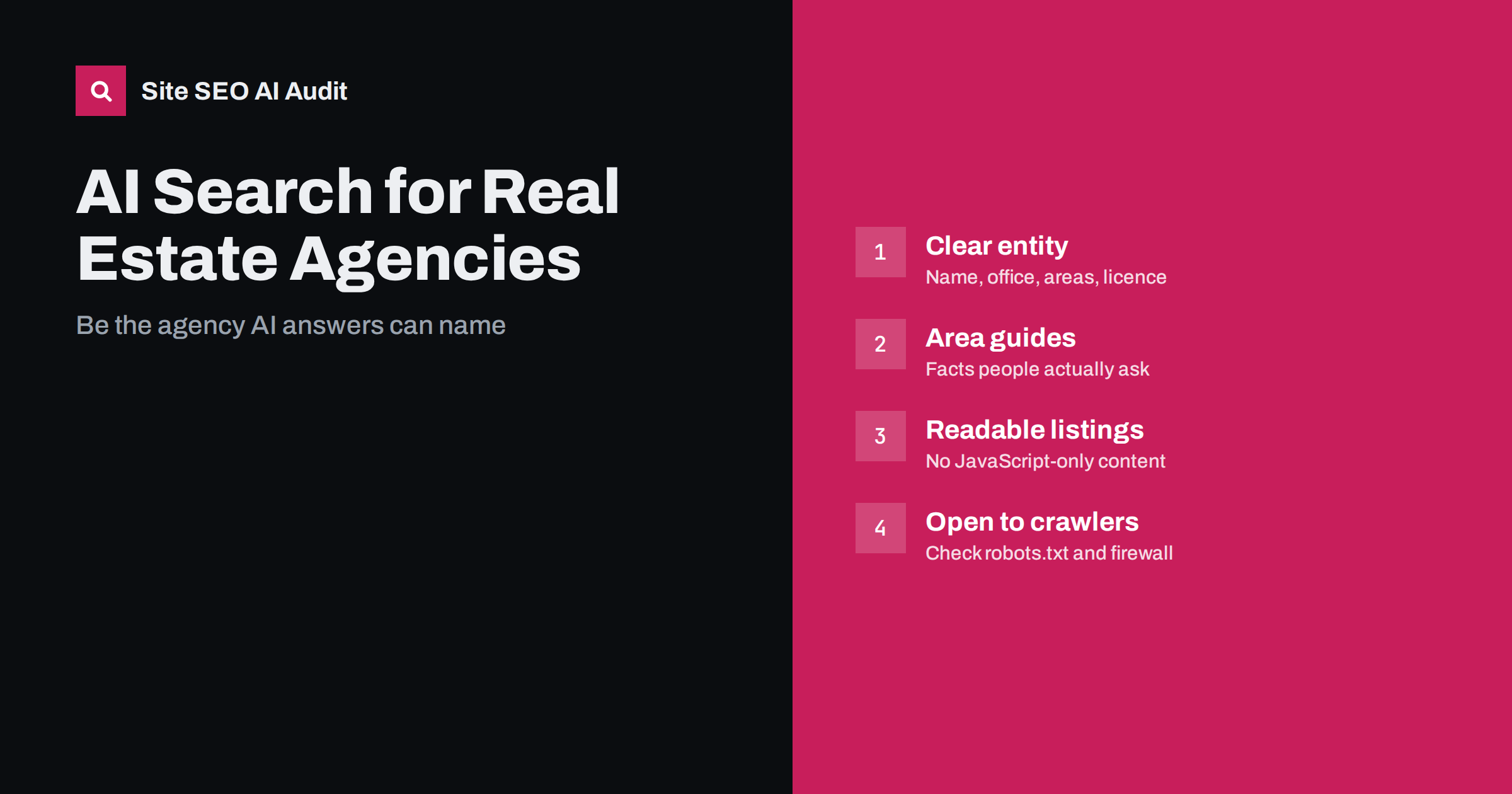
Short answer: AI assistants answer property questions by pulling facts from pages they can crawl and trust: agency profiles, area guides, review sites and listing portals. A real estate agency becomes visible in those answers when its own site clearly states who it is, where it works and what it specialises in, explains its areas with concrete facts, keeps listings and key pages readable without JavaScript, and does not block the crawlers that AI search uses. Portals will still dominate listing questions, so agencies win mostly on local expertise and trust.
People now ask questions like “which estate agent in this town is good for selling a flat quickly” or “is this neighbourhood good for families” in AI assistants and AI search features. The answers mention a handful of agencies, portals and sources by name. Being one of them depends less on clever tricks and more on whether your website gives those systems something clear and specific to work with.
How AI answers handle property questions
AI search systems usually break a question into several searches, retrieve pages for each, and write an answer from what they find. Our explainer on how AI search engines work covers this in detail. For real estate, the questions fall into a few groups, and each group draws on different sources:
- “Which agency should I use?” Answers lean on agency websites, review platforms, directory profiles and local news.
- “What is this area like?” Answers lean on area guides, council and statistics pages, schools data and local blogs.
- “How does buying or selling work here?” Answers lean on process guides from agencies, banks, legal firms and government sites.
- “Show me homes for sale” Answers lean heavily on large portals with structured listing data.
An independent agency rarely beats national portals on the last group. The first three are where a well-built agency site has a real chance.
Make your agency a clear entity
Before an AI system can recommend you, it has to be sure what you are. Agencies often make this hard: different names on the site, the logo and directory profiles, several offices on one vague contact page, no clear service area. Fix the basics:
- Use one consistent name for the agency everywhere: site header, title tags, footer, directory listings and social profiles.
- Give each office its own page with address, phone, opening hours, the areas it covers and the people who work there.
- State your specialisms in plain words: residential sales, lettings, new builds, commercial, rural property, a specific price range.
- Show credentials such as licence numbers or professional memberships where they exist in your country, as visible text.
- Add Organization or RealEstateAgent markup that matches the visible facts. Our guide to Organization schema for AI systems shows what to include.
The same facts should appear on your profiles elsewhere. When the website, the map listing and review sites agree, AI answers can describe you with confidence. Our article on entity SEO explains why that consistency matters.
Write area guides that answer real questions
Area guides are the strongest content most agencies can publish, and the most often wasted. A paragraph saying a district is “vibrant, with excellent amenities” gives an AI system nothing to quote. A useful area guide answers what people actually ask:
- typical property types and what is common in each street or section;
- how prices and rents compare with neighbouring areas, described honestly and dated;
- schools, transport links and travel times to the main employment centres;
- what sells quickly and what tends to sit on the market;
- local factors buyers ask about: parking, flood risk information, planned developments, noise.
Write from your own experience. “Two-bedroom flats near the station usually sell faster than larger houses in the outer streets” is the kind of first-hand detail that general sources cannot provide. Put a “last updated” date on each guide and review it regularly, because AI answers prefer current information; see content dates and freshness.
Avoid creating near-identical guides for dozens of places by swapping the town name. That pattern is weak for search and AI alike, as our guide to location pages without duplicates explains.
Keep listings and key pages readable
Many property websites load listings, prices and descriptions through JavaScript widgets or third-party feeds. Users see them; many crawlers do not. AI crawlers in particular often read only the raw HTML. Check what is actually there:
- Open a listing page and view the page source, not the inspector. Are the address, price, description and key features in the HTML?
- Do the same for office pages, team pages and area guides.
- If the content appears only after scripts run, ask your website provider about server-side rendering or a static HTML version of the listing data.
Our guide to why AI crawlers miss JavaScript content describes the options. Also watch for listings that disappear without a trace: a sold property should either stay as a clearly marked “sold” page or redirect to a relevant area page, not return a bare error.
Do not block the crawlers you want
Property sites are frequent targets of scrapers, so many agencies or their hosting providers block bots aggressively. That can quietly block AI search crawlers too. Check three places:
- robots.txt: look for rules that disallow AI search crawlers or the whole site for unknown user agents. Our guide on allowing or blocking AI crawlers lists the names.
- Firewall and CDN settings: bot protection can return challenges or errors to crawlers that robots.txt allows.
- Listing portal feeds: if your listings come from a portal’s embedded widget, the crawler may only see the portal, not you.
Decide deliberately. You can allow search and answer crawlers while blocking training crawlers, if that is your policy. The point is that it should be a decision, not an accident.
Build trust signals that AI answers can see
Recommendation questions are judged on reputation. AI answers often summarise what reviews and third-party sources say about a business, so:
- ask satisfied clients for reviews on the platforms people in your market actually use;
- reply to reviews, including the negative ones, factually and politely;
- publish real case studies, such as a sale in a difficult market, with the client’s permission and without invented figures;
- show the team with names, roles and experience on a team page;
- get mentioned in local media, community sites and business associations where it is genuine.
Our article on reviews and reputation in AI recommendations goes deeper into what tends to be picked up.
Answer process questions in plain language
Buyers and sellers ask the same questions again and again: what the steps are, what fees to expect, how long a sale takes, what documents are needed, what a valuation includes. A clear guide for each, written for your country and region, earns citations because it answers the question directly. Start each guide with a short, direct answer, then explain the details. Keep figures only where you can stand behind them and date them. Link each guide to the relevant service page and office page so that the reader, and the AI system, can see who wrote it.
Check what AI search can actually read on your site
Most real estate sites have the same handful of technical problems: listings loaded by scripts, blocked crawlers, duplicate area pages, missing titles on hundreds of listing URLs. Site SEO AI Audit crawls your site like a search engine and includes an AI visibility area that checks AI crawlers in robots.txt, llms.txt, content that needs JavaScript, and the structure and dates that AI answers quote, alongside titles, duplicates and links on every page. The first audit of up to 200 pages is free; for larger property sites it gives a preliminary report of the first 200 pages, and paid plans crawl the full site.
Related reading
- AI search for local businesses: what to fix first
- AI search for lawyers, accountants and consultants
- How to measure your brand’s visibility in AI answers
The bottom line
Real estate agencies rarely win listing questions in AI answers, but they can win the questions that matter most for new business: which agency to trust and what an area is really like. Make the agency a clear entity, write area and process guides with first-hand detail, keep key content in readable HTML, open your site to the crawlers you want and build visible trust. These are the same fixes that help ordinary search.
BUJ
Can a small agency appear in AI answers next to big portals?
Yes, for questions about local expertise, areas and which agency to use. Portals dominate searches for specific listings, but AI answers about recommendations and neighbourhoods often draw on agency sites, reviews and local sources.
Should property listings be blocked from AI crawlers?
That is a business decision. Blocking all AI crawlers protects listing data but also removes your pages from AI search answers. Many agencies allow search and answer crawlers and block only training crawlers in robots.txt.
Do area guides still work if prices change often?
Yes, if they are maintained. Describe price levels in relative terms where possible, date any figures you include and review the guides regularly. A dated, reviewed guide is more useful to readers and AI answers than an undated one.
Which structured data helps a real estate agency?
Organization or RealEstateAgent markup for the agency and LocalBusiness details for each office, matching the visible facts on the page. Markup alone does not create AI visibility, but it helps systems confirm who you are and where you work.
How do I know if AI assistants mention my agency?
Ask the questions your clients ask, in several AI assistants, and note which agencies are named and which sources are cited. Repeat this regularly and track referral traffic from AI tools in your analytics.