ENEnglish
 LTLietuviškai
 DEDeutsch
 FRFrançais
 RUРусский
 ESEspañol
 PLPolski
 ITItaliano
 UKУкраїнська
 CSČeština
 PTPortuguês
 JA日本語
JA日本語 LVLatviešu valoda
 ETEesti
 HUMagyar
 IDBahasa Indonesia
 TRTürkçe
 HIहिन्दी
 ELΕλληνικά
 ARالعربية
 THไทย
THไทย VITiếng Việt
 RORomână
 MSBahasa Melayu
 BNবাংলা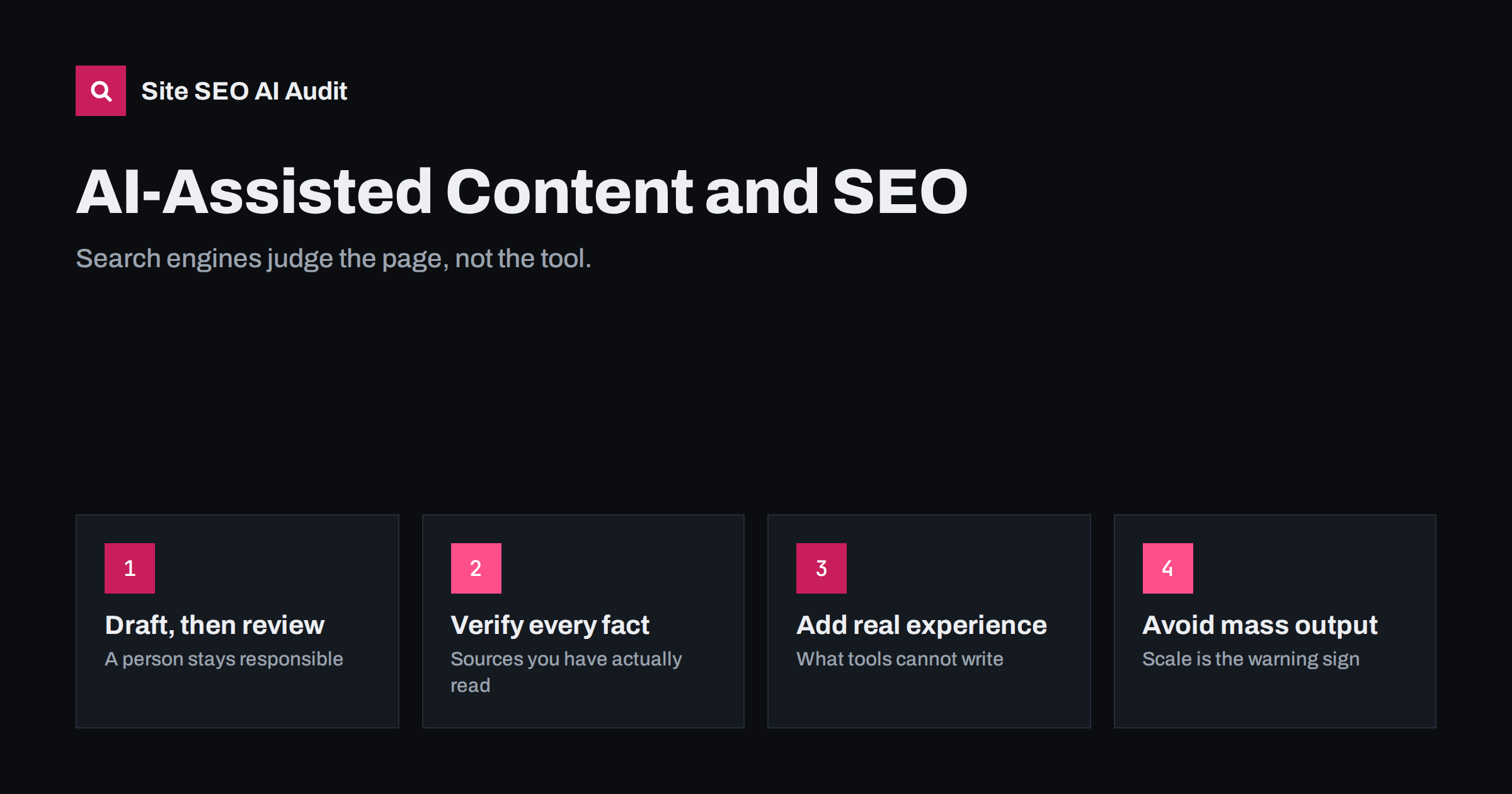
Short answer: AI-assisted content can rank when it is genuinely helpful, accurate and original in value; search engines judge the result, not the tool. The risk is publishing text that is generic, unverified or produced at scale mainly to attract search traffic, which search engine spam policies specifically target. Use AI tools for drafts, outlines and editing help, then add real expertise, check every fact, remove filler and make sure each page answers its search better than what already exists.
What search engines say about AI-generated content
Google’s position, published in its guidance on AI-generated content, is that it rewards helpful, reliable, people-first content regardless of how it is produced. Using automation or AI is not in itself against its guidelines. What is against them is using any method, AI or human, to generate lots of content primarily to manipulate search rankings rather than to help people. Its spam policies describe this as scaled content abuse.
For any search engine, the sensible assumption is the same: the quality and purpose of the content matter more than the method of production.
In practice, that means the question is never “was AI used?” but “is this page useful, accurate and worth ranking?” A careful expert who uses a tool to speed up drafting can produce excellent pages. A site that publishes hundreds of unreviewed, near-identical articles is at real risk, whatever produced them.
Where AI tools help
- Outlines. Suggesting the subtopics and questions a page might cover, as a starting point to check against real searches.
- First drafts of sections you already know well, which you then rewrite with your own knowledge and examples.
- Editing. Tightening long sentences, spotting unclear passages, suggesting simpler wording.
- Variations of titles and meta descriptions to choose from and refine.
- Summaries of your own long content, for introductions or FAQ answers.
- Translation drafts for review by a fluent speaker, who checks terminology, tone and local conventions.
- Structured tasks such as turning notes into a table or a checklist.
In all of these, a person who knows the subject stays responsible for the result. The tool is a fast assistant, not an author. It does not know your customers, your prices, your results or the mistakes you see every week, and it cannot take responsibility for advice that turns out to be wrong.
Where AI content goes wrong
| Problem | Why it happens | What to do |
|---|---|---|
| Generic text | Tools produce the average of what exists | Add specifics, examples and experience only you have |
| Confident errors | Tools can state false facts, figures and sources fluently | Verify every fact, number, name and link |
| Invented sources or quotes | Plausible-looking references that do not exist | Only cite sources you have opened and read |
| Padding | Long introductions, repeated points, filler phrases | Cut ruthlessly; answer first |
| Outdated information | Tools may not know recent changes | Check current documentation and prices |
| Near-duplicate pages | Same prompt template used for many topics | Give each page a distinct purpose and substance |
| Wrong intent | The draft answers a different question | Check the search results before writing |
A review checklist for AI-assisted pages
- Intent: does the page answer the search it targets, in the format searchers expect?
- Answer first: is the direct answer in the opening paragraph?
- Accuracy: has every fact, figure, date, name and instruction been checked against a reliable source?
- Sources: does every cited source exist, and does it say what the page claims?
- Experience: does the page include something only your business knows: real examples, data, photos, mistakes you have seen, specific advice?
- Specificity: have generic statements been replaced with concrete ones?
- Filler: have padding, repetition and empty phrases been removed?
- Uniqueness: is the page clearly different from other pages on your site and better than what already ranks?
- Tone and brand: does it sound like your business, not like every other site?
- On-page basics: unique title, one clear H1, descriptive headings, alt text, internal links.
If a page cannot pass this checklist, it should not be published, however quickly it was produced. It is worth writing the checklist down and making it part of the sign-off for every page, so that the standard does not depend on who happens to be publishing that day or how busy the week is.
Adding what tools cannot
The parts of a page that make it worth ranking are usually the parts no tool can write for you:
- First-hand experience: what happened when you actually did the thing, including what went wrong.
- Your own data: numbers from your business, customers or tests, reported honestly.
- Real images: photos and screenshots of your work, products and processes.
- Judgment: which option you recommend in which situation, and why.
- Customer questions: the actual questions your support and sales teams hear.
- Accountability: a named author with relevant experience who stands behind the advice.
These are also what readers remember and what other sites link to and cite. They are increasingly what AI answer engines look for too: when many pages say the same generic thing, the page with original data or first-hand detail is the one worth quoting.
A workflow that keeps quality high
Teams that use AI tools well tend to follow a similar sequence, with people at the start and the end:
- A person chooses the topic from real searches and customer questions, checks the search results for intent, and confirms no existing page on the site already covers it.
- A person writes a brief: the question, the audience, the angle, the key points only your business can make, and the sources to use.
- The tool helps with a draft or with specific sections, based on the brief rather than on a bare keyword.
- An expert rewrites: adds experience, examples and judgment, removes generic passages, and makes sure the answer comes first.
- Someone checks facts, opening every source, verifying every number and testing every instruction.
- An editor reviews the on-page basics, the tone and the internal links, and signs off.
- After publishing, the page is added to the keyword map and scheduled for review like any other page.
This takes longer than pressing a button, but far less than writing everything from scratch, and the result is a page the business can stand behind. Most of the time saved by the tool should be reinvested in the steps that add real value: research, examples and checking.
Scale is the warning sign
The fastest way to get into trouble is volume. Publishing a few carefully reviewed AI-assisted pages a month is very different from generating hundreds of pages targeting every keyword variation, city name or product combination. Mass-produced pages tend to be thin, similar to each other, and unreviewed, which is exactly what spam policies describe. They also create keyword cannibalization, thin archives and maintenance problems that are hard to undo.
If you plan to publish at scale, the review process has to scale too. If it cannot, publish less. A smaller number of strong pages will serve readers better, cause fewer problems later, and are far easier to keep accurate as your products, prices and advice change.
Disclosure and transparency
There is no universal rule that AI assistance must be disclosed on every page, but transparency supports trust. Many publishers describe how they create content in an editorial policy: which tools they use, how content is reviewed and who is responsible. Where readers would reasonably expect to know, for example on content presented as personal experience or expert advice, be honest about how it was produced. Never present AI-generated text as the first-hand experience of a real person who did not have that experience.
Checking AI-assisted content at site level
Problems with AI-assisted content often show up across a site before they show up in rankings: many pages with similar titles, near-duplicate text, thin pages, weak internal linking. Site SEO AI Audit checks every crawled page for duplicate titles and descriptions, thin and duplicate content and weakly linked pages, weighting each issue by how many pages it affects. See the plans, or start with a free first audit.
Related reading
- Thin Content: How to Find and Fix Low-Value Pages
- Original Data and First-Hand Experience: What AI Answers Cite
- Semantic SEO: How to Cover a Topic, Not Just a Keyword
- About Page SEO: What to Include to Build Trust
The bottom line
Search engines judge pages, not tools. AI assistance can speed up outlining, drafting and editing, but every page still needs a clear intent, a direct answer, verified facts, real sources, specific experience and a person responsible for it. Avoid mass-producing pages, review everything before publishing, and add what only your business can offer. That is what makes a page worth ranking, however it was written.
BUJ
Does Google penalize AI-generated content?
Not for being AI-generated. Google’s guidance says it rewards helpful content however it is produced. Content generated at scale mainly to manipulate rankings, by any method, is against its spam policies.
Can AI-written articles rank?
Yes, if they are genuinely useful, accurate and better than the alternatives. In practice that usually requires substantial human review, fact-checking and added expertise.
Should I disclose that I used AI?
There is no universal requirement for every page, but transparency builds trust. Describe your process in an editorial policy, and never present AI text as someone’s personal experience.
What is scaled content abuse?
It is Google’s term for producing many pages primarily to manipulate search rankings rather than help users, whether by AI, templates or people. It is covered by its spam policies.
How can I make AI-assisted content stand out?
Add what tools cannot: first-hand experience, your own data, real images, clear recommendations and answers to the questions your customers actually ask, and have a knowledgeable person review and stand behind it.