ENEnglish
 LTLietuviškai
 DEDeutsch
 FRFrançais
 RUРусский
 ESEspañol
 PLPolski
 ITItaliano
 UKУкраїнська
 CSČeština
 PTPortuguês
 JA日本語
 LVLatviešu valoda
 ETEesti
 HUMagyar
 IDBahasa Indonesia
 TRTürkçe
 HIहिन्दी
 ELΕλληνικά
 ARالعربية
 THไทย
 VITiếng Việt
 RORomână
 MSBahasa Melayu
 BNবাংলা

Short answer: “Broken external links” is a warning in the Links area of Site SEO AI Audit. It lists links on your pages that lead to other websites and get an error or no answer when the crawler follows them. The report shows each pair: the page on your site that holds the link, and the address it points to. Open the target in a browser to confirm it is really gone, then replace it with a working source, remove the link, or leave it if the other site only blocks crawlers. Run a new check to confirm the list shrinks.
Links to other websites are a sign of a careful author. They show readers where facts come from and where to read more. But websites change. A company closes, a news site reorganises its archive, a blog post is deleted. A link that worked the day you published slowly becomes a dead end. Nobody notices, because you rarely click your own old links. The audit does it for you, across the whole site, and turns the invisible decay into a list you can work through. This guide explains what the check does, how to read the list and how to decide what to do with each link.
What the check finds
While the crawler reads your pages, it collects every link that leaves your domain. It then requests a sample of up to 60 of these external addresses and records the answer. A link is reported when the target answers with an error status in the 400 range or above, or does not answer at all. The report then shows, for each problem link, the page that contains it and the address it points to. That pair is the most useful part, because it tells you exactly where to edit.
The finding is a warning, which counts four points in the score formula, and it sits in the Links area, which carries 15 percent of the total score. As with other findings, the penalty depends on the share of your pages that are affected, softened so that one old link on one old page does not matter much. A site with the same dead link in a footer on every page is a different story: one broken address then affects the whole site, and fixing it in the template clears the finding at once.
Why dead outbound links matter
The audit explains it in one sentence: links to dead sites look neglected to visitors and search engines. There are three practical reasons behind it.
- Visitors lose trust. Someone who clicks a source and lands on an error page concludes that the article is out of date, even if the rest is accurate.
- Pages look unmaintained. A long list of old resources with dead links suggests that nobody looks after the page. That is a poor signal for pages that claim to be helpful guides.
- The crawler wastes time. Search engines follow outbound links as well, and a page full of broken ones is a little less pleasant to process.
None of this means that outbound links hurt your rankings in a dramatic way. The point is hygiene: well-kept pages keep readers, and readers are the thing that matters most.
Reading the list: false alarms and real problems
Not every entry means that the other site is gone. Before you edit anything, open a few targets in your browser and sort them into three groups.
| What you see in the browser | What it means | What to do |
|---|---|---|
| Error page, domain for sale or no site | The target is really gone | Replace or remove the link |
| The page loads, but the address changed | The target moved, and the old address no longer works | Update the link to the new address |
| The page loads normally | The other site blocks crawlers or was down for a moment | Keep the link and run the check again later |
Large platforms and some company sites answer automated visitors with an error even when the page works for people. Others are only unavailable for a short time. That is why the first step is always a human check, and why a second check a few days later is a good test for doubtful cases.
Replace, remove or keep: how to decide
For each confirmed dead link, ask what the link was for.
- It supported a fact. Find a current source that says the same thing and link to it. If you cannot find one, consider rewording the sentence so that it does not depend on a source you cannot show.
- It was a recommendation. If the tool, shop or service no longer exists, remove the link and, where it makes sense, mention an alternative.
- It was a reference to your own partner or client. Ask them for the new address, and update it. If the relationship ended, remove the link.
- It was decorative. Remove it. A link that adds nothing has no reason to stay.
When you replace a link, think about the words around it. If the anchor text names the old source, change it as well. The guide to anchor text for internal and external links gives simple rules for wording that stays useful. And if some outbound links are paid or user-submitted, the article on nofollow, sponsored and UGC links explains how to mark them correctly.
Step by step: from report to repair
- Open the issue card. Read the explanation and open the list of affected pages.
- Group by target. The same dead address often appears on many pages, for example in a footer, a sidebar or an old widget. Fix each target once, in the place where it comes from.
- Verify in a browser. Open each unique target and classify it with the table above.
- Edit the source page. Use the page address from the pair in the report to find the link, and replace or remove it.
- Check templates and menus. If a link appears on dozens of pages, change the template, not the pages.
- Run a new check. Starter, Pro and Agency include re-checks. The entries you fixed should disappear.
The method is the same as for inside links. If you have not read it yet, the article on broken internal links in your report goes through the matching list for links within your own site, which is often the more urgent of the two because those links lead to your own pages.
An old idea turned around: use dead links to your advantage
The same decay that hurts you is a chance for other websites. Other publishers also have broken links, and a helpful replacement from you can earn a mention. This tactic is slow and works best when you already have a good page on the topic. The guide to broken link building for small sites gives a realistic view of what it can and cannot do. Treat it as a bonus, not as a plan, and start with the cleanup of your own links first.
Keep outbound links healthy
Links decay at a steady pace, so a one-time cleanup is never final. A simple routine works well: run a check every month or after a large content update, work through the Links area, and fix the dead links before they pile up. A check covers your whole website, up to 10,000 pages, and plans count checks per month, as the pricing page shows: Starter five, Pro twenty and Agency one hundred. When you publish a new article, prefer stable sources, such as official documentation, standards bodies and long-lived reference pages, because they are less likely to disappear. And limit the number of outbound links to what a reader will really use. Fewer, better links are easier to maintain.
The general method for finding and fixing broken links, with and without a crawler, is described in the guide to finding and fixing broken links.
A note on moved pages
Sometimes the best replacement is not a new source but the same page at its new address. Many sites move content and forget to redirect the old address, so a quick search for the page title on the other site often finds it. When you cannot find a live copy and the information still matters to your reader, describe it in your own words and name the source in plain text, without a link. That keeps the credit and avoids a dead end. Avoid the opposite habit of leaving a broken link in place “because the page is old”. Old pages are exactly where readers expect reliable sources, and an old page with a clean set of links reads as proof that it is still looked after.
Related reading
- Broken Links: How to Find and Fix Them Across Your Site
- Broken Internal Links: Find Every One in Your Report
- Anchor Text Best Practices for Internal and External Links
The bottom line
Dead outbound links make a careful page look neglected. Use the pairs in the report to find each link, confirm the problem in a browser, replace or remove what is really gone, keep the links that only block crawlers and run a new check to see the list shrink.
BUJ
Can broken external links hurt my rankings?
The effect is small and indirect. The bigger damage is to trust: visitors who meet error pages assume that the content is out of date. The audit flags it as a warning for that reason.
Why is a working link listed as broken?
Some websites answer automated visitors with an error even though the page works for people, and others are down for a short time. Open the target in a browser and run the check again later.
Does the audit check links to other websites on every page?
The crawler collects the outbound links it finds while reading your pages and checks a sample of up to 60 of their targets. The report then shows each problem link together with the page that holds it.
Should I add nofollow to a dead link?
No. Nofollow does not fix a dead link. Replace it with a working source or remove it.
Which plan shows the full list?
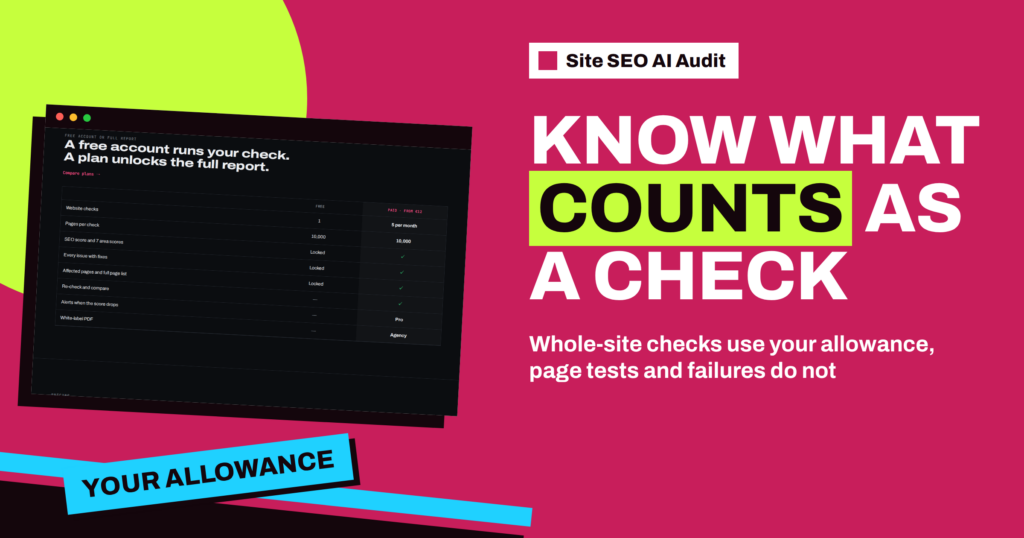
Any paid plan. A free account runs one check and shows the report locked, while Starter, Pro and Agency unlock every issue and the affected pages.