ENEnglish
 LTLietuviškai
 DEDeutsch
 FRFrançais
 RUРусский
 ESEspañol
 PLPolski
 ITItaliano
 UKУкраїнська
 CSČeština
 PTPortuguês
 JA日本語
JA日本語 LVLatviešu valoda
 ETEesti
 HUMagyar
 IDBahasa Indonesia
 TRTürkçe
 HIहिन्दी
 ELΕλληνικά
 ARالعربية
 THไทย
THไทย VITiếng Việt
 RORomână
 MSBahasa Melayu
 BNবাংলা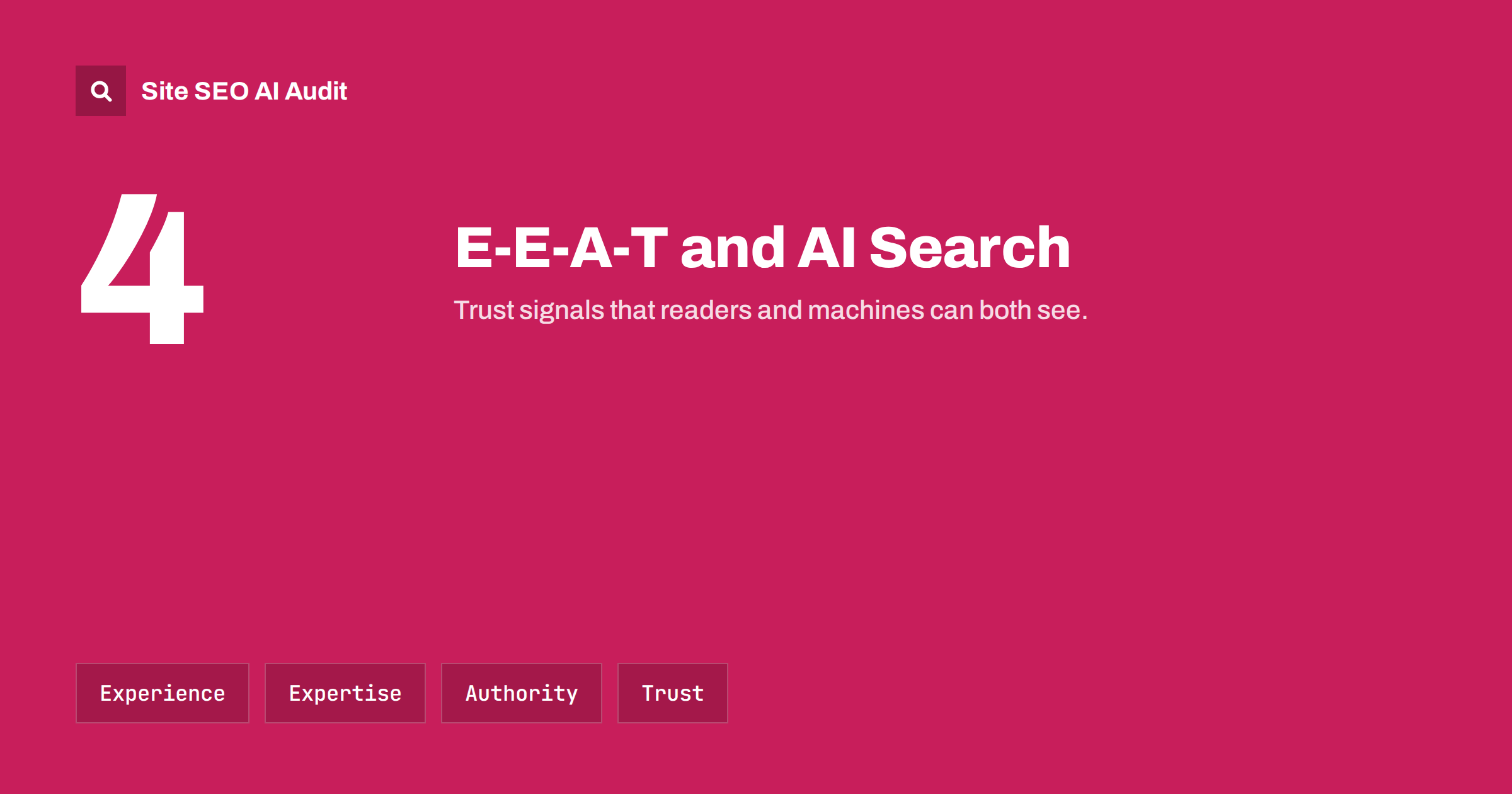
Short answer: E-E-A-T stands for experience, expertise, authoritativeness and trustworthiness. It comes from Google’s Search Quality Rater Guidelines and describes what reliable content looks like; it is not a single ranking factor or score. The same qualities matter in AI search because AI features are built on search systems that reward reliable sources, and because content that shows first-hand experience, named expertise and transparent facts gives any system more reason to trust and quote it.
Where E-E-A-T comes from
Google employs thousands of external quality raters who evaluate search results against a long public document, the Search Quality Rater Guidelines. Their ratings do not directly change rankings for any page. Instead, they help Google judge whether its ranking systems are returning good results. The guidelines describe what high and low quality look like, and E-E-A-T is the framework at their centre.
The original concept was E-A-T. In December 2022 Google added a second E for experience, recognising that first-hand experience often matters as much as formal expertise. Someone who has actually used a product, visited a place or run a business has knowledge that no amount of desk research can replace.
Google says that trust is the most important member of the group. Experience, expertise and authority all support trust, but a page can be untrustworthy even when its author is an expert, for example if it hides important information or misleads readers.
Why it matters for AI search
AI answers rely on sources, and AI systems try to prefer reliable ones. The exact methods are not published, but the logic is straightforward:
- Google’s AI features are built on Google Search, which uses ranking systems designed to reward helpful, reliable content. The same signals that help a page rank help it be selected as a source.
- Other assistants draw on search indexes and their own crawls. When several sources say similar things, the one that looks more credible is a safer choice for a system trying to avoid errors.
- Users check sources. When an answer cites a page, readers who click through judge it quickly. A page that shows who wrote it and why they know is more likely to satisfy them.
- Hallucination risk. AI developers work hard to reduce false answers, which gives them strong incentives to ground answers in trustworthy material.
There is no special AI version of E-E-A-T. The goal is the same as always: make it obvious to a reader why they should believe you.
Showing experience
Experience is the easiest signal for small businesses to show and the hardest for generic content to fake. Ways to make it visible:
- Describe what you did. “We migrated 40 client sites to a new host last year, and these are the three problems that came up every time” is more convincing than general advice.
- Use your own photos and screenshots rather than stock images. Show the product in use, the settings screen, the result.
- Include specifics that only practice reveals: how long something really takes, what went wrong, what you would do differently.
- Share honest limitations. Mentioning where a method does not work, or when a product is not the right fit, signals real use.
- Keep it true. Invented anecdotes and fake case studies undermine trust when discovered and may breach consumer protection rules.
Experience also shapes what you choose to write about. Topics where your team has done the work many times, and seen the problems first-hand, are where you can add something that large generic sites cannot. Start there rather than trying to cover every keyword in your industry.
Showing expertise
Expertise is about knowledge and skill in the topic. It matters most for subjects where mistakes have consequences, such as health, finance, law and safety, which Google calls “Your Money or Your Life” topics.
- Name the author on every substantive article and link to an author page.
- Explain relevant qualifications on the author page: training, certifications, years of practice, notable work. Only what is true and relevant.
- Use expert review for sensitive topics, and say who reviewed the content and when.
- Get the details right. Correct terminology, accurate figures and up-to-date rules are themselves evidence of expertise.
- Cite primary sources such as official documentation, standards and regulations when you rely on them.
Showing authoritativeness
Authority is about reputation: whether others in your field recognise you as a go-to source. It is the least controllable part of E-E-A-T, because it lives mostly on other sites.
Signals include mentions and links from respected publications, organisations and peers, reviews on independent platforms, speaking or teaching roles, and a history of accurate content. You build it slowly by doing good work in public: publishing original insights, contributing to industry discussions and being quotable. There are no shortcuts, and bought links or fake reviews carry real risk.
For AI answers, authority also shapes which brands appear in recommendations. When independent sources consistently mention you in connection with a topic, assistants are more likely to connect you with that topic.
A practical exercise is to list the ten sources your customers trust most, such as a trade association, a respected blog, a local newspaper or a review platform, and ask what it would take for each of them to mention you. Some will need original data, some a useful tool, some simply a good relationship. Working through that list is slower than chasing links, but it builds the kind of reputation that lasts.
Showing trustworthiness
Trust ties everything together. Practical signals on your own site include:
| Signal | What it looks like |
|---|---|
| Transparency | Clear company name, address, contact details and registration information |
| Accuracy | Correct facts, updated when they change, with visible update dates |
| Honest commercial intent | Affiliate links and sponsorships disclosed; reviews that mention weaknesses |
| Security | HTTPS everywhere, no mixed content, secure checkout |
| Customer policies | Easy-to-find pricing, returns, refunds and privacy information |
| Consistency | The same facts on your site, profiles and structured data |
Trust is also lost easily. A single page with an exaggerated claim, a missing disclosure or an obviously outdated fact can colour how readers view the whole site.
For AI answers in particular, consistency and accuracy carry extra weight. An assistant that repeats an outdated price or a wrong service area from your site creates a bad first impression before the customer ever reaches you. Reviewing key facts every quarter is a simple habit that protects both your readers and your reputation.
Author pages done well
Author pages are one of the most practical E-E-A-T improvements, and many sites still lack them. A good author page includes:
- The author’s full name and photo.
- Their role in the business and what they work on day to day.
- Relevant experience and qualifications, stated specifically.
- Links to their professional profiles and notable external work.
- A list of articles they have written or reviewed.
- Person structured data connected to your Organization markup.
On WordPress, the default author archive often shows only a list of posts. Fill in the biographical fields, and consider a theme or plugin option that shows a proper profile at the top of the archive.
Mistakes that undermine E-E-A-T
- Anonymous content on topics where credentials matter.
- Invented authors or stock-photo “experts”. They are easy to detect and damage trust.
- Mass-produced articles that repeat what every other site says, without experience or original information.
- Undated advice on topics that change, leaving readers unsure whether it still applies.
- Hidden commercial relationships, such as undisclosed affiliate links in “independent” reviews.
- Contradictory facts between pages, such as different prices or service areas.
How Site SEO AI Audit helps
E-E-A-T is mostly about content quality, which no crawler can judge for you. What an audit can do is check the technical signals around it. Site SEO AI Audit flags thin and duplicate content, missing titles and headings, invalid structured data and pages without the dates that AI answers tend to quote, and it confirms that AI crawlers can reach your pages at all. The fix list is ranked by impact, so you can clear the technical obstacles before investing in content. You can run a free audit to start.
Related reading
- How to Write Content That AI Answers Actually Quote
- Entity SEO: Helping AI Systems Understand Your Brand
- Thin Content: How to Find and Fix Low-Value Pages
The bottom line
E-E-A-T is not a score to optimise but a description of content people can rely on. Show first-hand experience, name qualified authors, earn recognition from others and make trust easy to verify with transparent, accurate and current information. These are the same qualities that make a page a safe source for AI answers.
BUJ
Is E-E-A-T a ranking factor?
Not directly. It is a framework from Google’s quality rater guidelines that describes reliable content. Google uses many signals that align with it, so improving E-E-A-T tends to improve how systems judge your content.
Does E-E-A-T matter for AI Overviews?
AI Overviews are built on Google Search and draw on pages its ranking systems consider helpful and reliable. The qualities E-E-A-T describes are therefore relevant, even though there is no separate AI score.
Do small businesses need author pages?
For substantive articles and advice, yes. A short, honest author page showing who wrote the content and why they know the subject is one of the simplest trust improvements a small business can make.
Can AI-written content have good E-E-A-T?
Content produced with AI tools can be helpful if people with real experience check, correct and add to it. Unedited generic output lacks the first-hand experience and accountability that E-E-A-T describes.
What is the fastest E-E-A-T improvement?
Adding named authors with real bios, visible update dates and clear company contact information is usually quick. Correcting outdated or exaggerated claims on key pages is equally fast and important.