ENEnglish
 LTLietuviškai
 DEDeutsch
 FRFrançais
 RUРусский
 ESEspañol
 PLPolski
 ITItaliano
 UKУкраїнська
 CSČeština
 PTPortuguês
 JA日本語
 LVLatviešu valoda
 ETEesti
 HUMagyar
 IDBahasa Indonesia
 TRTürkçe
 HIहिन्दी
 ELΕλληνικά
 ARالعربية
 THไทย
 VITiếng Việt
 RORomână
 MSBahasa Melayu
 BNবাংলা
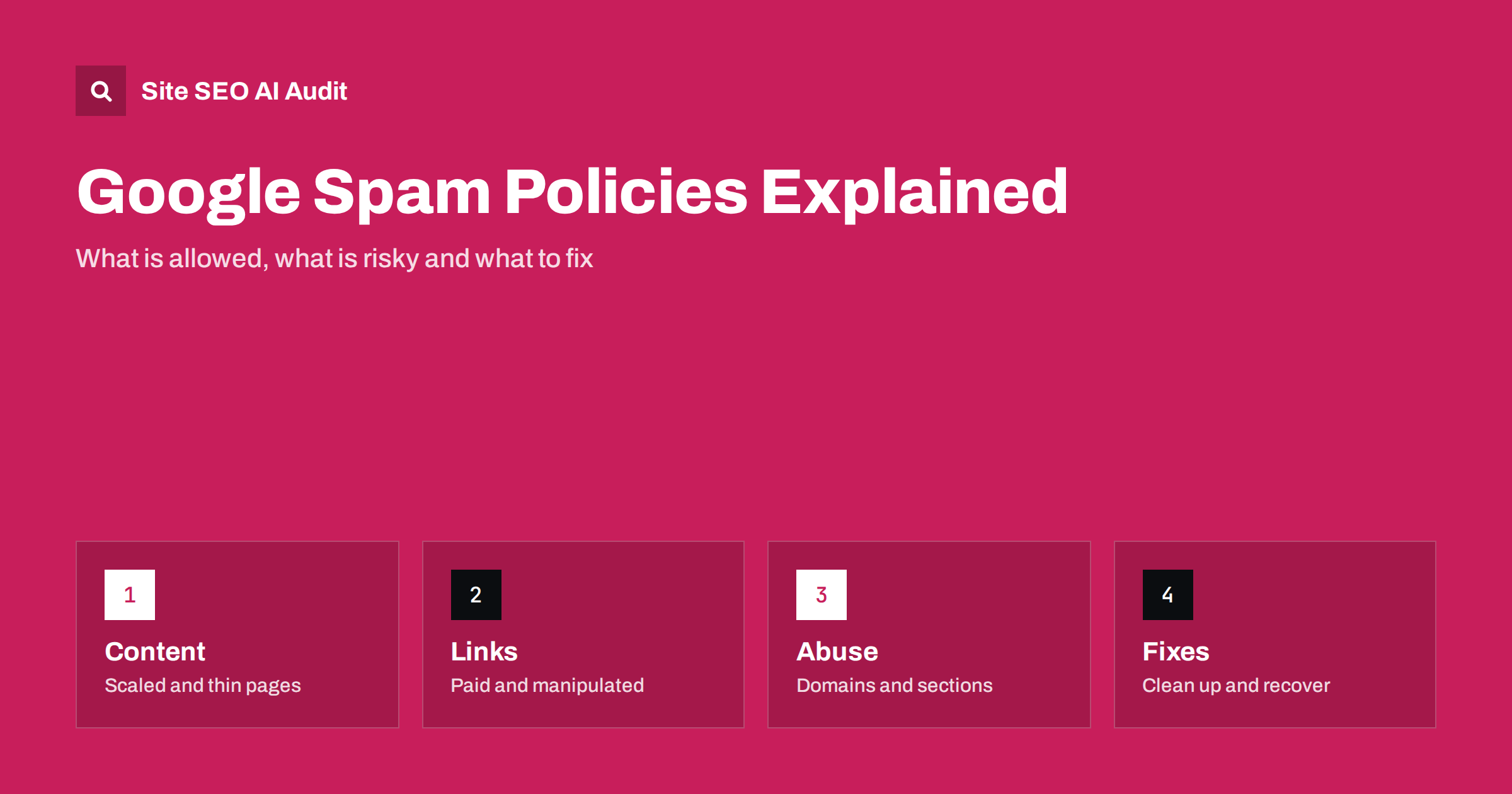
Short answer: Google’s spam policies list practices that can cause a page or a whole site to rank lower or be left out of search results. They include cloaking, hidden text, keyword stuffing, link spam, scaled content abuse, expired domain abuse, site reputation abuse, deceptive redirects, hacked content and scraping. Most are avoided by writing for people, showing crawlers the same page that visitors see, earning links naturally and keeping every page useful. If you are affected, remove the cause, document the change and ask for a review when a manual action exists.
Few topics cause as much worry as spam. Site owners hear that a technique is risky, but they are rarely told where the line is. Google publishes a set of spam policies for its web search, and understanding them turns a vague fear into a checklist. The policies are not a list of tricks to avoid being caught. They describe behaviour that tries to manipulate rankings instead of helping visitors. Some of it is done on purpose, and some is accidental, such as a plugin that injects links or a template that creates thousands of near-empty pages. This guide explains the main categories in plain language, shows how each appears on ordinary sites and describes what to do when you find a problem. For the wider picture of quality, read the core update recovery guide.
How the policies are enforced
Spam is handled in two ways. Automated systems detect many patterns and lower or ignore the pages involved, without any message to the site owner. For other cases, a human reviewer can apply a manual action, which appears in Search Console and describes the issue and the affected pages. Automated demotion has no notice, so the signs are indirect: a sudden fall in impressions for specific sections, pages dropping out of the index or being indexed without ranking. A manual action is clear, and it can be fixed and reviewed. Learn how to read the message in the guide to manual actions. In both cases the cure is the same: remove the practice, not just the symptom, and keep the site clean afterwards.
It also helps to know what is not spam. Ordinary optimisation, such as clear titles, good internal links, structured data, fast pages and well-organised content, helps people and search engines alike and is encouraged. Buying advertising is allowed, and so is promotional content, as long as it is honest and, where required, labelled. The policies target deception and low-value mass production, not effort. When you are unsure about a technique, ask whether you would be comfortable explaining it to a visitor, and whether it would still make sense if rankings did not exist.
Cloaking, hidden text and sneaky redirects
Cloaking means showing one version of a page to search engines and another to visitors. Hidden text, such as white text on a white background, text moved off the screen or text set to a tiny size, is a related practice. Sneaky redirects send visitors to a page different from the one the crawler saw, often only for people arriving from search results. These tricks are easy to create by accident: a script that serves a stripped-down page to bots, a mobile redirect that goes to the home page or a block of keywords placed in a collapsed section. Check your pages by viewing them as a crawler would, with the URL inspection tool, and compare the result with a normal visit. The risks in the age of AI crawlers are described in AI cloaking and hidden text.
Keyword stuffing and low-value text
Repeating a word or phrase until the text sounds unnatural, adding lists of cities or keywords at the foot of a page or inserting phrases only for search engines all fall under keyword stuffing. The same applies to text that is copied, spun or stitched together without adding value. The remedy is not a target density; it is to write the way an expert would speak to a customer, answer the question and use the words people use. If a page reads strangely aloud, rewrite it. For practical methods, see how to fix keyword stuffing naturally, and for pages with little content, see the thin content guide.
Scaled content abuse and automation
Scaled content abuse means producing many pages mainly to rank, no matter how they are made: by hand, by software or by a mix. The key question is value. A large site with thousands of useful pages, each with unique data, is not abusive just because it is large. A site that creates thousands of pages by changing a place name or product name in a template, or that publishes automatically generated text without review, is at risk. Before you publish at scale, ask whether each page would still be worth visiting if search engines did not exist, and whether a person edited it for accuracy. Learn how to build templates safely in programmatic SEO templates and thin pages, and how to use writing tools responsibly in AI-written content and SEO.
Link spam and manipulated signals
Links that are bought or sold to pass ranking signals, excessive link exchanges, automatically created links, large-scale guest posting with keyword-rich anchors and links hidden in widgets or footers are all considered link spam. Paid or promotional links are allowed when they are marked with the right attribute, and the same applies to user-generated links. A natural link profile grows from content that people want to cite. Review your own outgoing links too, since a hacked page can contain links you never added. The attributes are explained in nofollow, sponsored and UGC links, and safe methods are in link building basics for small sites.
Expired domains, site reputation and third-party content
Two newer categories surprise honest publishers. Expired domain abuse means buying a domain with an old reputation and filling it with unrelated content to benefit from that history. Site reputation abuse means hosting content from a third party, such as coupons, reviews or product comparisons, on a trusted site mainly to profit from its ranking power, with little oversight from the host. If you rent out sections, accept sponsored posts or buy a used domain for a legitimate relaunch, make sure the content fits the purpose of the site and that you supervise it. Read how to check a used domain’s history before you buy one.
Malware, hacked content and user-generated spam
Not all spam is created by the owner. Attackers inject hidden links, create thousands of pages with pharmaceutical or gambling terms or redirect visitors from search. Forums, comments and profile pages attract spam posts. Protect the site with updates, strong credentials, moderation and a rule that user links are marked as user-generated. Watch for strange new URLs in the index, unexpected pages in the sitemap and sudden traffic for unrelated queries. If you are hit, follow the steps in the hacked site guide and clean the cause before asking for a review.
Prevention is cheaper than recovery. Limit who can edit templates and install plugins, review scripts from third parties before adding them, and set up alerts for new pages and sudden changes in indexed URLs. A monthly look at the pages indexed with the site: operator and at the Search Console reports often reveals injected content weeks before a ranking drop does.
Audit your site against the policies
Make a short review part of your routine. List the sections of the site that were created in bulk, the places where third parties publish, the scripts that touch content or redirects and the pages that exist mainly for search engines. Sample the pages, compare what a crawler sees with what a person sees, check for duplicated or near-empty templates and look at the outgoing links. Record what you find and fix the highest risks first, then watch the Search Console reports for several weeks. When a problem is only a pattern in the template, one fix can clear thousands of pages. Do not wait for a manual action: most damage comes from automated systems, which never send a message.
Site SEO AI Audit does not judge whether a page breaks a spam policy. It crawls your site, checks titles, status codes, redirects, duplicate and thin pages, orphan pages and structured data, and ranks the fixes by the points they add. The first audit of up to 200 pages is free; larger sites can see the pricing page.
Related reading
- Manual Actions in Search Console
- Core Update Recovery Guide
- Hacked Site SEO Spam
- AI Cloaking and Hidden Text Risks
The bottom line
Spam policies describe attempts to manipulate rankings instead of helping visitors. Show crawlers the same page as people, write naturally, publish at scale only with real value, earn and label links honestly, supervise third-party content and keep the site secure.
BUJ
Will I get a message if my site is affected by spam systems?
Only for manual actions, which appear in Search Console. Automated demotion sends no notice, so watch impressions, indexing and ranking by section.
Is using automation to create content always spam?
No. The policy is about producing content mainly to rank, without value. Reviewed, accurate and useful pages are fine however they were drafted.
Are paid links against the policies?
Links that pass ranking signals in exchange for payment are. Mark paid or sponsored links with the proper attribute so that they do not pass those signals.
Can an old domain be reused safely?
Yes, when the new content fits the domain’s former purpose or is clearly a legitimate relaunch. Check its history and avoid unrelated content built to borrow a reputation.
How long does recovery take after cleaning up?
It varies. After a manual action, review can take days or weeks. For automated demotion, improvements may appear gradually as pages are recrawled and reassessed.