ENEnglish
 LTLietuviškai
 DEDeutsch
 FRFrançais
 RUРусский
 ESEspañol
 PLPolski
 ITItaliano
 UKУкраїнська
 CSČeština
 PTPortuguês
 JA日本語
JA日本語 LVLatviešu valoda
 ETEesti
 HUMagyar
 IDBahasa Indonesia
 TRTürkçe
 HIहिन्दी
 ELΕλληνικά
 ARالعربية
 THไทย
THไทย VITiếng Việt
 RORomână
 MSBahasa Melayu
 BNবাংলা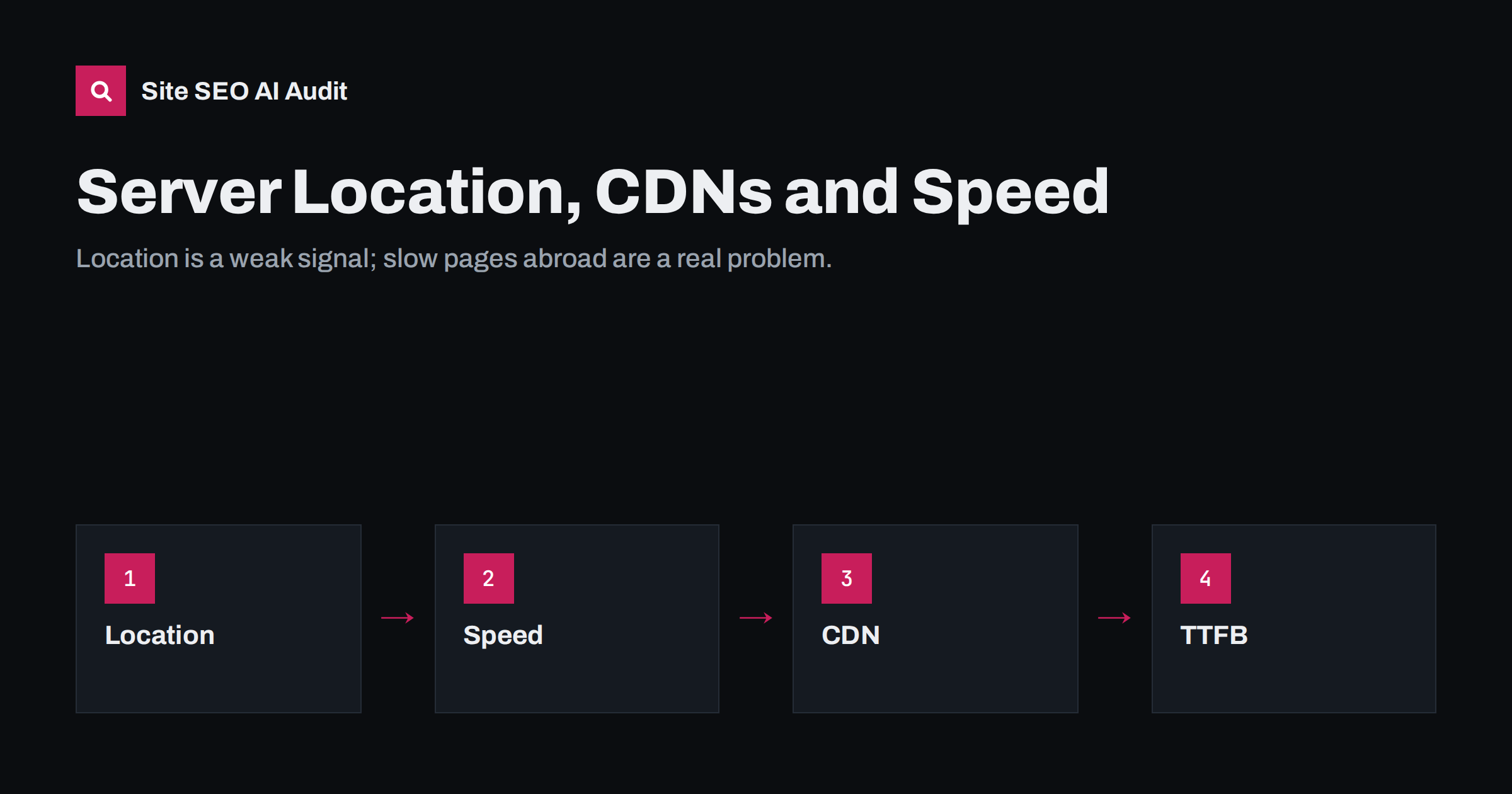
Short answer: Server location is at most a minor signal for international SEO today; what matters is how fast and reliably your pages load for visitors and crawlers in each target market. A site hosted in one country can serve pages slowly to users on another continent, especially for uncached pages. A content delivery network (CDN) caches content close to visitors and usually solves most of this. Measure speed per market, watch server response time for pages the CDN cannot cache, and make sure the CDN never blocks or mixes up language versions.
Does server location still matter?
In the early days of international SEO, the location of the server’s IP address was considered a hint about which country a site targeted. That made sense when most sites were hosted locally and there were few other signals. Today, content delivery networks, cloud hosting and global infrastructure mean that server location says little about the intended audience, and search engines rely much more on other signals: country-code domains, hreflang, local content and local links.
Google’s documentation on multi-regional sites mentions server location as a possible signal but notes that it is not a definitive one, because many sites use CDNs or are hosted in a different country for good reasons. In practice, you should not choose hosting based on geotargeting. Choose it for performance, reliability, data protection requirements and cost.
Why speed abroad is the real issue
Distance still matters for speed. Every request travels through networks to the server and back, and each round trip adds latency. A visitor on the other side of the world from the server can wait noticeably longer for the first byte of each uncached page than a visitor nearby, and that delay adds up across the requests a page needs.
Speed affects international SEO in several ways:
- User experience: slow pages lose visitors, and the effect is often strongest on mobile networks.
- Core Web Vitals: field data reflects real visitors, so a market with slow loading can show weaker results even when your home market looks fine.
- Crawling: slow server responses can reduce how much search engines crawl, which matters for large multilingual sites with many URLs.
How CDNs help international sites
A CDN stores copies of your content on servers in many locations and serves each visitor from a nearby one. For international sites, that brings clear benefits:
- Static files such as images, CSS, JavaScript and fonts load from nearby locations everywhere.
- Cached HTML pages can be served close to visitors, cutting the time to first byte dramatically.
- Traffic spikes in one market are absorbed by the CDN rather than the origin server.
- TLS connections are completed nearby, which shortens connection set-up for distant visitors.
For most small and medium sites, putting a well-configured CDN in front of the origin server removes most of the speed difference between markets.
Configuration still matters. A CDN that only caches images and scripts but sends every HTML request to the origin helps less than one that also caches pages. Check cache hit rates per region in your CDN’s reports, and look at which URL patterns are always passed through to the origin. Language folders sometimes end up excluded from caching by an overly broad rule, which makes translated pages slower than the original.
Where CDNs cause international problems
CDNs also introduce new ways to break an international site:
- Cache mixing between languages. If the language is chosen by cookie or header rather than URL, the CDN may cache one language and serve it to everyone. Separate URLs per language avoid this.
- Geo-redirect rules at the edge. Some CDNs make it easy to redirect visitors by country. Used on language URLs, these rules hide versions from crawlers that come from one country.
- Bot protection blocking crawlers. Aggressive firewall or bot rules can block or challenge legitimate search engine crawlers, sometimes only from certain regions.
- Stripped headers. hreflang delivered through HTTP Link headers, or content-language headers, may be dropped by misconfigured CDN rules.
- Stale caches after changes. Updated hreflang, canonicals or translations may not appear until the cache is purged.
After any CDN configuration change, request a few URLs in each language from outside your network and check status codes, response headers and the language of the returned page. It takes minutes and catches most of these problems before search engines do.
Uncached pages and server response time
CDNs work best for content that can be cached. Many important pages cannot be, or not for long: search results, carts, logged-in pages, pages with personalised elements and pages that were just updated. For these, every request travels to the origin server, and distance matters again.
Measure server response time, often called time to first byte (TTFB), for uncached requests from each target region. If it is high for distant markets, options include:
- Speeding up the origin itself: database queries, page generation and server resources.
- Caching more pages at the edge, with sensible expiry times and purging on updates.
- Serving parts of the page from the edge and loading personalised elements separately.
- For very large markets far from the origin, adding regional origin servers or hosting.
Front-end weight matters more across long distances
Latency multiplies with every request a page needs. A page that loads a dozen scripts, several web fonts, tracking tags and large images from different hosts pays the distance penalty many times over for a visitor far away. Reducing front-end weight therefore helps distant markets disproportionately.
- Fewer third-party requests. Each extra domain means another connection set-up. Remove tags and widgets that no longer earn their place.
- Lighter images. Modern formats, correct dimensions and lazy loading below the fold cut the largest part of most pages’ weight.
- Font strategy per language. Load only the character sets each language needs. A page in German does not need Cyrillic or Greek glyphs, and a Japanese page may need a very different font strategy.
- Compression and caching headers. Text resources should be compressed, and static files should carry long cache lifetimes so returning visitors do not download them again.
- Critical content first. Make sure the main content and its largest image load early, so the page is usable even while less important resources are still arriving.
These improvements help everywhere, but they are what turns an acceptable experience at home into an acceptable experience on the other side of the world. They also tend to be cheaper than new hosting infrastructure.
Translated versions deserve their own check. Language plugins, font loaders and localized scripts sometimes add weight only to some languages, so a page that is light in English can be noticeably heavier in Japanese or Arabic.
Special cases: China and data residency
Two situations need more than a CDN. Mainland China has network conditions and regulations that make sites hosted abroad slow or unreliable for Chinese users; serving that market well usually requires local hosting or a CDN with presence in mainland China, which in turn has licensing requirements. Some industries and countries also have data residency rules that require certain data to be stored locally. These are business and legal decisions that go beyond SEO, but they directly affect how well a market version performs.
How to measure speed per market
- Field data by country: real-user metrics, where available, show how visitors in each market experience your site.
- Lab tests from several locations: run tests from regions close to your target markets, not only from your office.
- Uncached and cached requests: test both, because CDN caching hides origin problems.
- Each language version: translated templates sometimes load extra fonts or scripts, making them slower than the original.
Checking speed and crawlability together
Site SEO AI Audit checks speed as one of its seven areas, including Google PageSpeed data, LCP and CLS, server response on every crawled page, compression and page weight. It also checks the Languages area, including hreflang return links and broken language versions, so you can see whether CDN or caching rules affect language versions. The first audit is free.
Related reading
- Server response time and TTFB: how to speed up your server
- Is your CDN or firewall blocking AI crawlers? How to check
- Locale-adaptive pages: why one URL for all markets is risky
The bottom line
Do not choose hosting to signal a target country; choose it for speed, reliability and compliance. Use a CDN to serve content close to visitors in every market, keep language in the URL so caches never mix versions, avoid geo-redirects at the edge, make sure bot protection lets search engine crawlers through, and measure speed and server response for each market, especially on uncached pages.
BUJ
Should I host my website in the country I target?
It is not necessary for SEO. Server location is a weak signal at most. Choose hosting for performance and reliability, and use a CDN to serve visitors quickly in every market.
Does a CDN affect hreflang?
Not directly, but misconfigured CDNs can serve the wrong language from cache, strip headers or redirect by country, all of which undermine hreflang.
Why is my site fast at home but slow abroad?
Distance adds latency, especially for uncached pages that must be generated by the origin server. A CDN and faster server-side generation usually close the gap.
Can bot protection block search engines?
Yes. Aggressive firewall or bot rules can challenge or block legitimate crawlers. Verify crawler access and allow known search engine bots.
Do I need special hosting for China?
Serving mainland China well usually requires local hosting or a CDN with presence there, which involves licensing requirements. It is a business decision beyond ordinary SEO.