ENEnglish
 LTLietuviškai
 DEDeutsch
 FRFrançais
 RUРусский
 ESEspañol
 PLPolski
 ITItaliano
 UKУкраїнська
 CSČeština
 PTPortuguês
 JA日本語
JA日本語 LVLatviešu valoda
 ETEesti
 HUMagyar
 IDBahasa Indonesia
 TRTürkçe
 HIहिन्दी
 ELΕλληνικά
 ARالعربية
 THไทย
THไทย VITiếng Việt
 RORomână
 MSBahasa Melayu
 BNবাংলা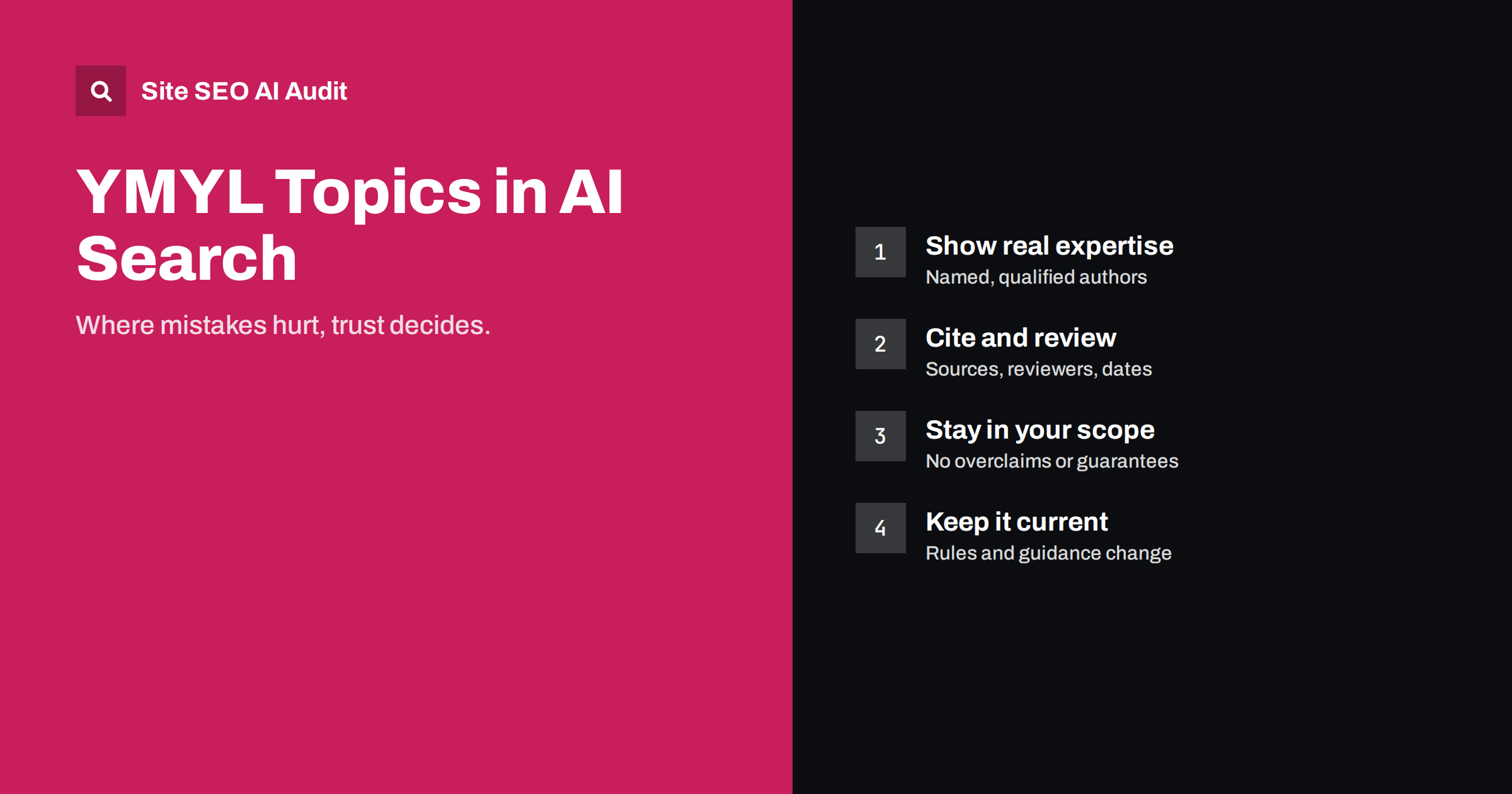
Short answer: YMYL (“Your Money or Your Life”) topics are those where wrong information could seriously affect someone’s health, finances, safety or legal situation. Search engines have long applied higher quality expectations to them, and AI assistants tend to be more cautious too: they often favour official and well-established sources and add caveats. For clinics, financial advisers, law firms and similar businesses, being cited means showing real, verifiable expertise: named and qualified authors, expert review, sources, current dates, a clear scope and no exaggerated claims.
What counts as YMYL
The term comes from Google’s search quality rater guidelines, which describe topics that could significantly affect a person’s health, financial stability, safety, or the welfare of society. Common categories include:
- Health and medicine: symptoms, treatments, medication, mental health, nutrition advice with health claims.
- Finance: investing, taxes, loans, insurance, pensions, budgeting advice.
- Legal matters: rights, contracts, immigration, family law, employment law.
- Safety: product safety, electrical or construction work, emergency information.
- Civic information: voting, government services, public policy facts.
Not every page on a medical or financial site is YMYL in the same degree. A clinic’s parking information carries little risk; its page about medication dosage carries a lot. The higher the potential harm, the higher the bar. Google’s guidance on creating helpful, reliable content explains that its systems give more weight to signals of expertise and trust on these topics.
How AI assistants handle YMYL questions
AI assistants are designed to be careful when answers could cause harm, and their behaviour on YMYL questions often differs from everyday topics. Patterns commonly observed include:
- A preference for authoritative institutions: health authorities, government agencies, regulators, universities and major established organisations appear often as sources.
- Caveats and referrals: answers frequently recommend consulting a doctor, lawyer or adviser, and some questions are answered only in general terms.
- Fewer small sources: for high-risk questions, lesser-known sites may be cited less often unless they show strong signals of expertise.
- More weight on consensus: answers tend to reflect widely agreed guidance rather than individual opinions.
The exact rules are not public and differ between assistants, so treat these as tendencies rather than laws. The practical takeaway is the same: on YMYL topics, you need to look like a source a careful system would be comfortable relying on. Our article on E-E-A-T and AI search covers the general principles.
Where smaller YMYL businesses can still win
Competing with national health services or tax authorities on “what is” questions is rarely realistic. But YMYL businesses have strengths institutions lack:
- Practical, local detail: how a procedure works at a specific clinic, what a local process involves, what documents a particular authority asks for.
- Experience-based guidance: what practitioners see in day-to-day work, common mistakes clients make, realistic timelines and costs.
- Specific situations: questions for particular groups, such as freelancers’ tax obligations, landlords’ legal duties or treatment options for athletes.
- Services and choices: when someone asks which kind of professional to see or what to expect from a first consultation.
Focus content on these areas, and link to official sources for the general rules rather than restating them less authoritatively.
This split also makes content easier to maintain. When the official rule changes, the link still points to the current version, and your page only needs updating where your own practical advice depends on it. A page that copies the whole rulebook, by contrast, goes out of date the moment anything changes and is exactly the kind of outdated source careful AI systems try to avoid.
Show who is behind the content
On YMYL topics, anonymous content is at a serious disadvantage. Make expertise visible and verifiable:
- Named authors with relevant qualifications, such as a licensed physician, certified accountant or practising lawyer, linked to author pages with credentials and registration details where applicable. Our guide on author pages and bylines explains the setup.
- Expert review: when content is written by a non-specialist, have it reviewed by a qualified professional and show “Reviewed by” with their name and date.
- Organisation details: an about page with the company’s legal name, registration, regulatory status, address and contact details. See our about page guide.
- Editorial policy: a short page explaining how content is created, reviewed and corrected.
Markup can support this. Article structured data can name the author with a link to their page, and schema.org includes properties such as reviewedBy and lastReviewed on web pages. These describe the facts for machines; the facts themselves must be real and visible on the page.
Cite sources and keep content current
YMYL content should be as checkable as possible:
- Link to primary sources: laws, official guidance, clinical guidelines, regulators’ pages. Our guide to outbound links explains why linking out helps.
- State the jurisdiction or context: tax rules, legal rights and medical guidance vary by country.
- Show published and last reviewed dates, and review content on a schedule, especially after rule changes such as new tax years.
- Correct errors visibly, with a note of what changed.
Outdated YMYL content is risky in AI answers, because an assistant may quote last year’s tax threshold or superseded medical guidance with confidence. Our article on content dates and freshness covers how dates are used.
Stay within your scope and avoid overclaims
Claims that would be harmless marketing elsewhere can undermine trust on YMYL topics, and some are regulated:
| Risky wording | Better approach |
|---|---|
| “Guaranteed results” or “cure” | Describe what the treatment or service typically involves and its limitations |
| “Risk-free investment” | Explain risks plainly, as financial rules in many countries require |
| “You will win your case” | Explain the factors that affect outcomes |
| Advice for every situation | State who the guidance applies to and when to seek individual advice |
| Unnamed statistics | Cite the source or remove the number |
Balanced, precise language reads as more expert, and it is the kind of text careful AI systems are comfortable quoting.
AI-assisted writing on YMYL topics
Drafting tools can speed up writing, but unreviewed AI-generated content is particularly risky on YMYL topics: plausible-sounding errors about dosage, deadlines or legal rights can cause real harm and damage the site’s credibility. If you use such tools, have every YMYL page checked by a qualified professional before publication, verify each fact against a primary source, and name the reviewer. Our guide on publishing AI-assisted content responsibly covers the process.
A pre-publication checklist for YMYL pages
Before a YMYL page goes live, or when reviewing existing ones, run through a short checklist. It takes a few minutes per page and catches most of the problems that undermine trust:
- Author: is a named person with relevant qualifications shown, with a link to their profile?
- Review: has a qualified professional checked the content, and is their name and review date visible?
- Sources: does every rule, threshold, statistic and medical or legal statement link to or name a primary source?
- Scope: does the page say which country, situation or group it applies to, and when readers should seek individual advice?
- Currency: are figures, deadlines and guidance current for this year, and is the next review date recorded internally?
- Wording: are there any guarantees, absolute claims or unsourced numbers left?
- Accessibility for machines: is the text in plain HTML, with clear headings, and does the page load without errors?
- Contact: can a reader easily find how to reach the organisation with a question or a correction?
Keep the completed checklist with the page record. When rules change, such as a new tax year or updated clinical guidance, it tells you exactly which pages need another review.
Check how assistants answer your topics
Test a set of questions your clients ask in the assistants they use, and record which sources are cited, whether your organisation appears and whether the answers are accurate. Where assistants repeat outdated or wrong information about your field or your business, update your own pages first and then address the sources. Our guide on fixing wrong information about your business in AI answers explains the steps.
Technical access matters as much on YMYL sites as anywhere. Site SEO AI Audit checks whether AI crawlers may read your site, whether content appears without JavaScript and whether pages have the structure and dates that AI answers quote, together with structured data and on-page checks on every page. Run a free audit to make sure your expert content can be read.
Related reading
- Original Data and First-Hand Experience: What AI Answers Cite
- AI Search for Local Businesses: What to Fix First
- Organization Schema: Telling AI Systems Who You Are
The bottom line
On health, money, legal and safety topics, search engines and AI assistants set a higher bar for trust. Meet it with named, qualified authors and reviewers, sources and dates, a clear scope and careful wording. Focus content where practitioners add real value, link to official guidance for the general rules, and keep everything current. That is what makes a YMYL business a source worth citing.
BUJ
What does YMYL mean?
YMYL stands for “Your Money or Your Life”. It describes topics where inaccurate information could significantly harm a person’s health, finances, safety or legal situation, such as medical, financial and legal advice.
Do AI assistants treat YMYL topics differently?
They tend to be more cautious, often favouring official and well-established sources and adding caveats or referrals to professionals. The exact behaviour varies between assistants and is not publicly documented.
Can a small clinic or advisory firm be cited in AI answers?
Yes, especially for practical, local and experience-based questions that institutions do not cover in detail. Clear expertise, expert review, sources and current dates improve the chances.
Is AI-written content allowed on YMYL topics?
Search engines focus on quality rather than how content is produced, but unreviewed AI text is risky on YMYL topics. Have a qualified professional review every page and verify facts against primary sources.
Do YMYL pages need a medical or legal disclaimer?
A clear note on scope, such as that content is general information and not individual advice, is good practice and sometimes required. It does not replace accurate content, named experts and cited sources.