ENEnglish
 LTLietuviškai
 DEDeutsch
 FRFrançais
 RUРусский
 ESEspañol
 PLPolski
 ITItaliano
 UKУкраїнська
 CSČeština
 PTPortuguês
 JA日本語
 LVLatviešu valoda
 ETEesti
 HUMagyar
 IDBahasa Indonesia
 TRTürkçe
 HIहिन्दी
 ELΕλληνικά
 ARالعربية
 THไทย
 VITiếng Việt
 RORomână
 MSBahasa Melayu
 BNবাংলা
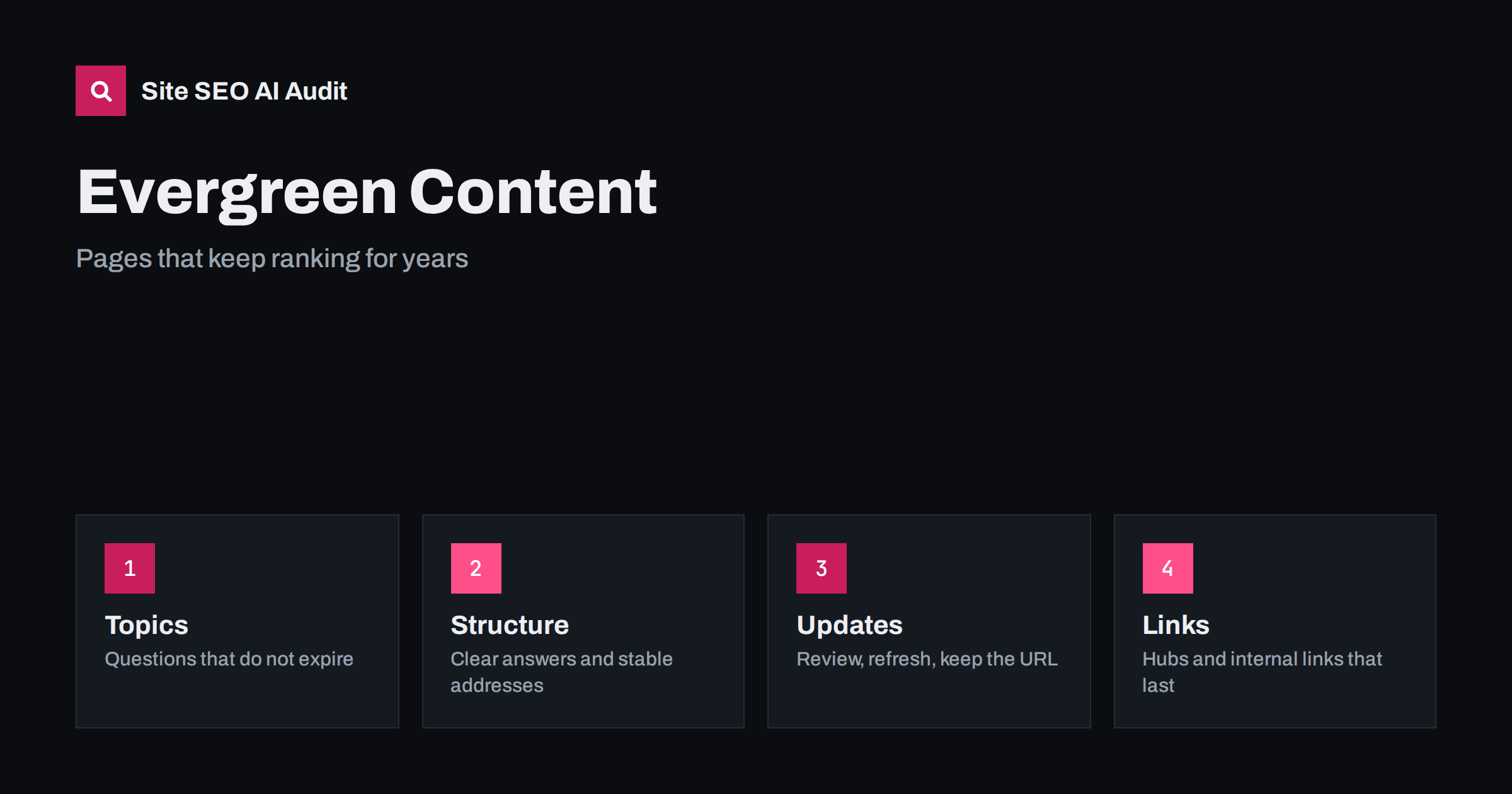
Short answer: Evergreen content answers questions that people keep asking year after year, and it earns search and AI visibility long after publication because the topic does not expire. Building it takes more than choosing a timeless subject. Pick topics with steady demand, write a clear and complete answer at the top, structure the page so that sections can be read alone, keep the address stable, avoid dates and trends in the title unless they are essential, and review the page on a schedule so that facts, screenshots and links stay correct. Link to it from hubs and related pages so that it gains authority over time. Evergreen does not mean unchanged: the best pages are maintained like products, with small regular improvements rather than rewrites after rankings fall.
Most blogs publish news-style posts that peak for a week and then disappear into the archive. A smaller set of pages usually brings the majority of organic traffic for years: definitions, how-to guides, checklists, comparisons and explanations of concepts. These are the pages that assistants also quote, because they provide stable, well-structured answers. The reason many sites fail to benefit is that they treat every post as one-off content, with no plan for maintenance. This guide explains how to choose evergreen topics, build pages that stay useful, maintain them without damaging their rankings and use them as the base of your content strategy. It builds on topic clusters and pillar pages and complements refreshing old posts.
What makes a topic evergreen
A topic is evergreen when the underlying need persists and the answer changes slowly. “How to write a title tag” is evergreen; “what changed in last month’s update” is not. Look for questions with steady search demand across the year, no strong dependence on a date or a product version, and a clear audience. Check demand in Search Console and keyword tools over several years, and look at whether the top results are old pages that still rank, which signals durability. Most industries have an evergreen core: definitions, processes, comparisons, costs, mistakes, checklists and templates. Even fast-moving fields have it, for instance the fundamentals of technical SEO beneath each platform change. Separate your plan into evergreen pages, which you maintain, and time-bound pages, such as announcements, which you publish and let age. See the search intent guide for matching pages to needs.
Write the answer first and make it complete
An evergreen page earns its place by being the clearest, most complete answer to a question. Open with a short answer of two or three sentences, then expand with sections for each aspect of the topic. Cover the definition, the process, examples, common mistakes, tools or requirements, costs or limits where relevant, and answers to follow-up questions. Aim to leave the reader with no need to return to the results. Keep paragraphs short, use descriptive headings and lists where steps or items are discrete. Avoid padding to hit a word count; completeness is measured by questions answered, not length. The opening pattern is described in answer-first introductions, and the structure of questions in FAQ sections for AI answers.
Format matters for durability as well. Use a clear heading structure so that each section can stand alone as an answer, add a short summary or table of contents for long guides, and use real HTML for lists and tables rather than images. Add descriptive alt text for diagrams and keep images in modern formats so that the page stays light. Include a brief section for common mistakes and a short checklist, which readers and assistants both value. Avoid embedding the key information in videos or interactive widgets without a text version, since text is what survives changes in platforms and tools. Pages built this way are easy to update section by section, which lowers the cost of maintaining them over years.
Keep the title, address and wording timeless
Years in titles and URLs make a page look dated within months and force you to change addresses. Avoid them unless the page is about something tied to a year, and if you do use one, update the title and keep the same URL. Use stable, descriptive slugs without dates or version numbers, and do not include words such as “new” or “latest” that age quickly. In the text, prefer phrases that remain true, and where you must mention a date, tie it to a fact (“as of the last review”) and keep it current. If a page does need a year, see the trade-offs in years in title tags. A stable address accumulates links and trust, so changing it should be a rare decision backed by redirects.
Back claims with evidence and experience
Pages that last are credible. State who wrote the page and why they are qualified, show real examples, screenshots, data from your own work or experience, and cite sources where they matter. Original data, such as a survey or an analysis of your own site, is worth more than a rewrite of other pages and can earn citations from other sites and assistants. Avoid claims you cannot support and statistics without a source. When facts do change, update them visibly, because users and systems notice outdated numbers quickly. The value of original material is explained in original research and AI citations.
Plan the refresh cycle
Give every evergreen page an owner, a review date and a short checklist: are the facts still correct, do all links work, are screenshots and examples current, has the search intent shifted, and can the page answer new related questions? Review high-traffic pages quarterly or twice a year and others yearly. When you update, improve the content itself, not only the date, and keep the same URL. A visible “last updated” date is useful when it reflects a genuine change, and misleading when it does not. Track clicks and impressions per page so that you refresh when performance slips, not only on the calendar. The details are in refreshing old posts and content dates and freshness.
Link evergreen pages into your structure
An evergreen page performs best when it sits within a clear structure. Link to it from the hub page on the topic, from related articles and from navigation or footers where it deserves prominence. Link out from it to deeper pages that cover subtopics, using descriptive anchor text. Over time add links from newer posts that mention the topic, so that fresh content passes relevance to your durable pages instead of competing with them. Review which evergreen pages receive the fewest internal links and fix that first. See the internal linking strategy guide for the method, and consider glossary pages as another durable format for definitions.
Prune and consolidate
Evergreen programmes fail when the archive fills with overlapping posts that split attention. If several pages answer the same question, merge them into the strongest one and redirect the others permanently. If a page has no demand and no strategic role, improve it, merge it or remove it. Fewer, stronger pages usually outperform many weak ones, and maintenance becomes manageable. Decide with data, not with feelings about the effort spent writing them. See the content pruning guide and fixing keyword cannibalization.
Balance evergreen and timely content
Do not abandon timely content: announcements, seasonal pages and commentary build awareness and links. The point is to connect them. A news post about a change should link to the evergreen guide that explains the concept, and the guide can link back to the post for history. Seasonal pages that repeat every year should keep one address and be refreshed each year, as explained in seasonal pages SEO. Plan a calendar that mixes both types, with an editorial cadence that you can maintain, as in the SEO content calendar guide.
Checklist and audit
- Topics with steady demand and slow-changing answers.
- A short answer at the top and complete sections below.
- Stable address, no years or fads in the slug.
- Author, sources, examples and original data where possible.
- Owner, review date and refresh checklist per page.
- Hub links, descriptive anchors and consolidation of duplicates.
Site SEO AI Audit crawls your blog, shows which pages are thin, duplicated, orphaned or weakly linked, and lists fixes ranked by the points they add, so you know which evergreen pages to improve first. The first audit of up to 200 pages is free; larger sites can see the pricing page.
Related reading
- Content Refresh for Old Posts
- Topic Clusters and Pillar Pages
- Content Pruning Guide
- Internal Linking Strategy
The bottom line
Evergreen content is a maintained asset. Choose durable questions, answer them completely, keep addresses and titles timeless, support claims with evidence, review pages on a schedule and link them into a clear structure. A small set of such pages often outperforms a large archive of posts that were published once and forgotten.
FAQ
How often should I update an evergreen page?
Review important pages every three to six months and others yearly, or sooner when rankings, facts or search intent change. Improve the content, not only the date.
Should I change the URL when I refresh a page?
No. Keep the address stable so that links and rankings accumulate. Change it only for a strong reason and add a permanent redirect.
Can evergreen content include the year?
Avoid it in the slug. If the title needs a year, update the title each year on the same address and make sure the content really is current.
Is evergreen content only for blogs?
No. Guides, glossaries, comparison pages, FAQs and service explanations can all be evergreen. Any page that answers a lasting question qualifies.
How do I know if a topic is really evergreen?
Check that search demand is steady across several years, that the answer rarely changes and that older pages still rank for it.