ENEnglish
 LTLietuviškai
 DEDeutsch
 FRFrançais
 RUРусский
 ESEspañol
 PLPolski
 ITItaliano
 UKУкраїнська
 CSČeština
 PTPortuguês
 JA日本語
 LVLatviešu valoda
 ETEesti
 HUMagyar
 IDBahasa Indonesia
 TRTürkçe
 HIहिन्दी
 ELΕλληνικά
 ARالعربية
 THไทย
 VITiếng Việt
 RORomână
 MSBahasa Melayu
 BNবাংলা
Short answer: A local business website is small, but the basics still decide whether nearby customers find it. Site SEO AI Audit crawls the whole site and shows a score for seven areas with a fix list ranked by points. For a local business, the most useful findings are missing or weak titles and descriptions, dead pages, thin service pages, missing structured data, slow mobile speed and a missing canonical or sitemap. Run a check, fix the top items, re-check and then repeat every month or after each change.
The owner of a dental clinic, a bakery, a plumbing company or a small law office rarely has time for SEO. The website was built once, it has ten or twenty pages, and every few months somebody adds an offer or a new price list. Customers search on their phones, “plumber near me”, “dentist Kaunas”, and they choose among a few results. The website that is easy for search engines to read, fast on a phone and clear about who, what and where has a real advantage. An audit is the quickest way to learn what is wrong without hiring a specialist. This article shows how to read the report as a local business owner.
Start with the score, then the fix list
Enter your address, create a free account if you do not have one, and run the check. A small site finishes in a few minutes. The report opens with a score out of 100 and seven area scores. Below it is the list of top fixes, each with the number of points it would add. On a free account the report is locked, so to read every issue and the affected pages, you need a plan. For a small local site, Starter, with full reports and five checks a month, is usually enough.
Do not worry about a score in the middle range. Small sites often have a few big problems rather than many small ones. Read the first five items in the fix list, because they are the cheapest way to raise the score. The article on fixing SEO issues by impact explains how to work through the list in order.
Titles and descriptions: say who, what and where
For a local business, the title of each page should tell a searcher three things: what you do, where you do it and who you are. “Emergency plumber in Kaunas | Example Plumbing” does that. “Home” does not. The audit flags missing titles as critical, titles under 20 or over 65 characters as notices and duplicate titles as warnings. A small site with ten pages should have ten different titles, each with the service and the city. The meta description is the short text under the title in results, and the audit asks for one of 120 to 160 characters. Write it for a customer: what you offer, what makes you different and how to reach you. The guide to writing title tags and the article on missing and badly sized page titles give examples.
Dead pages and old links
Local businesses change: a service ends, an offer expires, a team page is removed. Pages that return an error are a critical finding, because a customer who clicks an old link in a search result or on a directory lands on nothing. Use the list in the report to restore, redirect or clean up each address. The article on pages that return 4xx errors shows how to decide. Remember also the links to other websites, such as a supplier or a partner that closed: the Links area lists broken outbound links as well.
Thin service pages
A page with fewer than 200 words is flagged as thin content. For a local business, this often means a service page with two lines and a phone number. Customers and search engines both want more: what the service includes, how it works, how long it takes, what it costs or how pricing is set, which areas you serve, answers to common questions and proof such as reviews or examples. You do not need a long essay, but a page that really answers the question will beat one that only names the service. Give each important service its own page, rather than a single page that lists everything.
Structured data: tell search engines the facts
The Structured data area checks whether your pages carry JSON-LD, whether it is valid and whether share tags exist. For a local business, the most valuable markup is LocalBusiness with your name, address, phone, opening hours and the area you serve. It gives search engines clean facts to use in results and in answers from assistants. The guide to LocalBusiness schema shows the types, the fields and the common mistakes. Keep the details identical to those on your contact page and in your business listings, because a different phone number in two places confuses everyone.
Speed on a phone
Local searches happen on phones, often outdoors and often with a weak connection. The Speed and Core Web Vitals area uses Google PageSpeed for mobile, plus the server response time, compression and page weight on every page. Small business sites often have large, uncompressed photos, a heavy slider on the home page and a cheap hosting plan. The findings tell you which of these hurts you. Compressing images and enabling page caching usually bring the biggest gains for the least effort. Fix those first and run a new check.
Basic hygiene that is easy to forget
- A sitemap. “No XML sitemap found” is a warning. Most SEO plugins create one with a single setting.
- A canonical for each page. The notice “No canonical tag” usually means a plugin is switched off.
- A favicon. A small icon makes your tab and your mobile result look professional.
- Images with alt text. Descriptions help visitors who use screen readers and give search engines context.
- A share image. When someone shares your page on a social network, an image makes it look credible.
None of these is hard. Together, they separate a site that looks maintained from one that looks forgotten.
AI assistants and local questions
More people now ask an assistant for a recommendation instead of searching. The AI visibility area checks whether AI crawlers are allowed, whether an llms.txt file exists and whether pages show their text without scripts. For a small site, the most important point is the first one: make sure that nothing blocks the crawlers you want, and that your contact details and services are written in plain text on the page. The article on AI search for local businesses describes what to fix first.
A simple routine
- Run a check. Do it once a month, and after any change to the site.
- Fix three things. Take the top items by points. Small sites can clear them in an evening.
- Update the facts. Opening hours, prices, address and services should be correct on every page and in the structured data.
- Add one useful page. A new service page or a short guide for customers adds value over time.
- Re-check. Open My websites and compare the new score with the previous one.
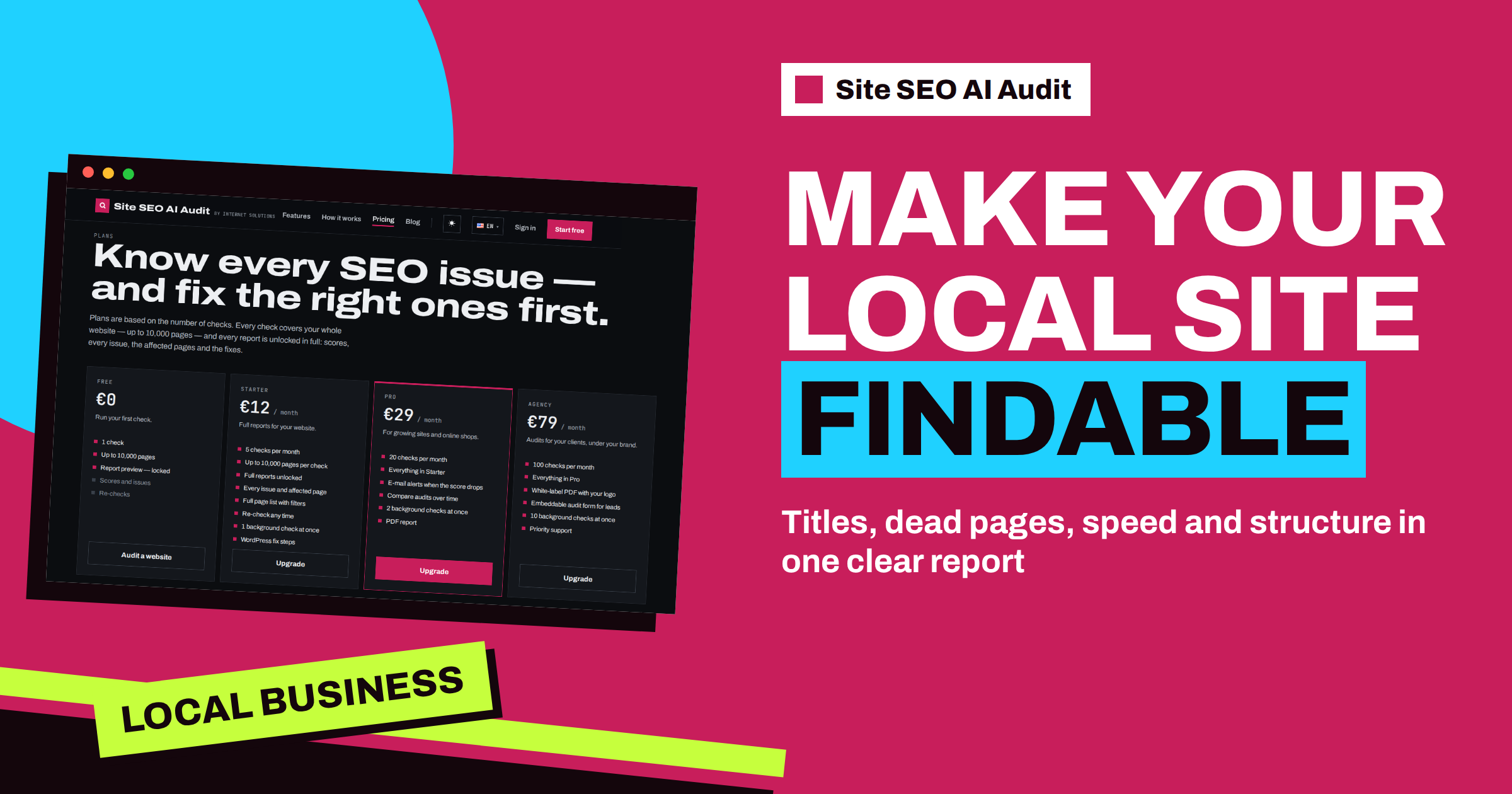
A more detailed version of this routine is in the article on a simple SEO audit routine for small business websites. The plans on the pricing page let you repeat it: Starter has five checks a month for €12, Pro twenty, and Agency a hundred for people who look after several clients.
What to ignore, at least at first. A report can list findings that matter little to a small local site, and it helps to know which ones to leave for later. If your website is in one language, the Languages area does not apply and is left out of the score, so there is nothing to do there. If you have a short list of pages and a few of them are deliberately private, such as a thank-you page, a noindex finding for those is expected. Notices such as a missing llms.txt are the lowest priority, worth one point each. Spend your first evening on the critical findings and the warnings with the highest impact, and come back to the small items when the main problems are gone.
It also helps to ask what a customer would notice. A customer will notice a page that does not open, a phone number that differs between pages and a site that takes ten seconds to load. They will not notice a missing alt text on a decorative image. Let the customer’s experience set your order of work, and let the audit confirm that nothing important is hidden from search engines. That is the balance between serving people and serving machines, and local business sites usually do best when they favour people first.
Related reading
- A Simple SEO Audit Routine for Small Business Websites
- LocalBusiness Schema: Types, Fields and Common Mistakes
- AI Search for Local Businesses: What to Fix First
The bottom line
A local business does not need a complicated SEO plan. Run a whole-site check, fix the top items in the list, make titles say who, what and where, keep the facts consistent and make the site fast on phones, then check again every month.
FAQ
Is the audit useful for a site with only ten pages?
Yes. Small sites often have a few large problems, such as missing titles or a blocked sitemap, and the audit finds them in minutes.
Do I need technical knowledge to use the report?
No. Each issue card explains why it matters and how to fix it, and on WordPress sites it shows the exact steps in wp-admin and your SEO plugin.
How often should a local business run a check?
Monthly is a good rhythm, plus a check after you change the site, switch a plugin or move to a new host.
Does the audit look at my Google Business Profile?
No. It audits your website: pages, links, speed, structured data, languages and AI visibility. Keep your business profile consistent with your site yourself.
Which plan should I choose?
For one small site, Starter, with full reports and five checks a month, is usually enough. A free account runs one check and shows the report locked.