ENEnglish
 LTLietuviškai
 DEDeutsch
 FRFrançais
 RUРусский
 ESEspañol
 PLPolski
 ITItaliano
 UKУкраїнська
 CSČeština
 PTPortuguês
 JA日本語
JA日本語 LVLatviešu valoda
 ETEesti
 HUMagyar
 IDBahasa Indonesia
 TRTürkçe
 HIहिन्दी
 ELΕλληνικά
 ARالعربية
 THไทย
THไทย VITiếng Việt
 RORomână
 MSBahasa Melayu
 BNবাংলা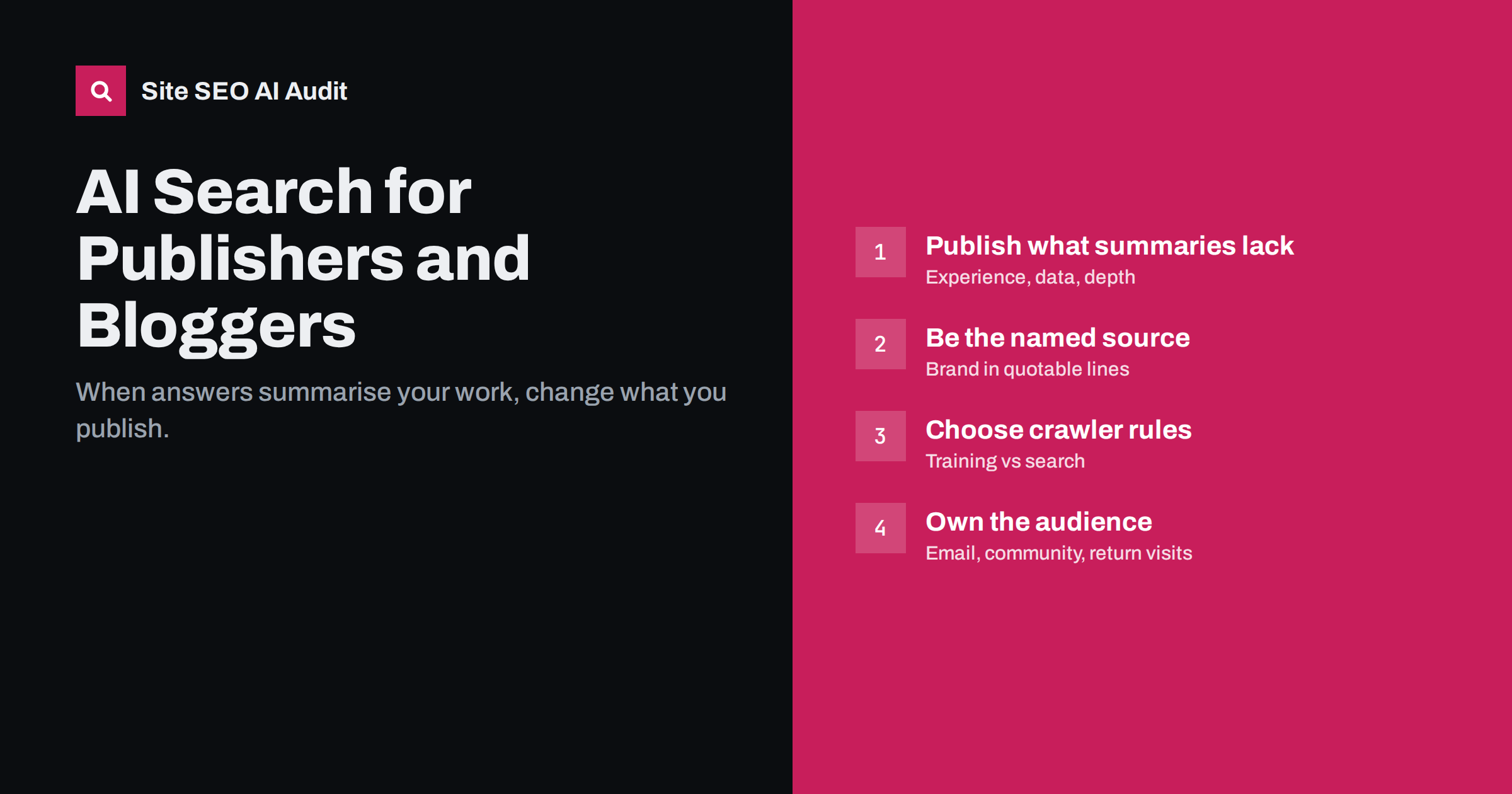
Short answer: For publishers and bloggers, AI search reduces clicks for simple informational questions but still sends readers to sources that offer something a summary cannot: first-hand experience, original data, depth, personality and tools. The practical strategy is to shift effort towards that kind of content, make sure your brand is named in the passages AI answers quote, decide deliberately which AI crawlers to allow, build direct relationships with readers through email and community, and measure impressions, citations and loyalty as well as sessions.
What AI search changes for content sites
Content sites have always depended on search traffic, and much of that traffic came from informational questions: how to do something, what something means, which option is better. AI Overviews, AI Mode and chat assistants now answer many of these questions directly, drawing on the same kind of content that publishers and bloggers create. Independent studies have generally found lower click-through rates on queries where AI Overviews appear, especially for simple questions.
At the same time, AI answers cite sources, and readers who want more than a summary still click. The effect is uneven: generic articles that repeat widely known information lose the most, while distinctive content often holds up well. For many sites, the change is less about total collapse and more about which content is worth producing.
It also changes what a successful article looks like. A post that is quoted in many AI answers but receives modest traffic may still be building your reputation, while a post with steady traffic but no distinctive content may be vulnerable. Both deserve attention, but for different reasons.
Content that still earns visits
The question for every planned article is simple: what will a reader get here that an AI summary cannot give them? Content types with strong answers include:
- First-hand experience: tested products, visited places, completed projects, lessons from doing the work, with photos and specifics.
- Original data: surveys, measurements, price tracking, analysis of your own records.
- Depth and nuance: long-form guides for complex decisions, where readers want to follow the reasoning.
- Personality and perspective: opinion, analysis and voice that readers seek out for who is writing.
- Tools and resources: calculators, templates, checklists and downloadable material.
- Timely reporting: news and updates that summaries rely on but cannot originate.
- Community: comments, forums and discussions that give readers a reason to return.
Content types that struggle most are short definitions, simple how-tos and rewritten versions of what other sites already say.
If you publish in a crowded niche, look for the angle only you can cover: a region, a specific audience, a type of test, a professional background. Specialisation makes it more likely that your pages are the best available source for at least some questions, which is where citations and loyal readers come from.
Being the named source
When an answer uses your work, you want your name in it. Some practical habits help:
- State key findings with attribution in the text, for example “In our test of twelve robot vacuums, the quietest model measured…” with your publication named nearby.
- Coin clear names for recurring features, rankings or methods, and use them consistently.
- Put the conclusion early and make it specific, so a quoted passage carries your verdict.
- Show authors and dates prominently, with author pages that explain expertise.
- Keep facts accurate and updated, because corrected, current pages are safer sources.
Think about the reader who clicks through from a citation. They arrive already knowing the summary, so the page should reward them immediately with the detail, evidence or perspective that the summary left out, not with a long introduction that repeats it.
Consistency across articles builds recognition over time, both for readers and for the systems that summarise your work.
Deciding on AI crawlers
Publishers have more reason than most sites to think carefully about AI crawlers, because their content is their product. The main options are:
| Policy | Effect | Suits |
|---|---|---|
| Allow all | Maximum visibility in AI answers and model knowledge | Blogs that monetise through services, products or brand |
| Allow search, block training | Citable in AI search, excluded from future training by compliant operators | Most publishers weighing visibility against reuse |
| Block most AI use | Limited presence in AI answers | Premium publishers, licensed content, paid archives |
Whatever you choose, implement it carefully in robots.txt and check your CDN, because blanket AI blocking tools often catch search crawlers too. Remember that Google’s AI Overviews follow Search rules, so they are controlled through snippet directives rather than a separate AI crawler.
Review the choice regularly. Licensing markets, legal rules and the traffic value of AI citations are all changing, and a policy that suits you today may need to change next year. Keep a dated record of each version of your robots.txt so that you can show what you allowed and when.
Building an audience you own
Search, whether classic or AI, is a channel you do not control. The more of your audience depends on it, the more exposed you are to its changes. Publishers and bloggers who weather these shifts best tend to have direct relationships with readers:
- Email newsletters that readers value for their own sake, not only as traffic drivers.
- RSS feeds that let loyal readers follow new posts in their preferred reader.
- Communities such as comment sections, forums or member groups.
- Memberships or subscriptions for readers who want more.
- A recognisable brand that readers search for directly.
AI answers can even help here: a reader who sees your publication named repeatedly may look you up and subscribe.
Make subscribing easy at the moments readers are most engaged: at the end of a useful article, next to a downloadable resource or after a helpful answer in the comments.
Updating your content plan
A practical way to adapt is to review your existing articles and future plans against three questions: does this piece offer something distinctive, would an AI summary fully satisfy the reader, and does the piece connect to how the site earns money? Improve articles that score well on the first and third questions, consolidate or retire thin generic pieces, and redirect effort from low-value definitions towards experience, data and depth.
Plan fewer, better pieces. One well-researched article with original findings often does more for a site today than several quick posts on topics that every competitor already covers.
Technical basics content sites often miss
Even the best writing cannot be cited if machines cannot read it. Content sites tend to share a set of technical problems that quietly limit their visibility in both classic and AI search:
- Thin archive pages: hundreds of tag and date archives with no unique content, which dilute the site.
- Missing or hidden dates: themes that hide publication dates, removing a useful freshness signal.
- Content inside scripts: tables, comparisons or embeds that load only with JavaScript.
- Heavy ads and pop-ups: slow pages and interstitials that frustrate readers arriving from AI citations.
- Broken internal links after years of restructuring and deleted posts.
- Duplicate titles and descriptions from templated or syndicated content.
- Accidental AI blocking by security plugins or CDN defaults.
Fixing these rarely requires new content, and it improves the performance of everything you have already published.
Measuring what matters now
- Impressions and clicks by query type in Search Console, separating informational from other queries.
- AI referral traffic from assistants, with landing pages and engagement.
- Citations and mentions in a fixed set of questions checked monthly.
- Branded search and direct traffic as signs of growing recognition.
- Subscribers, returning visitors and revenue per visit as signs of a healthy audience.
Compare these figures quarter by quarter rather than week by week, and note major changes in search features or your own publishing so you can interpret shifts correctly.
How Site SEO AI Audit helps
Content sites accumulate technical debt: thin tag archives, duplicate titles, broken internal links, outdated pages and slow templates. Site SEO AI Audit crawls the whole site, flags these issues and ranks fixes by impact, while its AI visibility area checks AI crawler rules, JavaScript-dependent content and the structure and dates that AI answers quote. Plans with weekly audits are on the pricing page.
Related reading
- Original Data and First-Hand Experience: What AI Answers Cite
- Zero-Click Search: How to Get Value When Nobody Clicks
- Should You Let AI Train on Your Content? A Decision Guide
- How to Optimize a Blog Post for SEO, Step by Step
The bottom line
AI search rewards publishers and bloggers who offer what summaries cannot. Focus on experience, original data, depth and voice, make sure your name travels with the passages AI answers quote, choose crawler rules deliberately, build an audience you own and measure more than sessions. Generic content loses ground; distinctive content keeps its value.
FAQ
Is blogging still worth it with AI search?
Yes, for content that offers experience, data, depth or a distinctive voice. Generic informational posts are the most affected, so the case for them is weaker than before.
Should publishers block AI crawlers?
Many allow AI search crawlers for citations and block training crawlers. The right choice depends on how the content earns money and whether licensing is realistic.
How can a blog get cited in AI answers?
Make sure AI search crawlers can reach the site, put content in HTML, lead with clear answers, include specific and original information, and show authors and dates.
What should bloggers measure instead of traffic alone?
Impressions by query type, AI referrals, citations in AI answers, branded search, subscribers and returning visitors, alongside revenue per visit.
Should I delete old generic posts?
Review them first. Improve posts that can offer something distinctive, merge overlapping ones and redirect or remove thin posts that no longer serve readers.