ENEnglish
 LTLietuviškai
 DEDeutsch
 FRFrançais
 RUРусский
 ESEspañol
 PLPolski
 ITItaliano
 UKУкраїнська
 CSČeština
 PTPortuguês
 JA日本語
 LVLatviešu valoda
 ETEesti
 HUMagyar
 IDBahasa Indonesia
 TRTürkçe
 HIहिन्दी
 ELΕλληνικά
 ARالعربية
 THไทย
 VITiếng Việt
 RORomână
 MSBahasa Melayu
 BNবাংলা
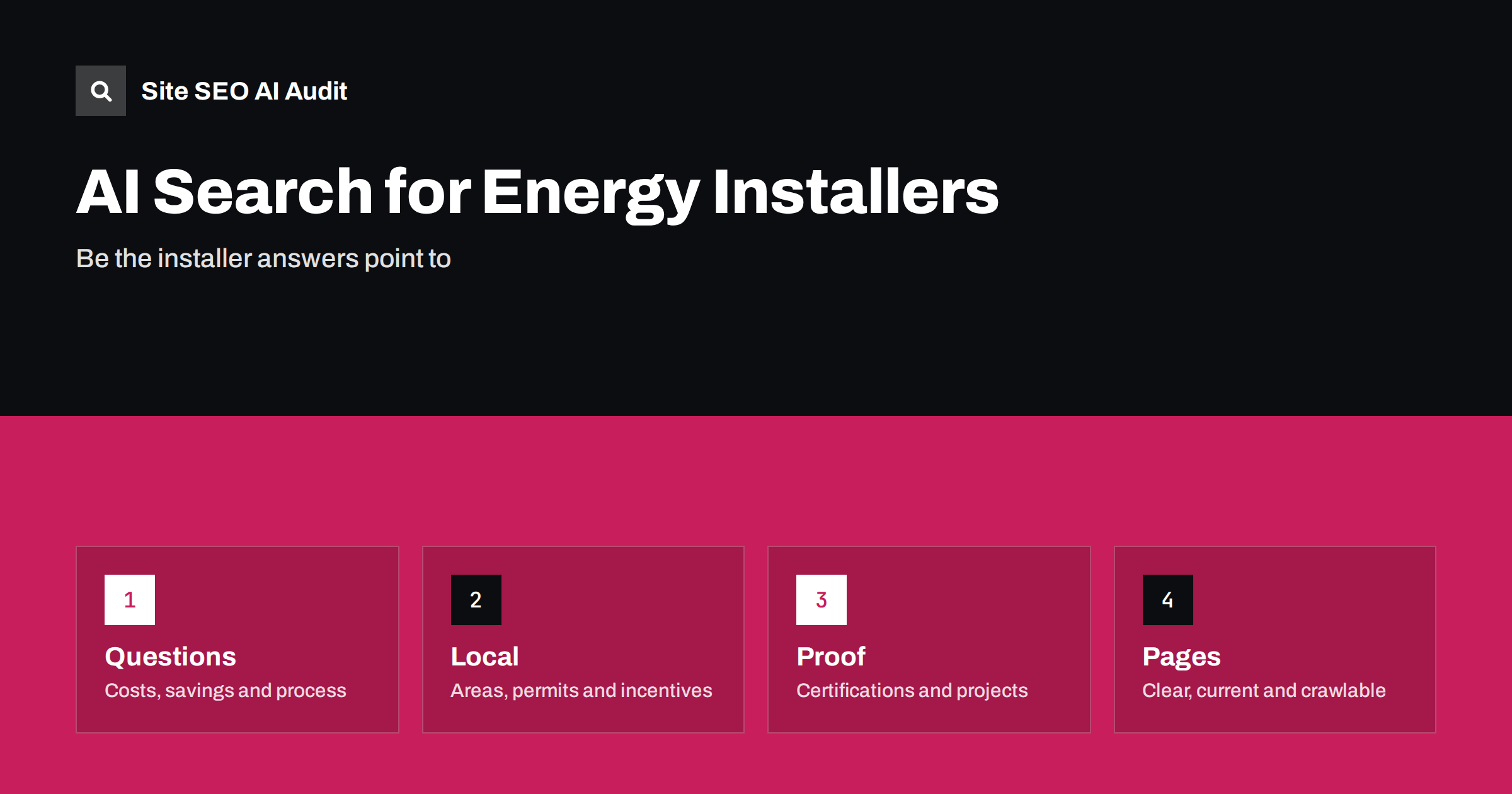
Short answer: Solar, heat pump and energy efficiency installers get recommended by AI assistants when their websites explain the buying journey clearly and locally: what a system involves, what influences cost, how long installation takes, which permits and incentives apply in each area, who does the work and what customers say afterwards. Publish accurate, dated pages for each service and each service area, show certifications and real projects, keep company details consistent across profiles and allow the crawlers you want to read the site.
Energy upgrades are big, infrequent purchases, so buyers research for weeks. They ask assistants questions such as whether solar panels suit their roof, how much a heat pump costs to run, which incentives exist in their region and how to choose an installer. The answers often include a short list of local companies and a summary of what each does. If your site is vague about services and areas, or if the facts are outdated, you may be left out or described wrongly. This guide shows what to publish and how to keep it trustworthy. For the general mechanics, see how AI search engines work.
Understand the buyer journey
Energy buyers move through stages, and each stage has its own questions. At the start they ask whether the technology fits their home and what it could save. Next they compare options, such as panels with or without a battery, air-source and ground-source heat pumps or different insulation measures. Then they look for money information: costs, financing, incentives and payback time. Finally they choose an installer and ask about warranties, certifications, timelines and reviews. Map your pages to these stages, and make sure that each stage has at least one page that gives a direct, honest answer. Pages written only to ask for a quote leave the early stages to others.
Write clear pages for each service
Give every service its own page: residential solar, commercial solar, battery storage, heat pumps, EV charger installation, insulation, maintenance and monitoring. Open each page with a short answer, then cover who the service suits, what the installation involves from survey to commissioning, how long each stage typically takes, what the customer must prepare, which warranties apply and what ongoing care is needed. Include a section on limits, such as roof conditions, shading, electrical capacity or building types where the service is not a good fit. Straight talk builds trust and prevents poor leads. The layout is explained in service page SEO.
Handle costs and savings honestly
Price and savings are the questions people ask most, and the area where careless claims do the most harm. Explain what determines cost: system size, equipment type, roof or site complexity, electrical work, scaffolding, grid connection, permits and the chosen warranty. Give realistic ranges only when you can stand behind them, label them as examples and date them. Describe how savings depend on usage, tariffs, orientation, shading and how the system is operated, and avoid promises of guaranteed returns or fixed payback periods. Provide a simple worked example with clearly stated assumptions rather than a headline number without context. If you offer a calculator, make sure that the assumptions are visible and that the result is also written in text, so that it can be read and quoted. See free tools and calculators for SEO for ways to make them crawlable.
Cover incentives, permits and rules locally
Energy incentives, grid connection rules, permits and building requirements differ by country, region and sometimes by municipality, and they change often. This is an opportunity, because general sources cannot cover every locality. Create pages for each area you serve that explain, in plain language, which permits are usually needed, which standards the installation follows, how grid connection works and where customers can check current incentive programmes. Link to the official sources, add the date when you last reviewed the page and update it when rules change. Outdated incentive information is worse than none, because it creates wrong expectations and complaints. Use unique, useful content for each area, not copied pages with only the place name changed, a mistake covered in location pages and SEO.
Show certifications, projects and people
Customers let installers into their homes and trust them with large sums, so evidence matters. Display the certifications and registrations your company and your installers hold, in text, with the name of the issuing body and a link to it where one exists. Show insurance and warranty terms, the brands you install and how you handle after-sales service. Publish real project pages: location in general terms, system type and size, the customer’s goals, what you did and the result, with photographs taken by your team. Ask customers for permission before naming them. Introduce the team with roles and experience. The structure of project pages is described in case study pages and SEO, and the trust signals in E-E-A-T and AI search.
Keep business details consistent
Assistants combine your website with business listings, maps, directories, association pages and reviews. Make sure that your company name, address, phone number, service areas, opening hours and service list are identical everywhere. Add organisation and local business markup to the site, with your logo, contact points, area served and profiles, as explained in LocalBusiness schema. Claim and complete the profiles that customers use, respond to reviews calmly and keep the answers accurate. Encourage satisfied customers to leave reviews, but never offer payment for positive ones. The wider approach is in local business and AI search and reviews and reputation.
Publish guides before and after the sale
Many buyers ask comparison questions that installers can answer better than anonymous sites: panels with or without storage, heat pump or gas boiler, roof or ground mounting, buying or leasing, what to expect during the survey. Write balanced guides that explain when each option fits, with simple tables and honest trade-offs, as discussed in comparison pages and AI search. Add FAQ blocks to each page and answer the questions that customers ask on the phone. Include a short list of what the buyer should have ready for an accurate quote, such as recent electricity bills, roof photographs and the age of the building. These pages attract readers early and show your approach before they contact you.
Many questions arrive after installation, and answering them builds a reputation that assistants and buyers notice. Publish help pages that explain how to read a monitoring app, what normal output looks like in winter, how to clean or inspect equipment safely, how to tell when a fault needs a visit and how warranty claims work. Describe maintenance plans in plain terms, including what is covered and what is not. Add short guides for common situations, such as a change of electricity tariff, a new battery or an electric car. Such pages are practical, they attract existing customers and neighbours who are considering the same upgrade and they show that your company stands behind its work. Keep the instructions careful, tell readers when to call a qualified professional and avoid advice that could put anyone at risk. The approach is similar to help centre pages that AI answers can use.
Make the site easy to crawl
Check that the pages can be read. Keep the main content in the HTML rather than only in scripts, test the quote form and calculators without relying on them for essential information and make sure that images carry descriptive file names and alternative text. Review robots.txt and firewall rules for rules that block crawlers you want, and decide your position on training opt-outs separately, using AI crawlers and robots.txt. Keep pages fast on mobile, because many visitors browse on phones, often on slower connections. Add a sitemap that lists your service, area and project pages and update it whenever you add or remove them.
Track what answers say
Every month, ask a fixed set of questions as a customer in your area would: best installer for a given service, cost of a typical system, incentives in your region and reviews of your company. Record whether you appear, how you are described, which pages are cited and which competitors are named. Correct inaccuracies at the source, on your site first and then on external profiles. Compare the log over time, and refresh dated pages every quarter. Use the AI search visibility checklist as a routine.
Site SEO AI Audit crawls your site, checks status codes, titles, structured data, images, orphan pages and AI crawler rules, and lists the fixes ranked by the points they add. That helps you confirm that service and area pages are reachable and consistent. The first audit of up to 200 pages is free; larger sites can see the pricing page.
Related reading
- AI Search for Home Services
- AI Search for Construction and Architects
- Multi-Country Local SEO
- Content Dates and Freshness
The bottom line
Energy buyers want honest, local and current information before they trust an installer. Explain each service and its limits, be careful with costs and savings, cover local rules and incentives with dated pages, show certifications and real projects, keep business details consistent and check regularly what assistants say about you.
FAQ
Should I publish prices for solar or heat pump installations?
Publish what you can stand behind. Explain what drives cost and give dated example ranges with stated assumptions, so that readers and answer engines get useful numbers without false precision.
How do I keep incentive information accurate?
Link to official sources, state the date of your last review and schedule a regular check. Remove or update any page when rules change.
Do I need a separate page for each town I serve?
Only if you can add real local value, such as permits, rules, projects and contacts for that area. Near-identical pages with a changed place name are weak and may be treated as thin content.
Do customer reviews help with AI recommendations?
Yes. Reviews on well-known platforms and on your own site help assistants and buyers judge your reputation, as long as they are genuine and answered professionally.
What is the first thing to fix on an installer website?
Make the service, area and contact information clear and consistent, then ensure the pages can be crawled. After that, add helpful guides that answer the questions customers ask.