ENEnglish
 LTLietuviškai
 DEDeutsch
 FRFrançais
 RUРусский
 ESEspañol
 PLPolski
 ITItaliano
 UKУкраїнська
 CSČeština
 PTPortuguês
 JA日本語
 LVLatviešu valoda
 ETEesti
 HUMagyar
 IDBahasa Indonesia
 TRTürkçe
 HIहिन्दी
 ELΕλληνικά
 ARالعربية
 THไทย
 VITiếng Việt
 RORomână
 MSBahasa Melayu
 BNবাংলা
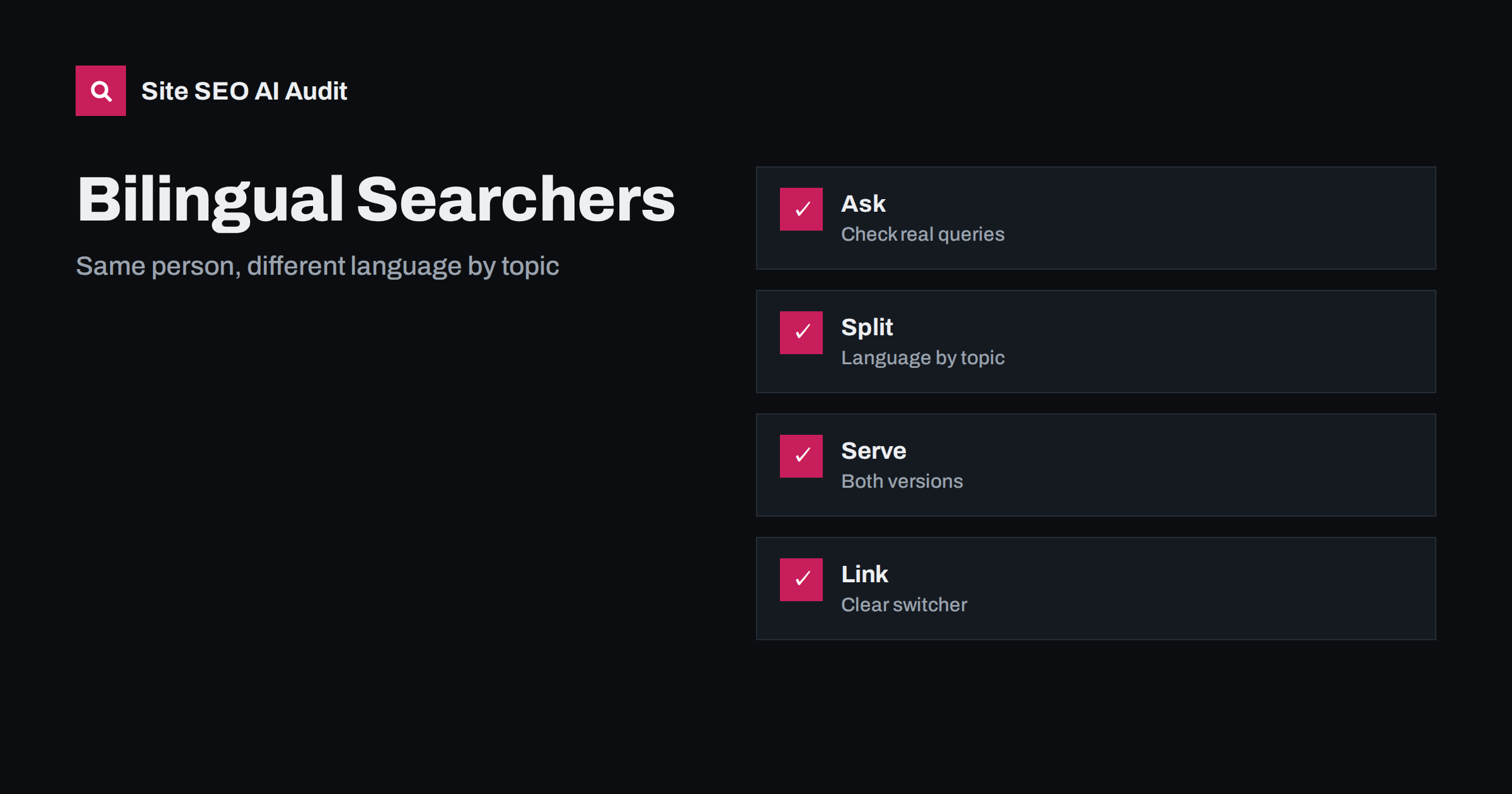
Short answer: Bilingual people do not always search in their first language. They often choose the language by topic: work and technology in one, family, shopping and local services in another. To serve them, look at real queries in Search Console, compare impressions by country and language, test keywords in both languages and publish the versions that match each topic. Link the versions with hreflang and a visible language switcher, and do not force a choice based on location alone.
Most international SEO advice assumes that a person has one language. In reality, a large part of the world’s population uses two or more languages every day. A software engineer in a country with a local language may search for technical topics in English and for tax or health questions in the national language. A family that speaks a minority language at home may use the majority language for school and government. If you only plan for one language per person, you will misjudge demand and may offer the wrong version. This guide explains how to learn what your audience actually does and how to respond. For the basics of translating and adapting, see the guide to translation and localisation.
How bilingual people choose a language
The choice depends on several factors. Topic is the strongest: terms that were learned in one language, such as professional vocabulary, are searched in that language. Device and interface settings matter too, since a phone set to one language tends to produce queries and results in that language. Trust and comfort also play a part: people may prefer their first language for important decisions such as health, finance or legal matters, even if they use another language for hobbies.
Another factor is the expected quality of results. If people know that results in one language are richer for a topic, they search in it. For a local business, the language of the place is often used for the name and address, while the language of comfort is used for questions. This is why the same person can bring two kinds of queries to your site.
Find out what your audience does
Start with data you already have. In Search Console, look at queries by country and compare the language of the queries with the language of the page that received them. Pages in one language that receive many queries in another language are a signal that part of the audience prefers the other language. Check the languages of the browser and interface in your analytics for visitors from each country, and compare them with the version they landed on and how long they stayed.
Next, look at behaviour on the site. Do visitors switch the language after landing? Do they leave quickly from one version but stay on another? A high rate of switching after arrival means that the first impression was wrong for many people, which is useful to know. The methods are described in the guide to Search Console for international sites.
Research keywords in both languages
Do not assume that a translation of a keyword is a keyword. Some terms have no common equivalent and people use the original word, even inside sentences in another language. Others have several natural forms, including mixed phrases that combine both languages. Collect real queries, check how people write them and see which version results pages show. The approach is in the guide to multilingual keyword research.
Pay attention to mixed-language queries. A search that contains words from two languages is a sign of a bilingual audience, and results may combine both. You do not need a page for every mix, but you should know which terms are used so that titles and headings reflect them.
Decide which versions to publish
You do not have to publish everything in both languages. Prioritise by topic and demand. Pages where your audience clearly searches in a language, and where competition and results are good, deserve a real version in that language. Topics where the audience uses one language almost everywhere can stay in that language for now. Use the logic of the guide on which posts to translate first.
Keep quality high. Machine output without review can produce odd phrases that bilingual readers notice quickly. If you publish both versions of a page, the content should be equivalent, not a loose copy, and the details such as prices, opening hours and legal information must match.
Connect the versions properly
Use separate addresses for each language, and link the equivalents with hreflang annotations, as explained in the guide to hreflang. Add an x-default for a language selection page or your main version, as described in the guide to x-default. Make the language switcher visible on every page and keep it pointed at the equivalent page, not the home page, as covered in the guide to language switchers.
Avoid automatic redirects that choose a language by location or browser and trap people, because bilingual visitors often need the other version. A suggestion banner that the visitor can dismiss is safer, and crawlers must always be able to reach every version, as explained in the guide to language redirects.
Mixed pages and shared elements
Some sites try to serve bilingual people with one page that contains both languages. This usually confuses search engines about the language of the page and makes the experience harder to read. Prefer separate pages. If you must show a few words in another language, for example a brand name, a quote or a menu item, mark it with the right language attribute and keep the main text in one language. See the guide to mixed-language pages and the guide to the lang attribute.
Shared elements, such as the navigation, forms and error messages, should follow the language of the page. A page in one language with a menu in another feels unfinished and may weaken trust.
Countries where two languages are official
In countries with two or more official languages, both audiences are large and often expect the same level of service. You will need a clear structure, equal quality and careful signals about both language and country. The patterns are discussed in the guide to multilingual countries and the guide to bilingual SEO in Canada. The same approach works for smaller communities that use a minority language alongside the majority language.
Also consider diaspora and expatriate groups, who may search in their home language while living abroad. Their needs are covered in the guide to diaspora and expat audiences.
Measure and adjust
After you publish new versions, follow their impressions, clicks and conversions by language. Compare the share of traffic that arrives on the right version for the visitor’s language, and watch the switching rate. If many people still switch away from a version, review the title, the first paragraph and the way the page is found. Adjust the plan every quarter and keep the list of topics per language up to date.
Content and tone across languages
Bilingual readers compare versions more often than other visitors, so differences are noticed. If one version has a friendly, detailed tone and the other is stiff and short, people draw conclusions about the company. Agree a style guide for each language, including how to address the reader, how to write dates, numbers and prices and which terms to keep untranslated. Ask a native speaker who is also comfortable in the other language to review key pages.
Keep updates in sync. When a price, a policy or a process changes, change every version on the same day, and mark the date of the last update where it matters. Out-of-date information in the less-used version is a common source of complaints and confusion, and it damages trust among exactly the people who read both.
Finally, think about support. If a visitor writes in one language, answer in the same one, and make sure that forms and confirmation messages are available in all versions you offer. A site that looks bilingual but only responds in one language creates disappointment, which is worse than not offering the second version at all.
Here is a short example. A clinic in a bilingual region had a website in the national language only. Search Console showed many queries in the second language for symptoms and treatments, but almost none for the clinic name or booking. The clinic translated the main treatment pages and the booking page, kept the address and opening hours identical and linked the versions with hreflang. Bookings from the second language group increased, while the generic national queries remained stable.
A second example is a software company whose users searched for documentation in English even in countries with other main languages. The company decided to keep documentation in English but translate the pricing, legal and onboarding pages. This matched the way its audience really behaved.
Site SEO AI Audit crawls your website and checks hreflang return links, broken language versions, x-default and lang attributes, as well as titles, descriptions and broken links, which helps you keep several language versions consistent. It does not research keywords or translate text. The first audit of up to 200 pages is free, and larger sites can see the pricing page.
Related reading
- International SEO for Small Businesses
- Global English Content and SEO
- How Google Detects the Language of a Page
The bottom line
Check which language people really use for each topic, publish proper versions where demand exists and let visitors choose freely between them.
FAQ
Do bilingual people search in one language only?
No. Many choose the language by topic, device and how important the decision is, so one person may use two languages.
How can I see which language my visitors prefer?
Compare Search Console queries with the page language, check browser languages in analytics and watch how often visitors switch versions.
Should I redirect visitors by browser language?
It is safer to suggest a version with a banner than to force a redirect, which can block both visitors and crawlers.
Can I put two languages on one page?
It is not recommended, because it confuses language detection and readers. Use separate pages and link them with hreflang.
Do I need to translate everything?
No. Prioritise topics and pages where your audience clearly searches in each language and where you can deliver good quality.