ENEnglish
 LTLietuviškai
 DEDeutsch
 FRFrançais
 RUРусский
 ESEspañol
 PLPolski
 ITItaliano
 UKУкраїнська
 CSČeština
 PTPortuguês
 JA日本語
JA日本語 LVLatviešu valoda
 ETEesti
 HUMagyar
 IDBahasa Indonesia
 TRTürkçe
 HIहिन्दी
 ELΕλληνικά
 ARالعربية
 THไทย
THไทย VITiếng Việt
 RORomână
 MSBahasa Melayu
 BNবাংলা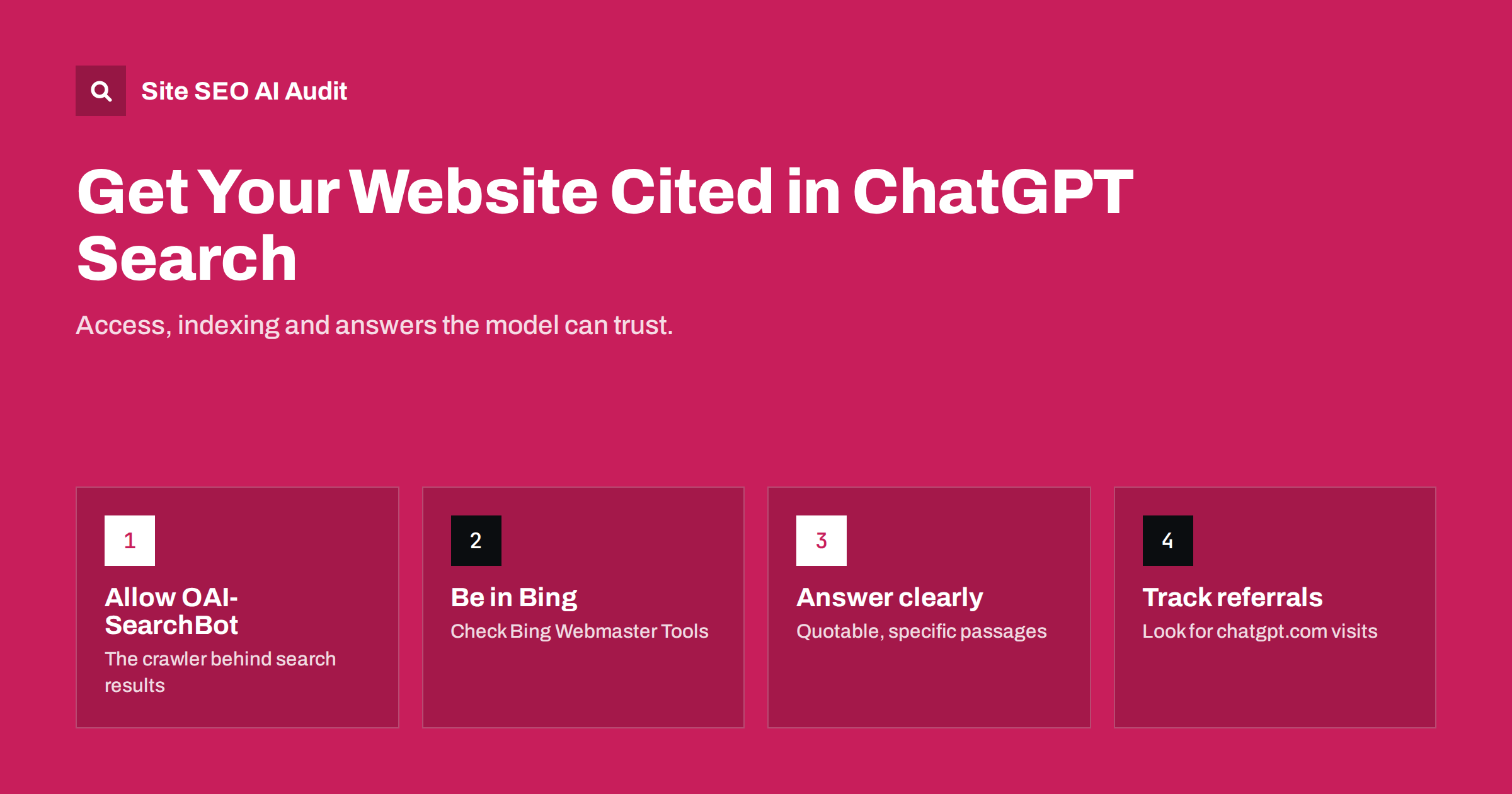
Short answer: To be cited in ChatGPT search, your pages must be reachable by OpenAI’s search crawler, OAI-SearchBot, and discoverable through the web search sources ChatGPT uses. Beyond access, the same qualities that help in Google apply: indexable pages, clear and specific answers, visible authorship and dates, and a brand that is described consistently across the web. There is no way to pay for organic citations, and results vary between users and conversations.
How ChatGPT search finds sources
ChatGPT can answer from what the model learned in training, or it can search the web and answer with citations. Search is triggered automatically when a question needs current or specific information, or manually when the user chooses to search. When it searches, ChatGPT sends one or more queries to its search systems, retrieves pages, reads relevant passages and writes an answer with links to the sources.
OpenAI has said that ChatGPT search uses a combination of third-party search providers and its own crawling. Its own crawler for search is called OAI-SearchBot. Bing has long been one of the providers powering ChatGPT’s web results, so Bing indexing is a sensible proxy for eligibility, although OpenAI does not publish the full list of sources or how they are weighted.
OpenAI documents its crawlers and their roles in its overview of OpenAI crawlers. That page is the authoritative reference if names or behaviour change.
Step 1: make sure OpenAI can reach your pages
OpenAI runs three relevant user agents, and they are controlled separately:
- OAI-SearchBot crawls pages for ChatGPT’s search features. If you block it, OpenAI says your pages will not be shown in search answers, though they may still appear as plain navigational links.
- GPTBot collects content that may be used to train models. Blocking it does not remove you from ChatGPT search.
- ChatGPT-User fetches pages when a user or a custom GPT asks ChatGPT to visit a specific URL.
Check three places. First, your robots.txt: look for any group that names OAI-SearchBot, and remember that a bot with its own group ignores the wildcard group. Second, your CDN or firewall: bot-management settings can return 403 errors to AI crawlers even when robots.txt allows them. Third, your server logs: confirm that OAI-SearchBot requests actually receive status 200. OpenAI publishes IP ranges for its crawlers so you can verify genuine requests.
Step 2: get indexed where ChatGPT searches
Many sites focus entirely on Google and never look at Bing. That is a risk for AI search, because several assistants rely on Bing’s index in some form.
- Verify your site in Bing Webmaster Tools. You can import settings from Google Search Console in a few minutes.
- Submit your XML sitemap and check that it is processed without errors.
- Review indexing reports for pages that are excluded, blocked or returning errors.
- Consider IndexNow, a protocol supported by Bing and some other engines that lets you notify them when URLs change. Many CMS plugins and CDNs support it.
- Search your brand and key topics in Bing to see which of your pages appear and how they are described.
If important pages are not indexed in Bing, fix that before anything else. It is a concrete, measurable step, unlike most AI visibility advice.
Step 3: make pages easy to retrieve and quote
ChatGPT reads passages from the pages it retrieves. Pages that answer clearly give it more to work with:
- Put the core content in the HTML. Many AI crawlers do not run JavaScript. Text, prices and specifications loaded by scripts may be invisible.
- Open with a direct answer and follow with detail, steps and exceptions.
- Use headings that match how people ask. Conversational queries in ChatGPT are often longer and more specific than typed search queries.
- Include specific facts: what you offer, for whom, where, how long, what it requires. Link to pricing and policy pages rather than burying details.
- Show authors and dates. For topics that change, a visible update date helps readers and systems judge freshness.
Step 4: strengthen how the web describes your brand
For questions such as “which accounting software suits a small agency” or “best bakery in Vilnius for wedding cakes”, ChatGPT tends to draw on sources that compare and review options: comparison articles, directories, review platforms, forums and news coverage. Your own site is one input among many.
- Keep your business name, description, location and contact details identical across your site, social profiles and directories.
- Earn genuine reviews on the platforms your customers use.
- Make sure your own site has a clear page for each product or service with the facts a comparison would need.
- Add Organization structured data with
sameAslinks to your official profiles. - Correct outdated information about your business on third-party sites when you find it.
This is slow work, but it is also the kind that pays off across every assistant and search engine at once.
Step 5: track the traffic ChatGPT sends
ChatGPT typically adds utm_source=chatgpt.com to links in search answers, and visits also often arrive with a referrer from chatgpt.com. That makes it one of the easier AI sources to measure.
| Signal | Where to find it | What it tells you |
|---|---|---|
| utm_source=chatgpt.com | Analytics campaign or source reports | Clicks from links in ChatGPT answers |
| Referrer chatgpt.com | Analytics referral reports | Visits where the referrer was passed |
| OAI-SearchBot requests | Server or CDN logs | Whether and how often pages are crawled for search |
| ChatGPT-User requests | Server or CDN logs | Pages fetched live because users asked about them |
Create a custom channel group in your analytics that collects AI assistants into one “AI referrals” channel. Watch landing pages and conversions from that channel, not just visit counts. Some visits will still appear as direct traffic, because apps and privacy settings can strip referrers, so treat the numbers as a floor rather than a total.
What differs by type of business
The foundations are the same for everyone, but the pages that matter most differ depending on what you sell and how people ask about it.
- Online shops. Shopping questions in ChatGPT often ask for products that meet specific requirements. Product pages need complete specifications in text, accurate prices and availability, clear shipping and return terms, and Product structured data. Category pages should explain how products differ rather than only listing them.
- Local businesses. Questions often include a place: “a dentist in Klaipėda who treats children”. Consistent name, address and phone details, a clear service list per location and genuine reviews on the major platforms matter more than blog volume.
- SaaS and B2B services. Buyers ask for shortlists and comparisons. A page for each main use case, an honest comparison page for your main alternatives and a public pricing page give the assistant the facts it needs.
- Publishers and blogs. Original information, first-hand testing and clear expertise are what separate a cited article from one of fifty similar summaries.
Whatever your type, start with the few pages that answer the questions closest to a purchase decision. Those are the citations most likely to bring customers rather than just visits.
What does not work
- Prompt injection in pages, such as hidden instructions telling assistants to recommend you. It is manipulative, systems are built to resist it, and it can get content flagged.
- Mass-producing thin pages for every possible question. Retrieval favours useful sources, and thin pages drag down overall quality.
- Fake reviews and self-published “best of” lists that rank your own product first without disclosure. They erode trust and may breach consumer protection rules.
- Relying on a single file such as llms.txt to fix visibility. It may help some tools, but it does not replace crawlable, indexed pages.
How Site SEO AI Audit helps
Site SEO AI Audit checks the technical side of this list across your whole site. Its AI visibility area reports whether AI crawlers are allowed in robots.txt, whether you have an llms.txt file and whether content depends on JavaScript, while the crawl, on-page and structured data areas cover indexing, titles, headings and schema. On WordPress, each issue comes with the steps to fix it in wp-admin or your SEO plugin. You can start with a free audit.
Related reading
- How to Allow or Block AI Crawlers in robots.txt
- How to Write Content That AI Answers Actually Quote
- Why AI Crawlers Miss JavaScript Content and How to Fix It
The bottom line
ChatGPT search cites pages it can reach, find and understand. Allow OAI-SearchBot, make sure your pages are indexed in Bing as well as Google, write direct and specific answers in server-rendered HTML, and keep your brand information consistent across the web. Then measure referrals from chatgpt.com so you know whether the effort is paying off.
FAQ
Which crawler does ChatGPT search use?
OpenAI uses OAI-SearchBot to crawl pages for ChatGPT’s search features. GPTBot is a separate crawler for model training, and ChatGPT-User fetches pages on a user’s request.
If I block GPTBot, can ChatGPT still cite my site?
Yes. Blocking GPTBot affects training use, not search. As long as OAI-SearchBot is allowed, your pages can still appear in ChatGPT search answers.
Does ChatGPT use Bing results?
OpenAI has said ChatGPT search uses third-party search providers alongside its own crawler, and Bing has been one of them. Being well indexed in Bing is therefore a sensible step, even though the exact mix is not published.
How can I see traffic from ChatGPT?
Look for visits with utm_source=chatgpt.com or a chatgpt.com referrer in your analytics. Group them into a dedicated AI channel so you can track landing pages and conversions over time.
Can I submit my site to ChatGPT directly?
There is no submission form for organic inclusion. Allowing OAI-SearchBot, maintaining a sitemap and being indexed in major search engines are the practical ways to be discovered.