ENEnglish
 LTLietuviškai
 DEDeutsch
 FRFrançais
 RUРусский
 ESEspañol
 PLPolski
 ITItaliano
 UKУкраїнська
 CSČeština
 PTPortuguês
 JA日本語
JA日本語 LVLatviešu valoda
 ETEesti
 HUMagyar
 IDBahasa Indonesia
 TRTürkçe
 HIहिन्दी
 ELΕλληνικά
 ARالعربية
 THไทย
THไทย VITiếng Việt
 RORomână
 MSBahasa Melayu
 BNবাংলা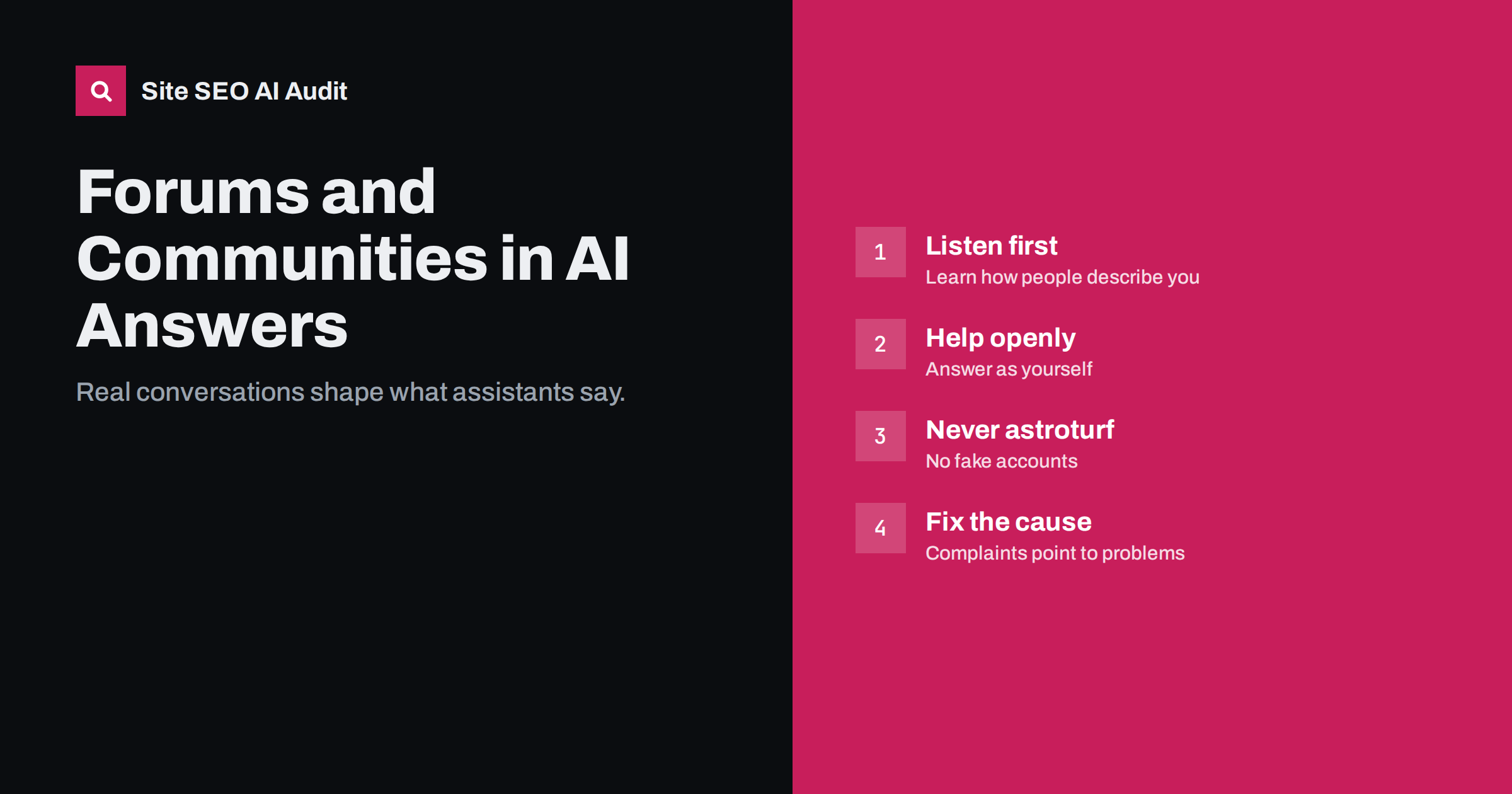
Short answer: Discussions in forums and online communities often appear in search results and AI answers, because they contain first-hand experiences and honest opinions that people find useful. What users say about your business or category in those places can shape how assistants describe you. Businesses can take part honestly by monitoring relevant discussions, answering questions openly as themselves, sharing genuine expertise and fixing the problems people raise. Fake accounts, planted recommendations and spam backfire.
Why community content shows up in AI answers
For many questions, people want to hear from others who have been in the same situation: “Has anyone used this accounting software for a small agency?”, “Which bike shop in Vilnius is honest about repairs?”, “Is this web host still reliable?” Forums, community sites and discussion threads contain exactly that kind of first-hand experience.
Search engines have given more prominence to this content in recent years, and large AI companies have signed data agreements with major discussion platforms. Google and OpenAI both announced partnerships with Reddit in 2024, for example. Whatever the exact mechanisms, community discussions are a significant input into what search results and AI answers say about products, services and businesses.
For a business, this means that conversations you did not start and cannot control may influence the answer a potential customer receives.
This is not entirely new. Word of mouth has always shaped business reputations, and forums have ranked in search results for decades. What has changed is scale and compression. An assistant can read dozens of threads in seconds and condense them into one confident sentence, so the overall tone of community discussion about you matters more than any single post.
How community discussions affect your business
- Recommendations: threads where users recommend a provider can lead assistants to mention that provider when similar questions are asked.
- Complaints: a detailed negative thread can become part of how your business is summarised, especially if there is little else written about you.
- Comparisons: users compare options frankly, including pricing, support quality and limitations, and those comparisons shape answers to “X vs Y” questions.
- Outdated information: old threads may describe problems you fixed long ago or prices that no longer apply.
- Absence: if nobody discusses your business, assistants have less independent information to rely on, which can favour better-known competitors.
The effect is usually strongest for businesses in categories where people like to compare notes: software, hosting, home services, travel, electronics, financial services and anything involving a significant purchase. If your category is regularly discussed in communities, this work deserves a place in your plan.
Step 1: listen before you speak
Start by finding out where your customers talk and what they say:
- Search for your brand name, product names and category terms together with words like “forum”, “review”, “recommend” or “experience”.
- Identify the communities relevant to your industry and region: general discussion platforms, specialist forums, professional groups, local community groups.
- Read the threads that mention you or your competitors, noting recurring praise, complaints and questions.
- Note the language people use. It often differs from the language on your website.
- Set up simple alerts for your brand name so new mentions do not go unnoticed.
Listening alone often produces useful results. Teams are frequently surprised by what customers actually value, which competitors they compare against and which small frustrations come up again and again. Summarise the findings in a short internal note and share it with product, support and marketing, not only with whoever manages the website.
Step 2: take part honestly
Most communities welcome businesses that contribute genuinely and dislike those that advertise. A few principles make the difference:
- Identify yourself. Post from an account that clearly represents your business or states your role. Hidden affiliation is deceptive and often against community rules.
- Answer the question asked, even when the honest answer does not involve your product.
- Share expertise, not sales pitches: practical steps, explanations, warnings about common mistakes.
- Follow each community’s rules on self-promotion and links. Many allow links only when directly relevant.
- Respond to criticism calmly, acknowledge real problems and explain what you are doing about them.
- Be consistent over time. Occasional helpful participation builds more trust than a burst of activity during a campaign.
Decide in advance who may post on behalf of the business and in what tone. A short internal guideline, covering disclosure, what to do with angry threads and when to move a conversation to private support, prevents well-meaning staff from creating problems.
Finally, remember that helping in a thread where your product is not the right fit is still valuable. Recommending a better option honestly builds a reputation for expertise that people remember when your product is the right fit.
Step 3: fix what people complain about
Community complaints are often more candid than reviews. If several threads describe the same issue, such as unclear pricing, slow support or a confusing setup process, treat that as product feedback. Fixing the underlying issue is more effective than any reply. When you have fixed it, it is reasonable to mention the change in relevant threads, briefly and factually, and to update your own website so that the current situation is clearly documented.
It also helps to thank people who point out problems, even when their tone is harsh. Many complaints come from customers who cared enough to write, and a respectful, visible fix can turn a critic into one of your most credible advocates. Future readers of the thread see not only the original problem but also how your business handled it, which often matters more.
Step 4: make your own site the best source
Community discussions often happen because official information is missing or hard to find. People ask each other what a service costs, whether a product works with another tool, or how long delivery takes, because the business does not say clearly. Every recurring question in community threads is a candidate for a clear answer on your site: in an FAQ, on a pricing page or in a help article. When your site answers these questions well, assistants have an authoritative source alongside the community opinions.
Your own site also has an advantage that community threads lack: it can be kept current. A thread from three years ago will stay as it is, but your pricing and help pages can state today’s facts, with a date. That gives assistants a clear, current reference to set against older opinions.
What not to do
| Tactic | Why it fails |
|---|---|
| Fake accounts praising your business | Communities detect patterns quickly; exposure damages reputation far more than any gain |
| Paying people to post recommendations without disclosure | Deceptive, often against platform rules and consumer protection law |
| Posting links in every thread | Treated as spam, removed, and may get your account banned |
| Arguing with critics | Makes the thread more visible and the business look defensive |
| Asking moderators to remove fair criticism | Rarely works and often becomes a story in itself |
The common thread in all of these is deception or pressure. Communities value honesty, and AI systems increasingly draw on the same signals of trust that human readers use.
Measuring the effect
Community work is slow and hard to measure directly. Useful indicators include the number and tone of brand mentions over time, whether recurring complaints decline after fixes, referral visits from community sites in your analytics, and how assistants describe your business in your regular question checks. Look for gradual change over months rather than immediate results.
Be patient with this work. Community reputation changes slowly, as new threads accumulate and older ones become less relevant. Consistent, honest participation over a year does far more than an intensive month.
How Site SEO AI Audit helps
When community threads reveal questions your site does not answer, the next step is making sure your answers can be found. Site SEO AI Audit checks that your pages are crawlable and indexed, that AI crawlers are allowed, that content does not depend on JavaScript, and that pages have the structure and dates AI answers tend to quote. You can run a free audit to check your help and FAQ pages.
Related reading
- Reviews and Reputation: How They Shape AI Recommendations
- FAQ Sections That Work for Readers and AI Answers
- Entity SEO: Helping AI Systems Understand Your Brand
The bottom line
Forums and communities are where people share honest experiences, and those experiences increasingly feed search results and AI answers. Listen to what is said about you, take part openly and helpfully, fix what people complain about and answer recurring questions clearly on your own site. Honest participation builds a reputation that no planted post can match.
FAQ
Do AI assistants use forum discussions?
Community discussions often appear in search results and are used as sources in AI answers, and some AI companies have data agreements with discussion platforms. Exact usage varies by product.
Should my business post on forums?
Yes, if you can contribute genuinely and follow each community’s rules. Identify yourself, answer questions helpfully and avoid promotional posting.
How should I respond to a negative thread about my business?
Reply calmly from an identified account, acknowledge any real problem, explain what you are doing about it and offer a direct contact. Then fix the underlying issue.
Is it acceptable to ask customers to recommend us in forums?
Customers may share their experiences freely, but coordinated or paid recommendations without disclosure are deceptive and often break platform rules. Focus on earning genuine word of mouth.
How can I track what communities say about my business?
Search regularly for your brand and product names with discussion-related terms, set up alerts, and note mentions and tone over time in a simple log.