ENEnglish
 LTLietuviškai
 DEDeutsch
 FRFrançais
 RUРусский
 ESEspañol
 PLPolski
 ITItaliano
 UKУкраїнська
 CSČeština
 PTPortuguês
 JA日本語
 LVLatviešu valoda
 ETEesti
 HUMagyar
 IDBahasa Indonesia
 TRTürkçe
 HIहिन्दी
 ELΕλληνικά
 ARالعربية
 THไทย
 VITiếng Việt
 RORomână
 MSBahasa Melayu
 BNবাংলা
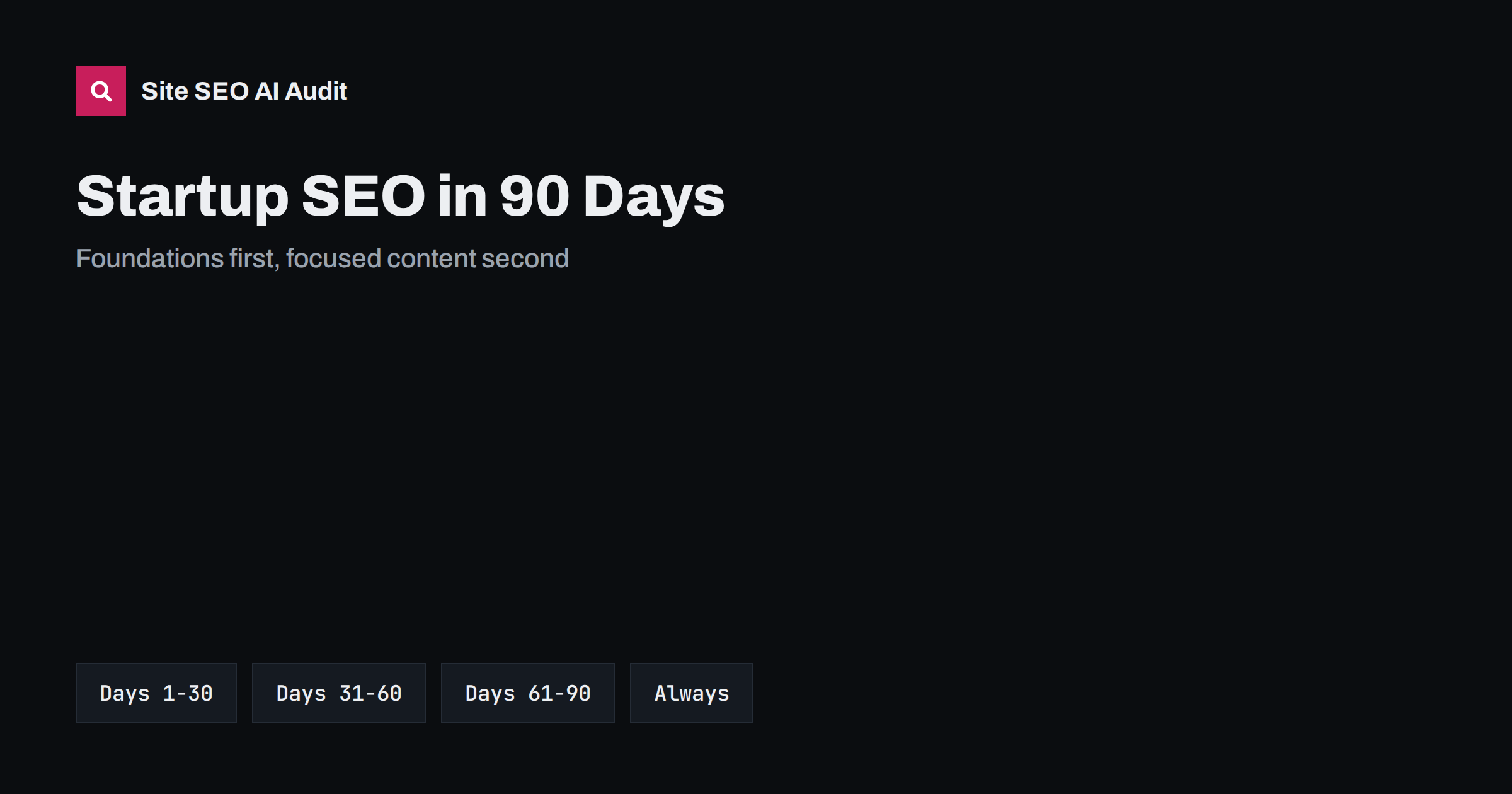
Short answer: In the first 90 days, a startup should build foundations, not chase volume. Spend the first month on technical basics, tracking and a clear picture of customers and competitors. Spend the second on a small set of strong pages for the product, the problem it solves and the questions buyers ask. Spend the third publishing focused content, earning first mentions and measuring what works. Expect early signals such as indexing and first impressions, not large traffic, and keep every claim on your site accurate.
A new site has no history, few links and no brand recognition. That makes SEO feel slow, and founders often respond by publishing dozens of weak articles or by buying shortcuts. A better approach is to treat the first quarter as a period of building a base that will support everything that follows. This plan is deliberately modest. It assumes a small team, little budget and a product that people actually need. For a general list of tasks, see the on-page SEO checklist; this article shows how to sequence them.
Before day one: know who you are writing for
SEO starts with understanding customers. Write a short description of who buys your product, what problem they have, what they type or ask when they look for help and what alternatives they use today. Talk to five real or potential customers if you can, and collect their words. Then list the questions at different stages: those who do not know they have a problem, those comparing options and those ready to buy.
This gives you a list of topics grounded in reality. It also guards against a common mistake, which is writing about what the team finds interesting rather than what buyers search for. The methods for matching content to intent are explained in the search intent guide.
Days 1 to 30: technical foundations
In the first month, make sure that the site can be found and measured. Use HTTPS, a single preferred address for the domain, a working robots.txt and an XML sitemap. Confirm that pages return correct status codes, load quickly on mobile and can be read without scripts. Set up Search Console and analytics, verify the domain and submit the sitemap. Create a clean URL structure with readable slugs, and plan the navigation so that every important page is within a few clicks from the home page.
Choose a content management system that lets you edit titles, descriptions, headings and structured data without a developer. Add basic organization information to the site and link to your public profiles. Check the setup with a crawler such as Site SEO AI Audit, which reports status codes, titles, descriptions, links, speed and AI visibility settings. Many startups launch with a staging block left in place or with duplicate versions of the site, which is covered in the guide to staging sites in the index.
Days 31 to 60: the core pages
In the second month, build the pages that carry the business. At minimum these are a home page that explains what you do in plain words, a page for each main product or service, a pricing or plans page if you can publish one, an about page that shows who is behind the company, and a contact page. Each page should answer a clear question, use a specific title and description and link to the next logical step.
Write for people first. Describe what the product does, who it is for, what it costs or how pricing works and what it does not do. Honest limits build trust and save wasted visits. Add proof where you have it: customer quotes with permission, case examples, numbers you can verify. Use the guides to feature pages, pricing pages and about pages for details. Do not publish claims you cannot support, even if competitors do.
Days 61 to 90: the first content
With the base in place, start publishing content that answers the questions you collected. Choose a handful of topics with clear intent, good fit with your product and a realistic chance of ranking. For a new domain, narrow topics and specific long phrases are more achievable than broad head terms, as discussed in the long-tail keywords guide.
Make each article the best answer you can give: clear structure, original examples, real data from your own work and a short FAQ. Link the articles to each other and to the relevant product pages, and group related ones into a cluster, following the approach in the guide to topic clusters and pillar pages. A realistic output for the quarter is one or two articles a week at high quality, or fewer if you are alone. Ten excellent pages are better than fifty thin ones.
Earning the first mentions
A new site needs signals from outside. Do not buy links or join schemes. Instead, give people reasons to mention you: publish original data from your product, write a useful free tool or template, contribute to relevant communities honestly and tell journalists or partners about something new and specific. List the business in directories and profiles that are genuinely relevant to your market, with consistent name, address and description.
Ask early customers for reviews and testimonials, and for permission to describe their results. Track unlinked mentions and ask politely for a link where it makes sense. The basics of earning links safely are covered in the guide to link building for small sites.
Measure and learn every week
Choose a few simple measures: pages indexed, impressions and clicks in Search Console, queries that show your pages, visits from search, sign-ups or enquiries from organic traffic. Review them weekly for trends and monthly for decisions. At 90 days, you will likely see growing impressions and a small number of clicks. That is normal; traffic usually accelerates later. If nothing is indexed, investigate technical problems at once.
Keep a log of what you published and changed, so that you can connect results to actions. Learn which questions bring qualified visitors and which pages lead to action, and use that to plan the next quarter. The guide on how long SEO takes sets expectations that you can share with your team.
Who does what in a small team
In a startup, one person often covers everything. Split the work so that it fits into a few hours a week. A founder or product lead owns the customer questions and the accuracy of every claim. A developer or technical contact owns the setup, speed, redirects and structured data. A writer, which may also be the founder, owns the content calendar and editing. If you have only one person, schedule fixed blocks: for example Monday for technical checks, Tuesday and Wednesday for writing, Friday for measurement and planning.
Write down the decisions that should not change every week: the preferred domain, the URL pattern, the tone of the content, the facts about pricing and limits, and the checklist for publishing an article. Consistency saves hours later and prevents the confusion that comes from several people editing the site with different habits. If an agency or freelancer helps, give them the same documents and ask for a handover note at the end, as in the agency handover checklist.
What to decide at day 90
At the end of the quarter, hold a short review with three questions. First, is the foundation sound: are all important pages indexed, fast and free of technical errors? Second, which pages and topics show early traction in impressions and clicks, and why? Third, what should the next ninety days focus on: more content in the topics that work, stronger product pages, partnerships and mentions, or fixing technical debt?
Be honest about what did not work. If a page gets impressions but no clicks, improve its title and description. If it gets clicks but no sign-ups, improve the page itself. If nothing is indexed, search for blocks. Use the review to set a small number of goals for the next quarter and drop activities that consumed time without results. A startup that learns quickly from small tests will outperform one that follows a rigid plan.
Mistakes to avoid
Do not publish dozens of AI-generated pages with no review, since quality problems will hold the whole domain back. Do not copy competitors’ pages or use doorway pages for every keyword variation. Do not change the URL structure repeatedly in the first months; each change needs redirects and causes delays. Do not ignore mobile devices, speed or accessibility. And do not promise results in your content that the product cannot deliver, because honest content is the foundation of lasting trust.
Site SEO AI Audit crawls your website and checks status codes, titles, descriptions, headings, broken links, structured data, page speed and AI visibility settings, which gives a new site a clear fix list ranked by impact. It does not write your content or promise rankings. The first audit of up to 200 pages is free, and larger sites can see the pricing page.
Related reading
The bottom line
Build the foundations, publish a few strong pages, learn from the data and give the work time to compound.
FAQ
How much traffic should a new site expect in 90 days?
Usually little. Expect indexing, first impressions and a few clicks, with growth coming after the base is established.
Should a startup start with a blog?
Only after the core product pages exist. Then publish focused articles that answer real customer questions.
How many pages should the first version of a site have?
Enough to explain the product, pricing, company and contact details clearly. Quality matters more than count.
Is paid advertising better for a new company?
It can bring faster visits, and many startups use both. SEO builds an asset that continues to work after spending stops.
Do I need an agency?
Not necessarily. A small team can handle the basics with a clear plan, and can hire help later for specific tasks.