ENEnglish
 LTLietuviškai
 DEDeutsch
 FRFrançais
 RUРусский
 ESEspañol
 PLPolski
 ITItaliano
 UKУкраїнська
 CSČeština
 PTPortuguês
 JA日本語
 LVLatviešu valoda
 ETEesti
 HUMagyar
 IDBahasa Indonesia
 TRTürkçe
 HIहिन्दी
 ELΕλληνικά
 ARالعربية
 THไทย
 VITiếng Việt
 RORomână
 MSBahasa Melayu
 BNবাংলা
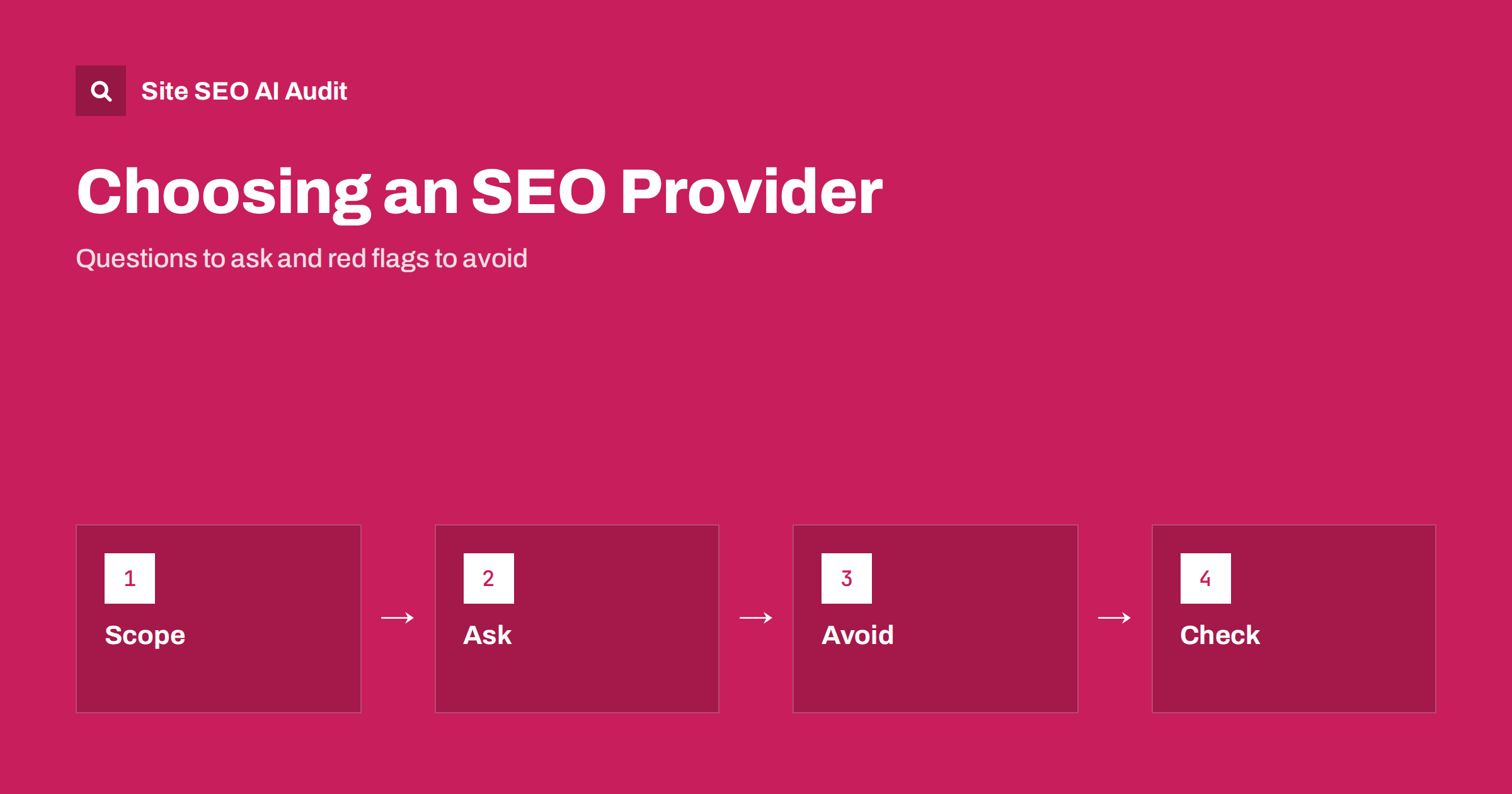
Short answer: A good SEO provider starts with your goals, audits your site before proposing work, explains what will be done and why, gives you access to your own accounts, reports on outcomes instead of activity and is honest that results take time. Be wary of guaranteed rankings, secret methods, bulk link purchases, vague reports, long lock-in contracts and pressure to decide fast. Define what you need, ask for examples and references, compare at least three proposals, agree measurable goals and keep ownership of your site, content and data.
Choosing an SEO provider is hard because the work is partly invisible and the results arrive slowly. You may not be able to judge the quality of technical advice, and a confident salesperson can sound convincing whether the plan is sound or not. Poor choices are expensive: money is lost, months pass and some tactics can leave a site worse than before. Good providers, on the other hand, can bring expertise that is difficult to build in-house, from technical fixes to content planning and measurement. This guide gives you a practical method to define your needs, ask the right questions, recognise warning signs and keep control. It applies to agencies, freelancers and consultants alike. For realistic timelines, read how long SEO takes.
Decide what you actually need
Before you contact anyone, write down your goals, such as more leads, online sales, visibility in a new market or recovery from a drop. Note the size of your site, your platform, your team’s ability to make changes and your budget range. Decide whether you need a one-off audit and a plan that your team will carry out, ongoing monthly work, help with a specific project such as a migration or training. Different needs call for different providers: a technical specialist for a migration, a content team for growth, a local expert for a service business. A clear brief helps you compare proposals fairly and also shows providers who take the time to understand you.
Understand what SEO providers can and cannot promise
Nobody outside the search engine controls rankings, so no one can honestly guarantee a position. What a provider can promise is a process, a standard of work, regular reporting and clear goals about activity and outcomes, such as fixing a list of issues, publishing a defined number of pages or improving visibility for a set of queries over a period. Be sceptical of claims such as first-page placement in a few weeks, a special relationship with a search engine or a secret method. Honest providers talk about risk, dependencies and the effect of competition and updates, and they say when something is outside their control. The difference between SEO, GEO and AEO is explained in SEO vs GEO vs AEO.
Ask the right questions about process
Good questions reveal how a provider works. How do you start a project, and what do you review first? Which tools and data do you use, and who owns the accounts? How do you decide priorities? Who will do the work, and who will I speak to? How do you handle technical changes on our platform? How do you create content, and who checks accuracy? How do you build links, and what will you not do? How often do you report, and what do the reports show? What do you need from us? Expect clear, specific answers, and be wary of jargon without explanation. The best providers can explain complex ideas simply, as in how to explain AI search to clients.
Review a sample audit and proposal
A serious proposal is based on your site, not on a template. Ask for a short audit or an example of earlier work with client details removed. Look for evidence that they examined your pages, your competitors and your goals: specific findings, a prioritised list and an explanation of the expected effect. Compare how proposals rank fixes; a good plan puts high-impact, low-effort items first, as discussed in how to prioritise SEO fixes. Check whether the scope, deliverables, timeline, roles and costs are described clearly. A proposal that consists of a list of services with no link to your situation is a warning sign. If you can, run your own audit and compare it with theirs.
It also helps to know what a healthy engagement feels like. The provider asks about your customers and your business more than about keywords, tells you when something you want is not a good idea, explains trade-offs and documents decisions. They deliver small visible improvements early, such as fixed errors and better titles, while they work on bigger projects. They do not hide bad news: if a change did not work or a page lost visibility, they tell you, offer an explanation and propose the next step. Such openness is the best sign that you have chosen well.
Recognise the common red flags
Several signs deserve caution. Guaranteed rankings or traffic, and promises of results in unrealistically short times. Refusal to explain methods, or claims that they are proprietary. Selling large numbers of links, directory submissions or automatically generated content, which can break search engine policies and put the site at risk. Requests for full control of your site or domain while keeping ownership of accounts. Reports that show only activity, such as hours or keywords tracked, with no link to business results. Pressure to sign quickly or for a long term with expensive exit fees. Poor communication from the first week. Unsolicited emails that criticise your site in general terms. The risks of aggressive tactics are described in Google spam policies explained.
Check references, work samples and fit
Ask for references from clients with similar sites, and call them. Ask what changed, how communication worked, whether goals were met and what they would do differently. Look at published work: the provider’s own site, case studies and content. A company that sells SEO should show clear, well-structured and informative pages of its own, but do not judge only by its rankings for broad terms. Ask about the team’s experience with your platform and market, and, if you operate in several languages, whether they have a process for international work, such as the one in the multilingual SEO audit guide. Fit matters too: you will be working together for months, so choose people who listen.
Agree on goals, reporting and ownership
Write down measurable goals before work starts: the pages or topics to improve, the technical issues to fix, the content to publish, the visibility and conversions to track and how progress will be measured. Agree on a reporting rhythm and format, with a short explanation of what changed, what it means and what comes next, in the style recommended in SEO reporting for clients. Make sure you own your domain, hosting, analytics, search accounts and content, with the provider added as a user, and that you receive documentation of every change. Ask how work can be transferred if you end the relationship. These arrangements protect you whether things go well or badly.
Think about content and approvals as well. If the provider will write for your site, ask who the writers are, what sources they use, how they check facts and how you approve the text before publishing. Content in your name should be accurate and reflect your expertise, and it should not be produced in bulk without review. If they will make technical changes, ask how changes are tested, how they can be reversed and who is responsible if something breaks. Clear rules for approvals prevent most disputes.
Start small and review regularly
Reduce risk by beginning with a paid audit or a short project, then expand if the results and the working relationship are good. Choose a contract with a notice period you can accept. In the first months, look for the leading signs of good work: issues found and fixed, pages improved, tracking set up, content published to a plan and clear communication, since rankings and traffic take longer. Every quarter, review the goals, the results and the costs against the original plan. Keep an internal owner for SEO, even if small, so that someone in your organisation understands the work and can ask questions. Test claims by using independent tools, including a crawl of your own site, and compare with what the provider reports.
Site SEO AI Audit is a tool, not an agency. It crawls your site, scores about 50 checks per page and ranks fixes by the points they add, which gives you an independent view of the technical and on-page state of the site before and after any work. The first audit of up to 200 pages is free; larger sites can see the pricing page.
Related reading
- SEO Reporting for Clients
- How Long Does SEO Take?
- SEO Testing: Measure Changes
- Technical SEO Audit Checklist
The bottom line
Choose an SEO provider by defining your needs, asking about process, reading a proposal based on your site, avoiding guarantees and secrecy, checking references, agreeing measurable goals, keeping ownership of your accounts and starting with a small project.
FAQ
Can an SEO provider guarantee first-page rankings?
No. Rankings are decided by search engines. A provider can guarantee work and reporting, not positions. Treat guarantees as a warning sign.
How much should I pay for SEO?
Prices vary widely with scope, market and experience. Compare proposals by deliverables and goals rather than by price alone, and avoid very cheap offers that promise a lot.
Should the provider own my analytics and search accounts?
No. You should own them and add the provider as a user. This keeps your data safe if you change provider.
How long before I see results?
Early signs, such as fixes and indexing, can appear within weeks, while ranking and traffic changes usually take months and depend on competition and the site.
Is it better to hire an agency or a freelancer?
It depends on needs. Agencies offer broader teams, freelancers offer focus and flexibility. Judge the people who will do the work, their process and references.