ENEnglish
 LTLietuviškai
 DEDeutsch
 FRFrançais
 RUРусский
 ESEspañol
 PLPolski
 ITItaliano
 UKУкраїнська
 CSČeština
 PTPortuguês
 JA日本語
JA日本語 LVLatviešu valoda
 ETEesti
 HUMagyar
 IDBahasa Indonesia
 TRTürkçe
 HIहिन्दी
 ELΕλληνικά
 ARالعربية
 THไทย
THไทย VITiếng Việt
 RORomână
 MSBahasa Melayu
 BNবাংলা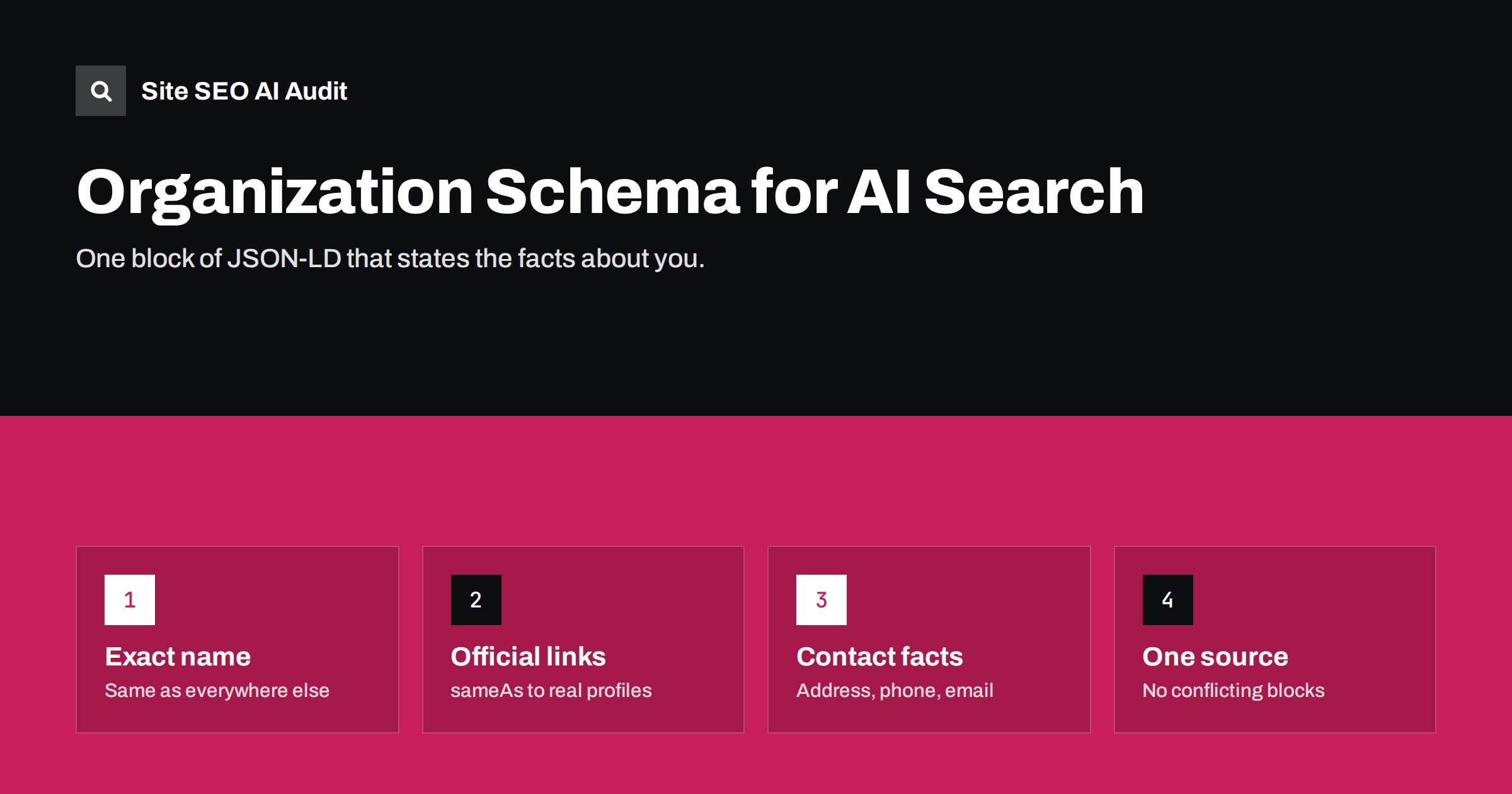
Short answer: Organization structured data is a block of JSON-LD, usually on your home or about page, that states the core facts about your business: its name, website, logo, contact details, address and official profiles. It helps search engines connect your site to the right entity in their knowledge graphs, which AI features draw on when describing you. Use the most specific type that fits, such as LocalBusiness or a subtype, keep every value identical to what your pages and profiles show, and output it from one source only.
What Organization schema does
Search engines try to understand businesses as entities: distinct things with names, locations, owners, products and relationships. Most of that understanding comes from crawling pages and comparing sources. Organization markup is your chance to state the key facts directly, in a standard vocabulary that machines do not have to interpret.
Google documents Organization structured data as a way to help it understand administrative details about your organisation and to disambiguate it in search results. Among other things, it can influence which logo Google shows and helps connect your site to details in knowledge panels. None of this guarantees any particular display, but it removes guesswork.
For AI search, the benefit is indirect but real. AI answers about your business rely on what search engines and other sources believe about you. Clear, consistent structured data is one of the inputs that helps those beliefs be correct.
It is worth being clear about the limits too. Organization markup does not create a knowledge panel on demand, does not improve rankings directly and does not override what other trusted sources say about you. It is one clear, consistent signal among many, and its value comes from agreeing with the rest.
Choosing the right type
Schema.org offers a hierarchy of types. Use the most specific one that genuinely describes you:
| Business | Suggested type |
|---|---|
| Company without a customer-facing location | Organization, or Corporation |
| Shop, office or clinic that customers visit | LocalBusiness or a subtype |
| Dental clinic | Dentist |
| Restaurant or café | Restaurant, CafeOrCoffeeShop |
| Online-only shop | OnlineStore (an Organization subtype) |
| Agency or consultancy | ProfessionalService or Organization |
If several locations exist, describe the organisation once on the main site and each location with its own LocalBusiness markup on its location page, linked to the parent organisation.
When no subtype fits exactly, choose the closest general type rather than a misleading specific one. A marketing agency described as a “Store” would confuse more than it helps. You can also list several types in an array when a business genuinely fits more than one, such as a bakery that is also a café.
Properties that matter most
- name: your public business name, written exactly as elsewhere.
- alternateName: abbreviations or former names, which help connect old references.
- url: your canonical home page URL.
- logo: an absolute URL to a logo image that is crawlable.
- sameAs: URLs of your official profiles, such as social networks, business directories and reference entries.
- address: a PostalAddress with street, city, postal code and country.
- telephone and email: in the same format you use on your contact page.
- contactPoint: for specific departments, such as customer support, with their contact type.
- foundingDate, founder: where public and relevant.
- vatID or taxID, legalName: useful for companies where legal identity matters.
For LocalBusiness types, add openingHoursSpecification, geo coordinates and priceRange where appropriate.
Do not add properties just because they exist. Every value you add is a value you must keep accurate. A short, correct block is better than a long one with stale details.
A simple JSON-LD example
Here is a minimal example for a small agency. Replace every value with your real details:
{
  "@context": "https://schema.org",
  "@type": "ProfessionalService",
  "name": "Example Studio",
  "legalName": "Example Studio, UAB",
  "url": "https://example.com/",
  "logo": "https://example.com/images/logo.png",
  "telephone": "+370 600 00000",
  "email": "[email protected]",
  "address": {
    "@type": "PostalAddress",
    "streetAddress": "Gedimino pr. 1",
    "addressLocality": "Vilnius",
    "postalCode": "01103",
    "addressCountry": "LT"
  },
  "sameAs": [
    "https://www.linkedin.com/company/example-studio",
    "https://www.facebook.com/examplestudio"
  ]
}
Place it inside a script element with the type application/ld+json, in the server-rendered HTML of your home page or about page.
The example uses ProfessionalService, a LocalBusiness subtype, because the agency has an office clients can visit. A purely online business would use Organization and could leave out the street address, while still listing email, phone and official profiles. Keep the phone number in international format so that it is unambiguous for any reader or system.
Where to place it
Google’s guidance suggests adding Organization markup to the home page or a page that describes the organisation, such as the about page. It does not need to appear on every page. Repeating it everywhere is not harmful if the values are identical, but many sites end up with slightly different blocks on different templates, which is worse than having one.
Make sure the markup is in the HTML the server sends. Markup injected later by a tag manager may be read by Google after rendering, but many other crawlers do not run JavaScript.
If you manage several brands from one company, give each brand’s website its own Organization block describing that brand, and use the parentOrganization property to connect it to the company. That keeps brands distinct while showing the relationship.
Keeping it consistent with the rest of the web
Structured data is most useful when it agrees with everything else. Compare each value with:
- Your visible contact and about pages.
- Your Google Business Profile and Bing Places listing.
- Your social profiles and the directories you appear in.
- Company registry information, where public.
If the markup says “Example Studio” while your profile says “Example Studio Vilnius” and your invoices say “Example Studio, UAB”, decide which is the public name, use legalName for the legal form, and align the rest.
Consistency also covers small details: the same phone format, the same spelling of street names and the same way of writing your company name with or without a legal suffix. Machines are good at matching near-duplicates, but every inconsistency adds a little doubt.
Common mistakes
- Duplicate blocks from a theme, an SEO plugin and a schema plugin, each with different values.
- Placeholder or theme values, such as the theme author’s name or a demo logo.
- sameAs links to unofficial pages, competitor profiles or pages that no longer exist.
- Outdated addresses or phone numbers after a move.
- Invalid JSON, such as a trailing comma, which makes the whole block unreadable.
- Relative logo URLs or logos blocked by robots.txt.
- Marking up reviews of your own business on your own site, which Google does not show as review rich results for LocalBusiness and Organization.
Testing and maintaining the markup
Structured data is easy to add and easy to forget. A simple maintenance routine keeps it accurate:
- Validate after adding it. Run the page through Google’s Rich Results Test and the Schema.org validator, and fix any errors or warnings that apply.
- Check the rendered source. View the page source and confirm there is exactly one organisation block, with the values you expect.
- Review after changes. Moving office, changing phone numbers, rebranding, adding social profiles or switching SEO plugins should all trigger a quick review.
- Check linked profiles. Open every sameAs URL once a year to confirm it still exists and still belongs to you.
- Keep a record of where the markup is generated, so the next developer knows which setting to change.
On WordPress, most SEO plugins generate Organization markup from a “site representation” or “knowledge graph” settings page. Filling in those fields carefully is usually all you need; a custom block is only necessary when the plugin cannot express something important, such as a specific LocalBusiness subtype or a legal name.
How Site SEO AI Audit helps
Site SEO AI Audit checks Schema.org markup on each page it crawls and flags invalid JSON-LD, so broken or duplicated Organization blocks show up quickly. It also reviews Open Graph tags and share images, which control how your brand appears when links are shared. On WordPress, fix steps point to the organisation settings in your SEO plugin. You can run a free audit to check your markup.
Related reading
- Entity SEO: Helping AI Systems Understand Your Brand
- Does Structured Data Help in AI Search? An Honest Look
- Structured Data Errors: How to Find and Fix Invalid Schema
The bottom line
Organization schema is a small piece of code with a clear job: stating who you are in a form machines cannot misread. Choose the most specific type, include your exact name, URL, logo, contact details and official profiles, keep every value consistent with your pages and listings, and output it from one source. It will not win citations by itself, but it helps every system describe you correctly.
FAQ
Where should Organization schema go?
On the home page or the page that describes your organisation, such as the about page. It does not need to be on every page, and it must be in the server-rendered HTML.
What is the difference between Organization and LocalBusiness?
LocalBusiness is a more specific type for businesses with a physical location customers visit. It supports properties such as opening hours and geo coordinates. Use it, or one of its subtypes, when it fits.
What should I put in sameAs?
URLs of your official profiles that clearly represent the same business, such as social media pages, business directories and reference entries. Do not include unofficial or unrelated pages.
Does Organization schema help AI answers?
Indirectly. It helps search engines understand and disambiguate your business, and AI features draw on that understanding. It does not guarantee mentions or citations.
Can I have several Organization blocks?
It is better to have one clear block for the organisation, plus separate LocalBusiness blocks for individual locations. Multiple conflicting organisation blocks create confusion.