ENEnglish
 LTLietuviškai
 DEDeutsch
 FRFrançais
 RUРусский
 ESEspañol
 PLPolski
 ITItaliano
 UKУкраїнська
 CSČeština
 PTPortuguês
 JA日本語
 LVLatviešu valoda
 ETEesti
 HUMagyar
 IDBahasa Indonesia
 TRTürkçe
 HIहिन्दी
 ELΕλληνικά
 ARالعربية
 THไทย
 VITiếng Việt
 RORomână
 MSBahasa Melayu
 BNবাংলা
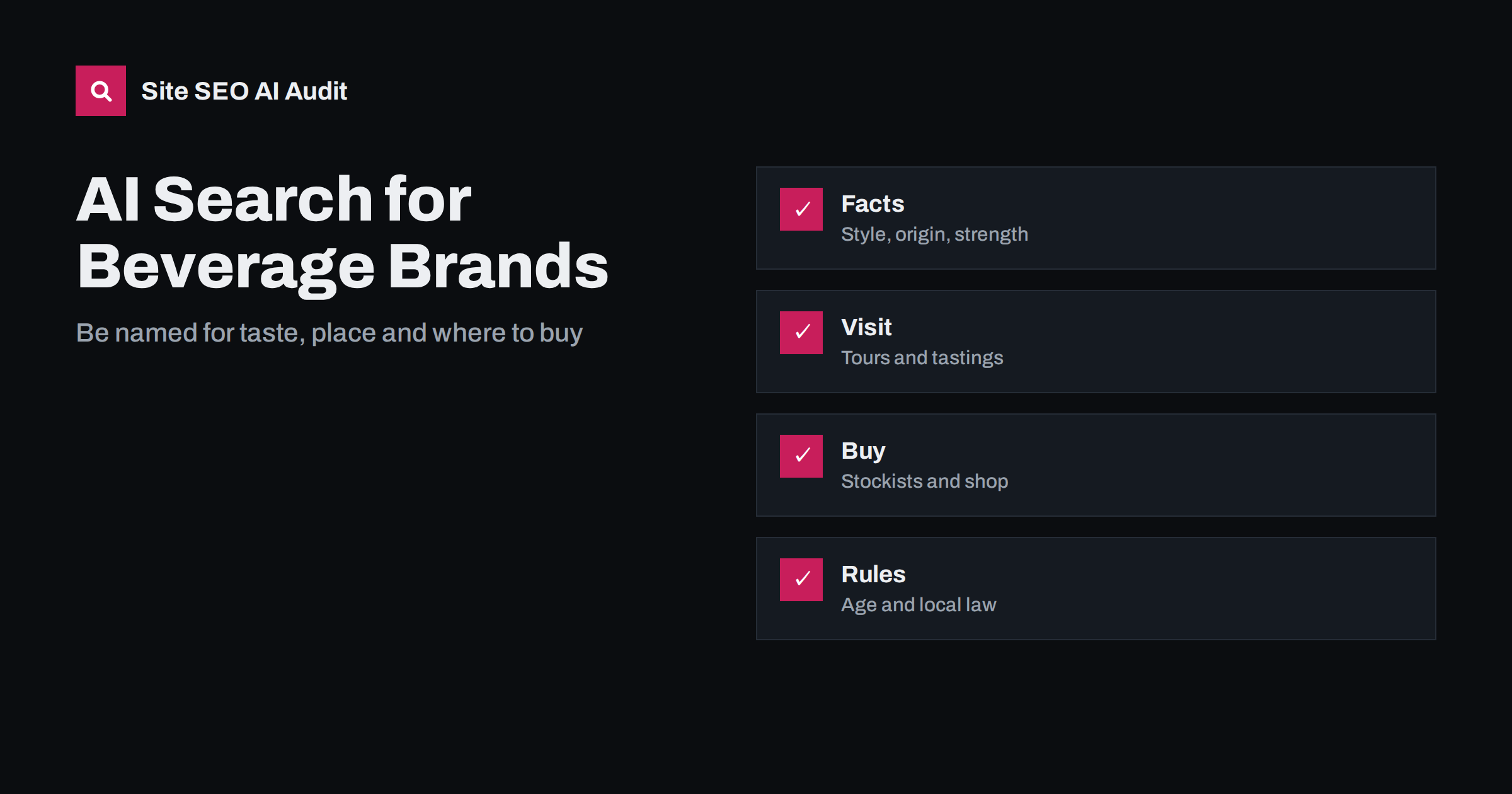
Short answer: People ask AI assistants for a local craft beer to try, a wine to serve with fish or a distillery to visit on a trip. To be recommended, a producer needs pages that state exactly what each product is, where it comes from, how it tastes, where to buy it and how to visit, in plain text that can be quoted. Age-restricted products also need careful, lawful wording and a sensible age gate that does not hide the content from crawlers.
Drinks are bought on a mix of taste, story and place, and each of those appears in questions to assistants. Which brewery near me has a taproom, which dry cider suits a barbecue, which wine region makes light reds, where can I buy this brand abroad? The answers come from pages that describe the product and the place clearly. This guide explains what to publish and how to structure it for producers of beer, wine, cider, spirits and soft drinks. It builds on the generative engine optimization guide.
One page per product
Give each product its own page, even if the range is small. State the type and style in plain words, such as a pale ale, a dry riesling or a small-batch gin. Add the strength, volume, container sizes, ingredients, allergens where relevant and the year or batch for products that change. Describe the taste in concrete terms, mentioning aroma, body, sweetness and finish, and suggest food pairings and serving advice. This is the information a buyer would ask a shop assistant for, and it is also what an AI system needs to answer a question about a product.
Avoid empty marketing words such as exceptional or legendary. A sentence like a dry, lightly hopped lager with notes of bread and lemon peel, served cold with grilled fish, can be quoted. Use the same name everywhere, including the label, the shop and the social profiles, so that the product is recognised as one entity. The value of consistency is explained in the guide to entity SEO.
Tell the story of place and process
Origin matters for drinks. Write about the region, the water, the grape varieties, the soil, the barley, the orchards or the botanicals, depending on the product. Describe how it is made: fermentation, ageing, barrels, blending, the equipment and who does the work. If the product has a protected designation or an organic certification, state it with the name of the scheme and check that you meet the rules. Never claim an award or certification that you do not hold, and when you list medals, give the competition and the year.
Include people and dates: when the producer was founded, who runs it and what the team does. Such pages support the trust signals that matter for assistants and readers alike, as described in the guide to E-E-A-T and AI search.
Visits, tours and tastings
Many questions are about visiting. Create a clear page for the taproom, cellar door or distillery, with opening hours, address, how to get there, whether a booking is needed, prices of tastings and tours, group sizes, accessibility, parking, whether children and dogs are welcome and the languages of the tours. Keep the hours accurate, including seasonal changes and holidays, and mark them with structured data that matches the visible page. A local business listing with the same details helps, and consistency across them is explained in the guide to aligning your business profile with your website.
Events deserve their own pages: harvest festivals, tap takeovers, release days and pairing dinners. Give each a date, a time, a price and a booking link, and archive past events rather than deleting them, so that the history of the brand is visible.
Where to buy
If you sell online, make shop pages crawlable and complete, with price, availability, delivery countries and delivery times. If you sell through distributors and shops, publish a list of stockists by country or city, kept current. A buyer abroad asking where to find a product will be sent to the places that your pages and your partners’ pages name. Ask important stockists to link to the product page and to use the same product name and description.
For export brands, create versions of the key pages in the languages of your main markets, with local details such as importers and prices in local currency. The technical side of those versions is covered in the hreflang guide.
Age rules and the age gate
Alcohol is regulated, and rules differ by country. Many producers add an age gate that asks visitors to confirm their age. Make sure that it does not block crawlers from reading the product pages. An overlay that asks for a date of birth and then loads the page normally is easier for crawlers than a gate that redirects everyone to a separate page. Test with a fetch tool to see what the crawler receives. The principles of access control and AI crawlers are discussed in the guide to gated content and AI search.
Wording must follow the law and the codes of practice in your market, which can restrict claims about health, performance or social success, and rules on advertising to minors. Take advice for your country. Do not invent claims to please algorithms. A responsible drinking message is a good practice and is expected in many markets.
Reviews, ratings and press
Independent mentions matter. Beer rating sites, wine critics, travel guides, local newspapers and food bloggers all feed the picture that assistants build. Keep a press page that lists real coverage with links and dates. Encourage visitors to review the taproom or cellar door on map listings and answer reviews politely. If you use ratings markup on your own site, follow the guidelines, since review markup about your own business or organisation has restrictions. More on this is in the guide to review schema and star ratings.
Structure for questions
Use headings that match how people ask: what does it taste like, what food goes with it, how strong is it, how should I store it, can I visit, where can I buy it. Give short, direct answers first and detail below. Add a FAQ with accurate answers. Use structured data for the organisation, the local business, the products and the events, matching what is visible. Keep the pages fast and readable, since many visitors arrive from phones in a shop or on a trip.
Seasonal products need special care. A limited release, a harvest vintage or a winter ale can sell out. Keep the page after the sale, mark it as sold out and link to the current alternative, so that assistants and customers do not land on a missing page. Archive older vintages with their tasting notes, since collectors and restaurants search for them. This also protects the link value that earlier releases have gathered.
Think about the businesses that buy as well as consumers. Restaurants, bars and shops ask for wholesale terms, minimum orders, delivery areas and technical sheets. A trade page with downloadable product sheets, a contact person and clear terms makes it easy to be recommended in answers about suppliers. Keep the consumer and trade information clearly separated but linked.
Here is a short example. A family winery had one page with a long story and a photo of the cellar. After a rewrite, it published a page for each wine with grape, vintage, alcohol level, dryness, tasting notes and pairing advice, a visit page with tour times and prices, a stockist list for three countries and a short guide to storing and serving. Assistant answers to questions about light red wines from that region started to name the winery and quote the pairing advice, because the facts finally appeared in the text.
Photography and video support the text. Show the bottle or can clearly, the label legibly, the taproom or cellar and the people at work, and give every image a descriptive file name and alt text, such as a pale ale glass on the taproom bar. Short videos of a tour or of the brewing process can be embedded on the relevant pages with a transcript, which gives assistants text to read. Keep file sizes reasonable so that pages stay fast on phones, and avoid white backgrounds that disappear in search results where a coloured background would stand out. Good images also travel: stockists, bloggers and travel sites reuse them, and each reuse that credits and links to your page strengthens the connection between the product and your brand name.
Site SEO AI Audit crawls your site and reports crawl, on-page, link, speed, structured data, language and AI visibility checks, which helps you see whether product pages are reachable, whether duplicate titles appear and whether AI crawlers are blocked in robots.txt. It does not assess age-gate compliance or alcohol advertising rules. The first audit of up to 200 pages is free, and the pricing page lists plans for larger sites.
Related reading
The bottom line
Describe each drink, its origin, visits and stockists in specific, quotable text, keep age gates crawler-friendly and follow the rules of your market for claims.
FAQ
Does an age gate stop AI crawlers?
It can if it redirects everyone to a separate page. Use an overlay that leaves the page content readable, and test with a fetch tool.
What should a product page include?
Type, style, origin, strength, volume, ingredients, tasting notes, pairings, price, availability and where to buy.
Should I list stockists?
Yes, by country or city, kept current, so buyers and assistants can find where to purchase.
Can I use award badges?
Only for awards you hold. State the competition and the year, and keep the list accurate.
How do I handle sold-out vintages?
Keep the page, mark it as sold out and link to the current release.