ENEnglish
 LTLietuviškai
 DEDeutsch
 FRFrançais
 RUРусский
 ESEspañol
 PLPolski
 ITItaliano
 UKУкраїнська
 CSČeština
 PTPortuguês
 JA日本語
 LVLatviešu valoda
 ETEesti
 HUMagyar
 IDBahasa Indonesia
 TRTürkçe
 HIहिन्दी
 ELΕλληνικά
 ARالعربية
 THไทย
 VITiếng Việt
 RORomână
 MSBahasa Melayu
 BNবাংলা
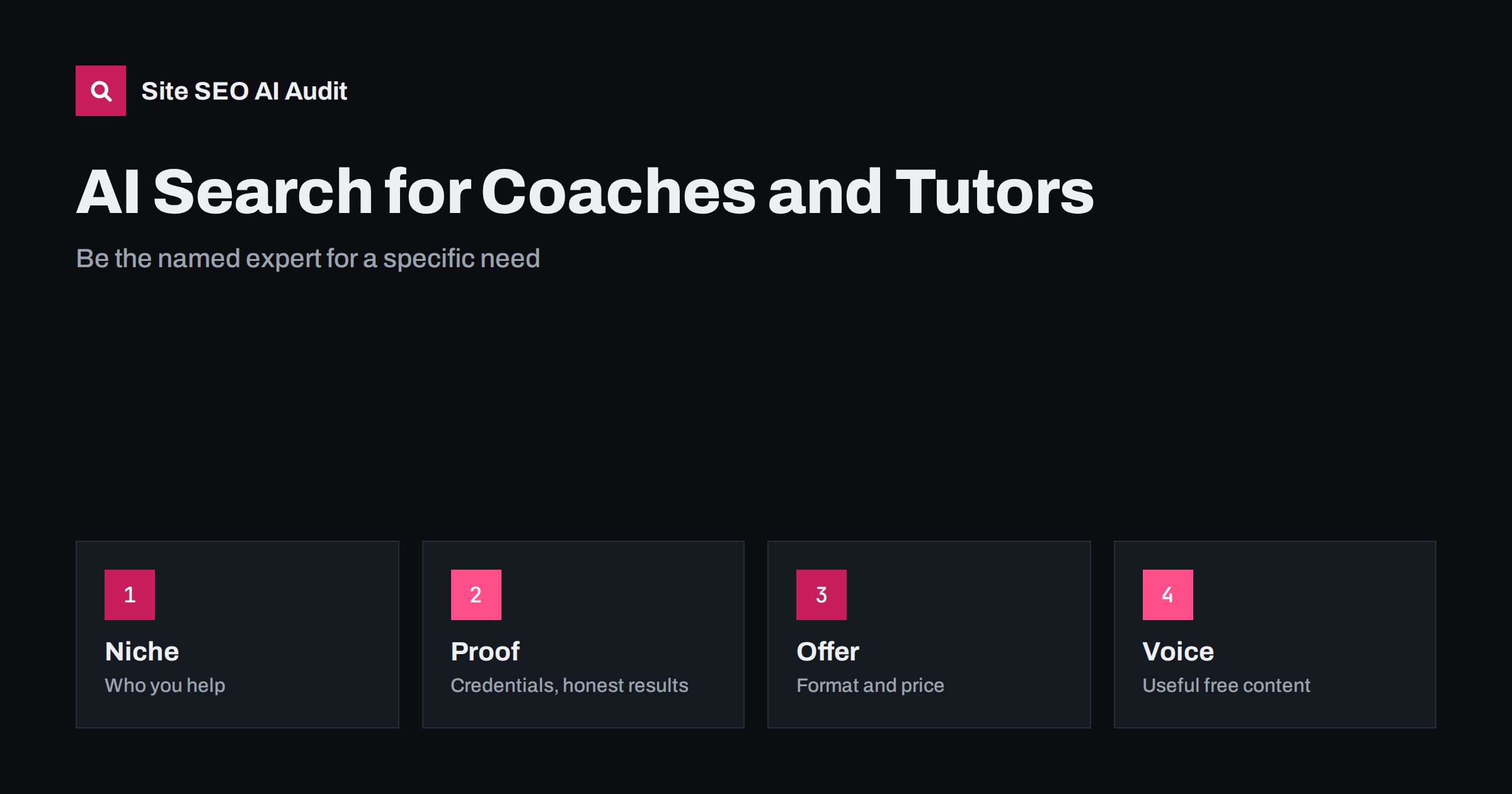
Short answer: People ask AI assistants to recommend a tutor, a coach or an expert for a very specific need. Independent experts are named when their website says exactly who they help and how, shows verifiable credentials and honest examples, explains formats and prices, publishes useful free content and carries consistent details across profiles and reviews. A clear niche and a recognisable personal brand matter more than a long list of general services.
For a solo professional, the website is often the whole business. A language tutor, a career coach, a fitness trainer, a music teacher, a consultant or an online course creator all depend on being found by people who have a particular problem. Assistants now answer questions such as who can help me prepare for an exam in a certain subject or how to find a coach for a career change after a break. The answers contain a short list, and the people on the list are those whose pages are clear and trustworthy. For related guidance on firms, see the guide to AI search for agencies, consultants and freelancers.
How people look for help
Searches begin with a need, not a profession: pass an exam, speak with confidence in a meeting, learn a language for a move, prepare for an interview, recover from an injury, grow a small business. Then they add details: level, age, language, budget, location or online, and time available. Finally they ask how to choose and what to expect: how many sessions, what happens in the first lesson, how results are measured and what a fair price looks like.
A page that matches these details has the best chance. Generic wording such as helping people reach their potential gives an assistant nothing to match. A sentence such as helping adult learners pass an advanced language exam in twelve weeks gives it a lot.
Define a clear niche and name it
Write a one-sentence description: who you help, with what and how. Use it in the title of the home page, the first lines of the about page, social profiles and directory listings. Create a page for each main service and audience, with the need in the title and a direct answer at the top. If you serve several groups, give each their own page instead of one long page. This is the logic of the guide to service pages.
Use your own name consistently. Many experts build a brand around their name, and assistants connect people through names. Use the same spelling, photo and short biography across the website, professional networks, directories and platforms. See the guide to entity SEO.
Show real credentials and experience
People entrust a tutor or coach with their time, money and sometimes sensitive matters, so trust signals are central. State qualifications, certifications, memberships and years of experience precisely, and link to verifiable sources where possible. Describe your method in simple terms, including what you do in a first session and what you expect from the client. Explain what you do not do, such as medical or legal advice, and where you refer clients elsewhere.
Never claim a credential you do not hold, and do not call yourself certified by a body that does not exist or that is only a paid badge. Honest statements, even modest ones, are more persuasive over time. For the broader principles, see the guide to E-E-A-T and AI search and the guide to author pages and bylines.
Results and case studies, honestly
Examples help people to imagine working with you. Write short case studies with permission: the starting point, what was done, how long it took and what changed, with details that make it believable. Avoid promises such as guaranteed success, and say that results vary. If you quote numbers, state the sample and the period, and do not cherry-pick. When names and details are confidential, use anonymised descriptions and say so.
Student and client testimonials should be real and permitted. Do not publish fake quotes or stock photos presented as clients. See the guide to case study pages for a structure.
Explain formats, prices and booking
Answer the questions that come before a booking. Say whether sessions are online or in person, the length of a session, the languages you work in, how packages are organised and what they cost. If you prefer not to publish exact prices, give a range or explain what the price depends on. State the cancellation and rescheduling policy, how to pay and what the first step is, such as a free intro call, if you offer one. Keep it current and clear. The structure is in the guide to pricing pages.
A booking path that works on a phone, with a visible link on every page, is part of the story. Assistants and people alike prefer a clear action over a vague contact form.
Publish useful free content
Experts show their skill by teaching. Write guides that answer common questions of your clients: how to prepare for the exam, how to practise between lessons, how to prepare for a coaching session, mistakes beginners make. Make them practical, specific and honest, with examples from your experience. Short videos or audio can accompany them, with a text summary on the same page so that the content can be read as well as watched.
If you sell courses or digital products, relate them to the free content and explain what each includes, as covered in the guide to AI search for online courses. For professional services, see the guide to AI search for professional services.
Reviews and profiles on other platforms
Many clients find experts through marketplaces, directories and review platforms. Keep your profiles complete and consistent with your website: the same name, description, services, languages and prices. Ask clients for honest reviews and reply politely. Mention platform profiles on your site and link to them, and link back from the profiles to your site. Review markup on your own pages should only be used for genuine reviews, as explained in the guide to reviews and AI recommendations.
Be present in the communities where your audience asks questions, and answer helpfully without promoting yourself in every post. Your name appearing next to good answers helps assistants to associate you with the topic.
Technical basics for a small site
Keep the site fast and readable on a phone, with plain HTML for the main text. Give each service and article its own address, use clear titles and headings and add structured data for the person or organisation, matching the visible information. Do not block search and AI crawlers by mistake, as in the guide to AI crawlers and robots.txt. If you work in several languages, publish proper versions and link them, rather than a single mixed page.
Protect your clients and yourself
Experts who work with people take on responsibility. Publish a short statement of how you handle client information, what is confidential and in which cases you would have to share it. If you work with children or vulnerable adults, say how you handle safeguarding and what checks you have. Explain the limits of your role: a coach is not a therapist, and a tutor does not guarantee a grade. Clear boundaries protect both sides and increase trust with readers and with the systems that summarise your pages.
Check your pages for claims that cannot be supported, such as certain success rates, instant transformations or fast results. Replace them with honest descriptions of the process and typical timelines. Where regulations apply to your field, such as data protection or advertising rules, make sure your site follows them. A page that states what you do, how you do it and what you do not do is both more ethical and more useful to an assistant that is trying to avoid recommending the wrong person.
Here is a short example. A maths tutor had a one-page website that said she helped students succeed. After she rewrote it to describe tutoring for a specific national exam in three levels, published her qualifications, a clear price list, two anonymised case studies and ten short guides on common mistakes, her enquiries came from better-matched students, and assistants began to name her for that exam in her city.
A second example is a career coach who split a general page into pages for returning to work after a break, changing industry and preparing for senior interviews. Each page had its own questions and examples, and each began to attract the right audience.
Site SEO AI Audit crawls your website and checks titles, descriptions, headings, broken links, structured data, page speed and AI visibility settings such as AI crawlers in robots.txt, which helps you keep a small expert site healthy. It does not verify credentials or manage bookings. The first audit of up to 200 pages is free, and larger sites can see the pricing page.
Related reading
The bottom line
Be specific about who you help, prove your experience honestly and keep your name and details consistent everywhere.
FAQ
Do I need a niche?
It helps greatly. A specific need and audience is easier for assistants to match than a general promise.
Should I publish my prices?
Publish prices or ranges where you can, and explain what affects them. Clear terms reduce doubt and wasted enquiries.
How do I show credentials safely?
State only qualifications you hold, with links to verifiable sources where possible.
Are case studies required?
They are very helpful. Write honest, permitted examples and avoid guarantees.
Is a platform profile enough?
Not by itself. Your own website gives you control over your message, and your profiles should match it.