ENEnglish
 LTLietuviškai
 DEDeutsch
 FRFrançais
 RUРусский
 ESEspañol
 PLPolski
 ITItaliano
 UKУкраїнська
 CSČeština
 PTPortuguês
 JA日本語
 LVLatviešu valoda
 ETEesti
 HUMagyar
 IDBahasa Indonesia
 TRTürkçe
 HIहिन्दी
 ELΕλληνικά
 ARالعربية
 THไทย
 VITiếng Việt
 RORomână
 MSBahasa Melayu
 BNবাংলা
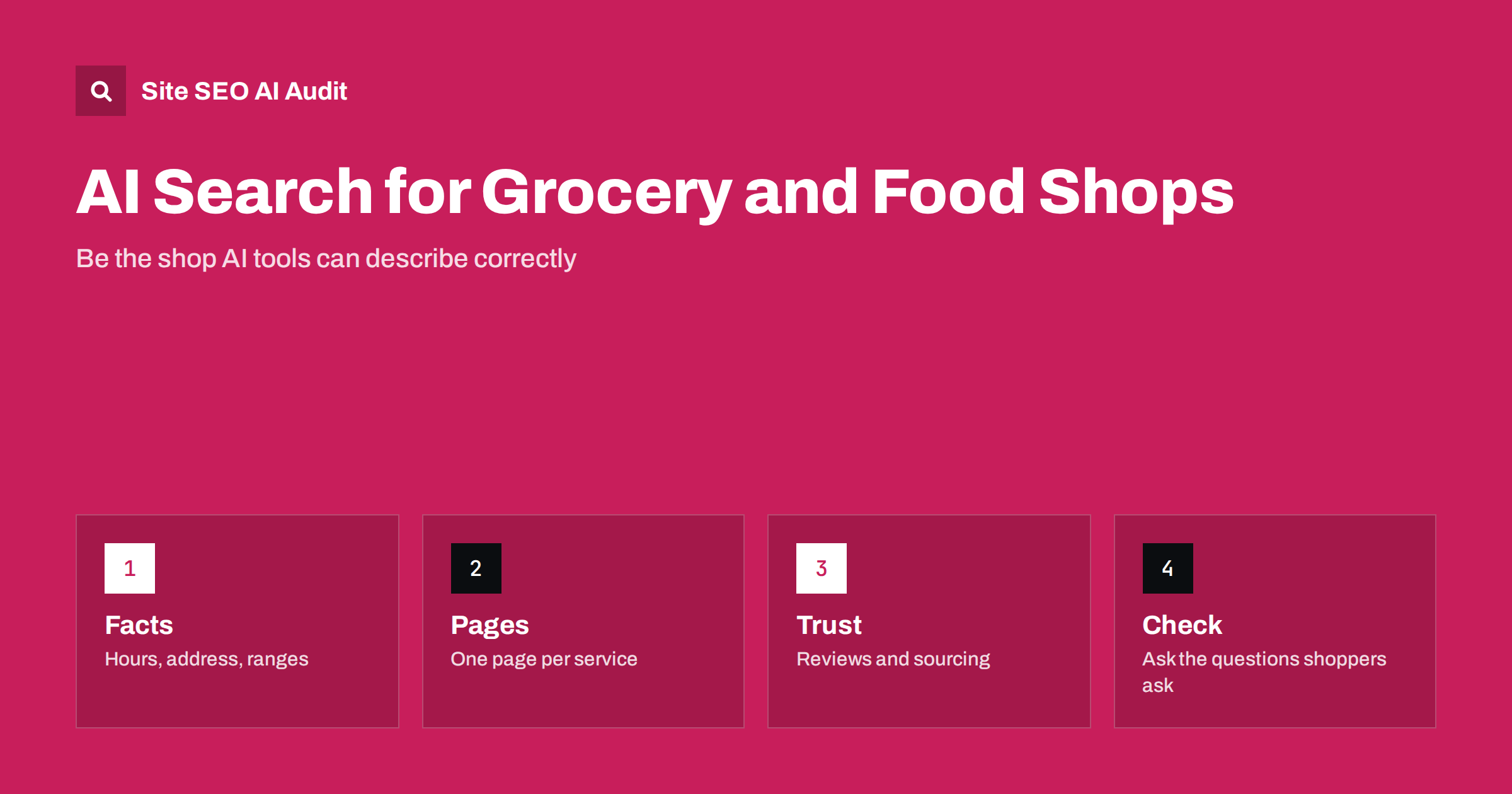
Short answer: A grocery store or local food shop is found in AI answers when its basic facts are clear, consistent and easy to read: name, address, opening hours, what it sells, whether it delivers or offers collection, and what makes it different. Put these facts in plain text on your own pages, mark them up with local business data, keep your business profiles identical to your website and give shoppers real reviews to quote. Then ask AI tools the questions your customers ask and fix what they get wrong.
People now ask assistants questions such as where to buy fresh bread near them, which shop sells gluten-free pasta or whether a deli delivers on Sundays. The answer is usually built from a handful of sources: business profiles, maps, review sites, your own website and local articles. A food shop often has a thin website, a menu of products that changes weekly and opening hours that are only correct on a social media post. This guide explains how to make the facts that matter easy to find and hard to get wrong. For the wider picture, read AI search for local businesses.
Start with the facts a shopper needs
List the questions a customer might ask before visiting: where are you, when are you open, how do I park or get there, do you take cards, do you deliver, can I order ahead, and what do you stock that others do not. Write the answers as short sentences on a page that is easy to reach from the home page, and repeat the essentials in the footer. AI tools prefer facts that are stated plainly and consistently over marketing phrases. A line such as “Open Monday to Saturday, 8:00 to 19:00, closed on public holidays” is far more useful than “we are here whenever you need us”.
Keep opening hours and holiday changes accurate
Opening hours are the most often wrong fact for shops. Seasonal changes, holiday closures and early closing before a festival are rarely updated in every place. Decide on one master source, update it first and then copy the change to your website, your map listing and every directory. Add a short notice on the home page for special days, and remove it when it no longer applies, because an old notice can be quoted for months. Mark the regular hours in structured data so that they are available in a form that machines can read. Our guide to local business schema shows what to include.
Describe your range in words, not just photos
Many food shop websites show pictures of shelves and little text. Assistants cannot read the labels in a photo reliably. Create pages for the main departments or services, such as fresh produce, bakery, butcher counter, dairy, wine, gift baskets, catering and delivery, and describe in a few paragraphs what you stock, where it comes from and who it suits. Mention dietary choices that you really offer, for example vegan, gluten-free or halal, but only when you can back them up and explain how you avoid cross-contact where it matters. Do not claim a certification you do not hold.
Explain delivery, collection and ordering clearly
Shoppers often ask whether they can order online, collect in the shop or get delivery the same day. Give each option its own short section with the area covered, the cost, the cut-off time and how to order. If you rely on a third-party delivery platform, say so and link to the page where the order is placed, so the answer does not depend on a guess. Keep the minimum order and the delivery area up to date. Where you have an online shop, use product data that matches what is on the shelf, as described in the product schema guide.
Show where the food comes from
Trust matters more for food than for most goods. A short page about your suppliers, farms, bakers or producers gives AI tools something specific to quote and gives shoppers a reason to choose you. Name real suppliers with their permission, describe seasonal products honestly and explain how you handle freshness and storage. If you stock local or organic products, say what that means in your shop. If you also work with producers, the ideas in AI search for farms and food producers apply from the other side of the counter.
Earn and use real reviews
Reviews are one of the main signals used to recommend a local business. Ask satisfied customers to leave an honest review on the profile that matters most in your area, reply politely to negative ones and never buy or invent reviews. Recurring phrases in reviews, such as “great fresh bread” or “friendly staff at the deli counter”, can end up in answers. Do not add review markup for reviews that are not shown on the page. The guide on reviews and reputation in AI recommendations explains what is safe.
Make sure your profiles agree with your website
Compare your name, address, phone number, category, hours and website address across your map listing, social profiles, delivery platforms and local directories. Small differences, such as an old phone number or a former trading name, confuse both search engines and assistants. Pick one spelling of the business name and use it everywhere. Check that the website address in each profile leads to a live page and not to an old redirect. This is a monthly task that takes minutes and prevents most wrong answers.
Test with real questions
Once a month, ask a few AI tools and search engines the questions customers would ask, using your own area and product names. Note whether your shop appears, what is said about it and which sources are cited. Write down each mistake and trace it back to its source: an old directory entry, a missing page or an unclear sentence on your site. Fix the source, then check again after a few weeks. For a repeatable method, use the AI search visibility checklist.
Keep your site technically simple, too. Pages should load quickly on a phone, because many shoppers look up a shop while walking or driving. Make the phone number a tap-to-call link, the address a link to the map and the opening hours visible without opening a menu. Use text for essential details and avoid putting them only in images or in a PDF leaflet. If you update the weekly offers, give each week a clear date and archive the old ones so that an assistant does not quote last month’s prices.
Finally, think about the questions that are specific to food. Customers ask about allergens, fresh or frozen products, whether items are made on the premises, what is in season, and whether you can prepare a platter or a gift box for an event. A short question and answer section on the relevant page covers these points in the same words customers use, and it gives assistants clear answers to quote. Review those answers whenever your range or suppliers change, and ask the staff at the counter which questions they hear most often; their list is usually better than any keyword tool.
Photos deserve a word of their own. Use real pictures of your shop front, your counter and your products, with short and accurate alternative text such as “fresh sourdough loaves on the bakery counter”. Real images help shoppers recognise the place and give visual search tools something genuine to match. Avoid stock photos of food that you do not sell, because they create wrong expectations and can lead to complaints. Keep the file names and captions tidy, and compress the images so that the page still loads quickly on a mobile connection in a busy street.
Lastly, give staff a simple routine. Whoever opens the shop on the first working day of the month checks the website, the map listing and the main directories against a one-page fact sheet that holds the current hours, phone number, address, delivery area and special notices. When something changes, the same person updates every place and records the date. This small habit protects you from the most common failure of local businesses: correct facts in one place and old facts in five others, which is exactly what assistants then repeat to your customers.
Site SEO AI Audit crawls your website and checks status codes, titles, descriptions, headings, structured data, broken links, page speed, robots.txt rules and AI crawler access, so you can find the technical gaps that make a small shop site hard to read. It does not manage your map listing or reviews, and it cannot check what is on the shelf. The first audit of up to 200 pages is free; larger sites can see the pricing page.
Related reading
- AI Search for Restaurants and Cafes
- AI Search for Fashion and Apparel Stores
- How AI Search Engines Work
The bottom line
Make your shop’s facts clear, consistent and readable: hours, range, delivery and sourcing on your own pages, matching profiles everywhere, honest reviews and a monthly test with real customer questions.
FAQ
Does a small food shop need a website for AI search?
Yes. Profiles and directories help, but your own site is the one source you control, and it gives assistants a clear page to quote.
What is the most important fact to keep correct?
Opening hours, including holiday changes. They are the fact shoppers rely on most and the one that goes out of date fastest.
Should I add product pages for everything I sell?
Not necessarily. Describe your main departments and services well, and add product pages only for items you sell online and can keep accurate.
Can I influence what AI tools say about my shop?
You can influence it by giving clear, consistent facts and earning honest reviews. You cannot control the answers or guarantee a mention.
How often should I check my listings?
Once a month, and immediately before holidays or after any change of hours, phone number or address.