ENEnglish
 LTLietuviškai
 DEDeutsch
 FRFrançais
 RUРусский
 ESEspañol
 PLPolski
 ITItaliano
 UKУкраїнська
 CSČeština
 PTPortuguês
 JA日本語
 LVLatviešu valoda
 ETEesti
 HUMagyar
 IDBahasa Indonesia
 TRTürkçe
 HIहिन्दी
 ELΕλληνικά
 ARالعربية
 THไทย
 VITiếng Việt
 RORomână
 MSBahasa Melayu
 BNবাংলা
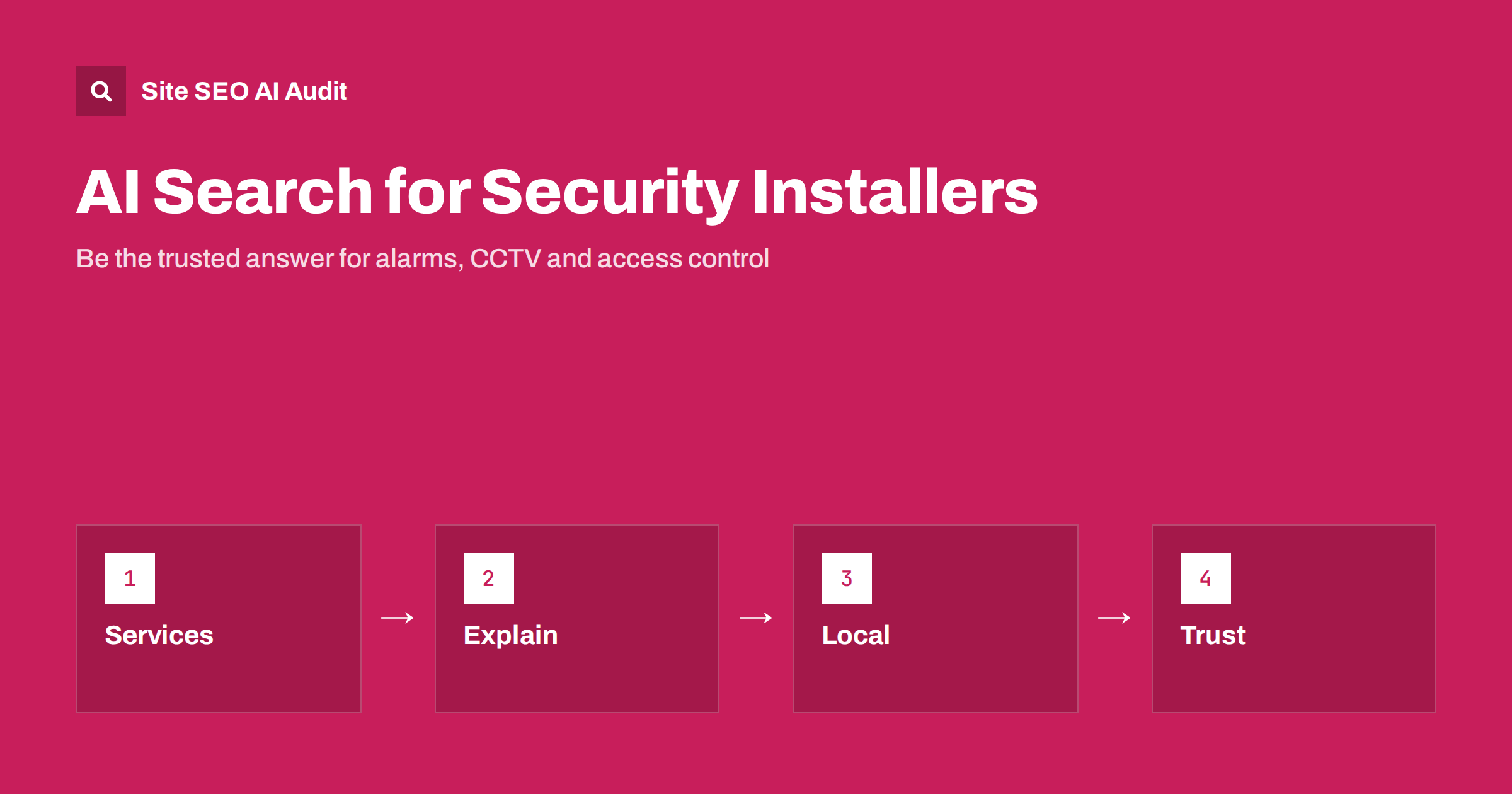
Short answer: People ask assistants which security company to choose, what an alarm system costs and whether cameras need a subscription. To be included in those answers, an installer needs a clear page for each service and system type, plain explanations of how equipment works, accurate service areas and contact details, visible licences, standards and warranties, and honest guidance on limits. Avoid fear-based claims and never publish details that could help someone defeat a customer’s protection.
Security is a purchase made with some anxiety. Homeowners and business owners want to know what they need, who is reliable and what happens after installation. They increasingly ask assistants first, and the answers favour companies whose sites explain things calmly and specifically. This guide shows how installers of alarms, video surveillance, access control and fire or intruder detection can build pages that answer real questions and earn trust. For the general method, see the AI search visibility checklist.
The questions customers ask
Typical questions include: how much does an alarm system cost for a house of a given size; is a wireless system as reliable as a wired one; do I need a monitoring contract; can I view cameras on my phone; how long does installation take; what happens when the power or internet fails; and which company covers my area. Business customers ask about access control for offices, compliance with insurer requirements and integration with existing systems.
Collect the questions your sales and support staff hear and group them by customer type: home, shop, office, warehouse, building manager. Each group needs pages that speak to its situation. The same advice sounds different to a family in a flat and to a company with three sites.
Service pages that can be cited
Create one page for each main service: intruder alarms, video surveillance, access control, fire detection if you offer it, monitoring and maintenance. Start each with a direct description of what the service includes, who it suits, how long installation usually takes, what the customer must prepare and how support works afterwards. Add typical price ranges or the factors that set the price, because cost is the most common question and an honest range is more useful than “contact us”.
Describe the process step by step: survey, proposal, installation, testing, training and handover. Explain what documents the customer receives, such as a plan, instructions and certificates. Keep wording factual. A page that says “the survey takes about an hour and you receive a written quote” is easier to trust and quote than one full of superlatives. The on-page basics are summarised in the on-page SEO checklist.
Explain systems in plain words
Many buyers do not know the terms. Write guides that explain wired and wireless detectors, door and window contacts, motion sensors, glass break detectors, sirens, control panels, app control, video recorders, camera resolution, night vision, cloud versus local storage and how access cards or codes work. For each, state what it does, when it is useful and what its limits are.
Be careful about what you publish. General explanations help customers. Detailed information about how to bypass equipment, the exact placement of devices at a named customer’s property or the weak points of specific models does not. Never show a customer’s address or plans without consent. Responsible content protects your clients as well as your reputation.
Honest limits and expectations
No system guarantees that nothing will ever happen. Explain what alarms and cameras can and cannot do, how false alarms occur and how to reduce them, and what the customer must do, such as maintaining batteries and keeping software updated. Describe what happens when the internet or power fails and what backup options exist.
This kind of candour builds more confidence than promises of total safety. It also matches how assistants prefer to answer: with balanced information and conditions. Avoid fear-based language and statistics you cannot source. If you cite crime figures, use a reliable public source and give the year.
Local details and coverage
For local searches, publish your service area clearly: the towns and regions you cover, where you do not install and how quickly you respond for emergencies and maintenance. Include the address of the office or workshop if customers can visit, opening hours, a phone number for new enquiries and a separate contact for existing customers who need support. Keep these identical on your site and your business profiles. The structure of local information is covered in the local business AI search guide, and the markup in the LocalBusiness schema guide.
If you operate from several branches, give each its own page with local staff, response areas and examples of completed work described in general terms. Mention if you provide 24-hour monitoring through your own centre or a partner, and be clear about which parts are done by whom.
Licences, standards and proof
Trust signals are especially important in this sector. State the licences or registrations required in your country, membership of professional bodies, the standards your installations follow, insurance cover and staff training or vetting. Link to the issuing body where a public register exists, so that a reader or an assistant can verify the claim. Keep these details current and remove any that have lapsed.
Add case descriptions that explain the problem, the solution and the result without revealing sensitive details, in the style of case study pages. Use genuine reviews and testimonials with permission, as covered in the guide to reviews and AI recommendations. Publish clear terms for warranties, maintenance contracts, cancellation and data handling for cameras, including how long recordings are kept and who can access them.
Maintenance, upgrades and after-sales content
Much of the value in this sector comes after installation, so describe it. Publish pages about maintenance visits, battery and sensor replacement, software updates for recorders and apps, upgrading an old alarm panel, adding cameras to an existing system and what happens when a customer moves house. Explain how to reach support, what the response times are and which problems the customer can solve alone, such as resetting a code or checking a connection.
A help section with short articles on common situations, such as a false alarm, a camera that went offline or a lost access card, answers questions that assistants receive from existing customers and shows prospects how well you look after people. Keep each article focused on one question, with steps in a numbered list and a contact route if the steps do not work. Link these to the main service pages so that crawlers and readers move easily between buying information and support information.
Business customers and compliance questions
Commercial buyers ask different things. They want to know how access control integrates with time and attendance, how many users and doors a system supports, how logs are kept and exported, how alarm events reach the responsible staff and what insurers or regulations may require. Publish a page for each business type you serve, such as shops, offices, warehouses, schools or residential buildings, and describe typical needs and solutions in plain terms.
Offer a downloadable checklist for site surveys or a short list of questions that a buyer should ask any supplier. Content like this is useful, easy to cite and shows confidence. Avoid claiming compliance with a standard or regulation unless you are certain and can show the evidence; where requirements vary by country or insurer, say so and advise the reader to confirm them.
Privacy and legal content
Surveillance raises privacy questions, and customers appreciate clear guidance. Explain in general terms the rules that apply to cameras on private property, signs, recording of public spaces and workplaces, and refer readers to the relevant authority for details. Say that you can advise on typical installations but that legal responsibility rests with the owner. Avoid giving legal advice beyond what you are qualified to provide. A short, accurate overview positions you as a careful professional.
Finally, measure and maintain. Each quarter, ask ten typical customer questions in several assistants, note whether your company appears and whether the details are correct, and fix the source pages when they are not. Review licence numbers, certificates, phone numbers and service areas whenever something changes, because outdated trust information can do more harm than none. Keep a record of the questions that new customers mention in their first call, and turn the most frequent into new pages or additions to existing ones.
Site SEO AI Audit crawls your website and checks status codes, titles, descriptions, headings, broken links, structured data, page speed and AI visibility settings such as AI crawlers in robots.txt, which helps you keep service and area pages crawlable and consistent. It does not assess security advice or compliance. The first audit of up to 200 pages is free, and larger sites can see the pricing page.
Related reading
The bottom line
Explain services and systems calmly, state limits honestly, show licences and keep local details exact.
FAQ
Should I publish prices for alarm installation?
Yes, at least ranges and the factors that change them. It answers the most common question and builds trust.
Can I show photos of completed installations?
Only with the customer’s consent and without revealing addresses, layouts or details that could weaken their security.
How do I handle monitoring in my content?
Explain what is monitored, by whom, how alerts are handled and what the contract terms are.
Is fear-based marketing effective?
It may attract clicks but harms trust and is a poor fit for assistants. Calm, factual information performs better over time.
Which structured data should I use?
LocalBusiness for each location, Organization for the company, and FAQPage for visible questions, all matching the page text.