ENEnglish
 LTLietuviškai
 DEDeutsch
 FRFrançais
 RUРусский
 ESEspañol
 PLPolski
 ITItaliano
 UKУкраїнська
 CSČeština
 PTPortuguês
 JA日本語
 LVLatviešu valoda
 ETEesti
 HUMagyar
 IDBahasa Indonesia
 TRTürkçe
 HIहिन्दी
 ELΕλληνικά
 ARالعربية
 THไทย
 VITiếng Việt
 RORomână
 MSBahasa Melayu
 BNবাংলা
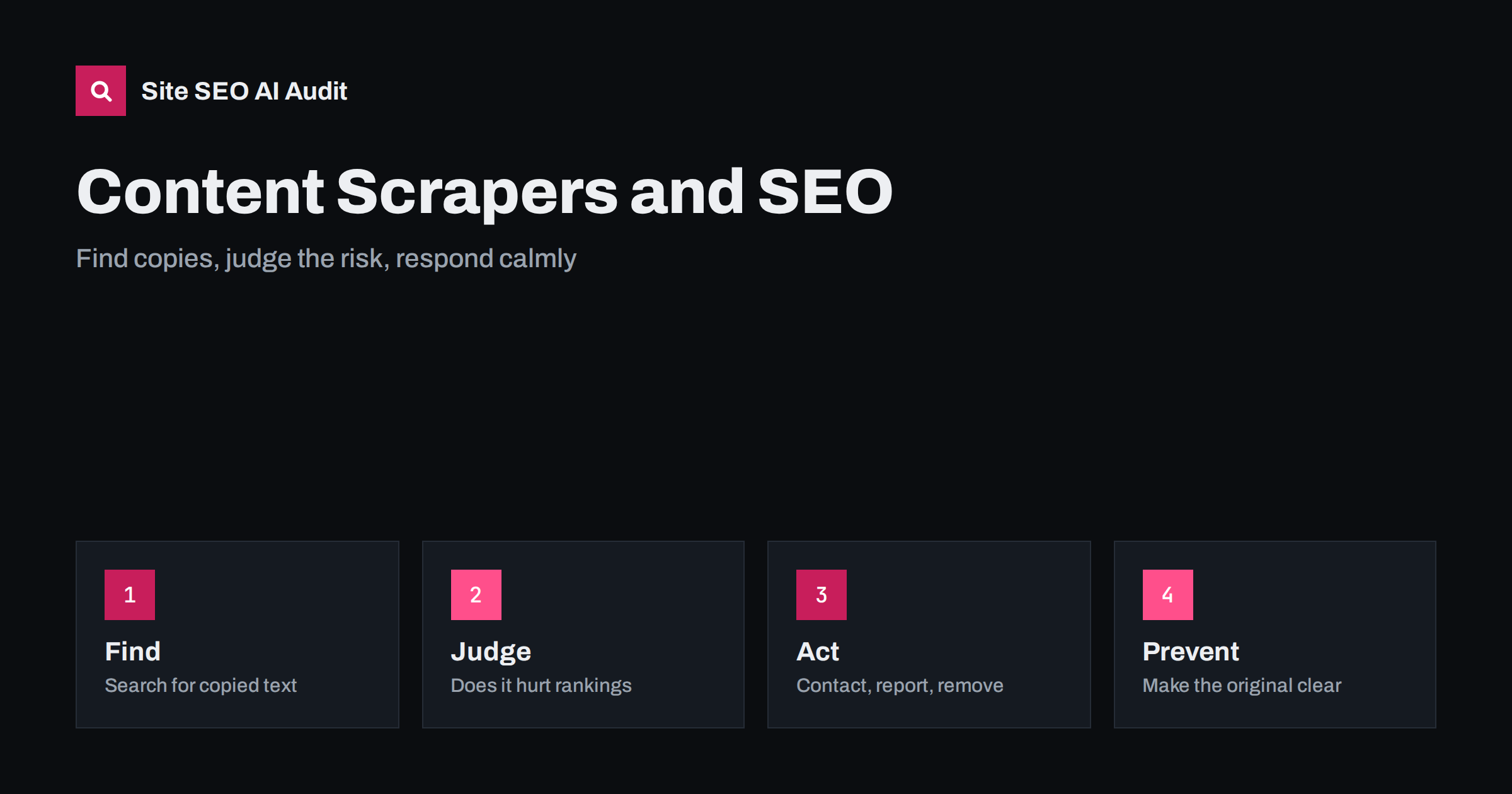
Short answer: Content scrapers copy articles, product descriptions and images and republish them elsewhere. In most cases search engines still prefer the original and the copy does little harm, but a scraper that outranks you, copies at scale or links to you from a spam network deserves action. Find copies by searching distinctive sentences, decide whether they matter, ask the site owner to remove them, report serious cases to the host and search engines through their legal and spam tools, and strengthen signals of originality such as fast indexing, canonicals and clear authorship.
Almost every successful site is copied. Automated tools harvest feeds, sitemaps and pages, then republish the text on sites built to earn advertising money or to fill a network with content. Seeing your article on a stranger’s site is irritating and can feel alarming, especially when you read that duplicate content can hurt rankings. The reality is usually calmer than the fear. Search engines have had years of experience with copies, and in most cases they identify the original. The skill lies in knowing when to ignore a copy, when to act and what actions work. This guide gives you a simple method and avoids both panic and neglect. For the wider topic, see cross-domain duplicate sites.
Understand why scrapers copy and how it happens
Scrapers take content for several reasons: to fill pages with text that attracts search traffic and advertising, to build a network of sites that link to one another, to create product catalogues without writing descriptions, to translate and republish articles in another language or to train other products. They find your pages through your RSS feed, your sitemap, links and general crawling. Some copy the text exactly, some rewrite it automatically and some change a few words to avoid detection. Knowing this helps you set expectations: you cannot stop every copy, and trying to chase all of them is a poor use of time. Focus on the cases that affect your visibility or your reputation.
Find copies of your content
Take a distinctive sentence from the middle of an article, put it in quotation marks and search for it. Repeat with a sentence from the end. Look for results from other domains. Search the same way for unusual product names or descriptions. You can also set alerts for phrases that are unique to your brand or articles, use a plagiarism checker on your most valuable pages and look at the links report in Search Console for sites that link to you from copied pages. Check your server logs for unusual crawlers that fetch pages at high speed. Keep a short log of what you find, with the address, the date and the extent of the copying, since you may need it for a complaint.
It also helps to separate scraping from legitimate reuse. Quotation with a link, a short excerpt in a news roundup, a translation published with permission and a partner who syndicates under an agreement are not the same as wholesale copying. Treat them differently: thank the partner, ask for a canonical link when it is missing and reserve complaints for copying that has no permission and no credit.
Judge the real SEO risk
Ask three questions. Does the copy rank above your page for your main queries? Is your original indexed and ranking as expected? Is the scraper site linking to you, and are those links likely to look like part of a spam pattern? If your page keeps its position and the copy ranks nowhere, the harm is negligible and the best response is to do nothing. If the copy outranks you, look for the reason: it may be on a stronger domain, it may have been indexed first or your page may have problems, such as being slow, blocked or thin. Check that your canonical tags and sitemap are correct and that your page is indexed, using the guidance in canonical tags explained. Do not assume that the copy is the cause before you have checked your own page.
Contact the site owner and the host
For a copy that matters, begin with a polite message to the owner through the contact page, with the address of the original, the address of the copy, the date of publication and a request to remove it or to add a link and a canonical pointing to the original. Many small site owners respond, especially if the copying was done by a plugin or an automated tool. If there is no reply, find the hosting company through public records of the domain and send a notice to their abuse contact, with the same evidence. Keep the tone factual. If you hold the copyright, you can state it, but get legal advice for serious or commercial disputes, because the rules differ between countries.
Report to search engines and use removal processes
Search engines have processes for reporting copyright infringement and spam. A copyright removal request can remove specific copied pages from results when you own the rights and the use is not permitted. A spam report is suitable for sites that publish mass scraped content to manipulate rankings. These processes have legal consequences and require accurate statements, so use them only for genuine cases and keep your evidence. Removal affects results in the search engine, not the site itself, so it works alongside contact with the owner and host. For general removal concepts, see how to remove a page from Google.
Make the original easier to recognise
You can lower the chance that a copy outranks you by making your page the clear source. Put your pages in your sitemap and request indexing for important new posts, use a self-referencing canonical on each page, include the publication and update dates and the author name in the visible text and markup, link to your own related pages inside the text so that copies carry those links, and use IndexNow where supported so that engines learn about your page early. Publish on your own site first, before you syndicate or send the text to partners. If you do syndicate, require a canonical link or at least a visible credit, as explained in content syndication and AI search.
A last technical measure is to watch your server logs for aggressive crawlers that request thousands of pages in minutes or ignore your robots.txt rules. A rate limit, a firewall rule or a bot-management setting at your content delivery network can slow them down. Do this with care so that you do not block search engine crawlers, and check the result in the crawl reports afterwards, using the crawl stats report guide.
Handle images, products and feeds
Scrapers also take pictures and product data. Add a clear brand mark in images where that fits your design, keep original files and dates, include descriptive alt text and consider whether your RSS feed should show full articles or a summary. A summary-only feed makes copying harder and sends readers to your site. For product descriptions, write original text instead of using manufacturer copy, since many shops share the same text and none of them stands out. Use unique details such as measurements, usage notes and photos of your own. The content issues that arise are explained in manufacturer product descriptions.
Know when to stop
Time spent on scrapers is time not spent on your own site. Set a rule: act only when a copy outranks you on an important query, copies a large part of your site, damages your reputation, appears in a context that misrepresents you or infringes on rights you wish to enforce. Otherwise, ignore it and invest the time in better content. Review the issue once a quarter with a quick search of your top pages. Remember that links from low-quality scraper sites are usually ignored, and you rarely need to disavow them; see when to use the disavow tool. A calm, regular check is far more effective than frantic action after each discovery, and it keeps the focus on making your own pages the best answer.
Site SEO AI Audit does not find copies of your content on other sites. It crawls your site, checks canonical tags, titles, duplicate pages, status codes, sitemaps and structured data, and ranks fixes by the points they add, so that your own pages send clear signals. The first audit of up to 200 pages is free; larger sites can see the pricing page.
Related reading
- Cross-Domain Duplicate Sites
- Duplicate Pages and AI Citations
- Content Syndication and AI Search
- Canonical Tags Explained
The bottom line
Most scraped copies do little harm. Search for distinctive sentences, check whether a copy outranks you, contact owners and hosts for the cases that matter, report serious abuse, make your original clear with canonicals and fast indexing, and avoid spending time on the rest.
FAQ
Does scraped content hurt my rankings?
Usually not, because search engines tend to identify the original. It matters if a copy outranks you or if copying is large and part of a spam pattern.
How do I find out if my content was copied?
Search for distinctive sentences in quotation marks, use plagiarism checkers on key pages and set alerts for unique phrases and product names.
Should I disavow links from scraper sites?
Rarely. Such links are usually ignored. Consider it only when there is a large, clear pattern of manipulative links and you have evidence of harm.
What is the best way to get a copy removed?
Contact the site owner first, then the host, and use the search engine’s copyright or spam reporting process if needed. Keep evidence and a factual tone.
Can I stop all scraping?
No. You can slow it, for example with summary feeds and bot rules, but a determined scraper will succeed. Focus on making your original clear and strong.