ENEnglish
 LTLietuviškai
 DEDeutsch
 FRFrançais
 RUРусский
 ESEspañol
 PLPolski
 ITItaliano
 UKУкраїнська
 CSČeština
 PTPortuguês
 JA日本語
JA日本語 LVLatviešu valoda
 ETEesti
 HUMagyar
 IDBahasa Indonesia
 TRTürkçe
 HIहिन्दी
 ELΕλληνικά
 ARالعربية
 THไทย
THไทย VITiếng Việt
 RORomână
 MSBahasa Melayu
 BNবাংলা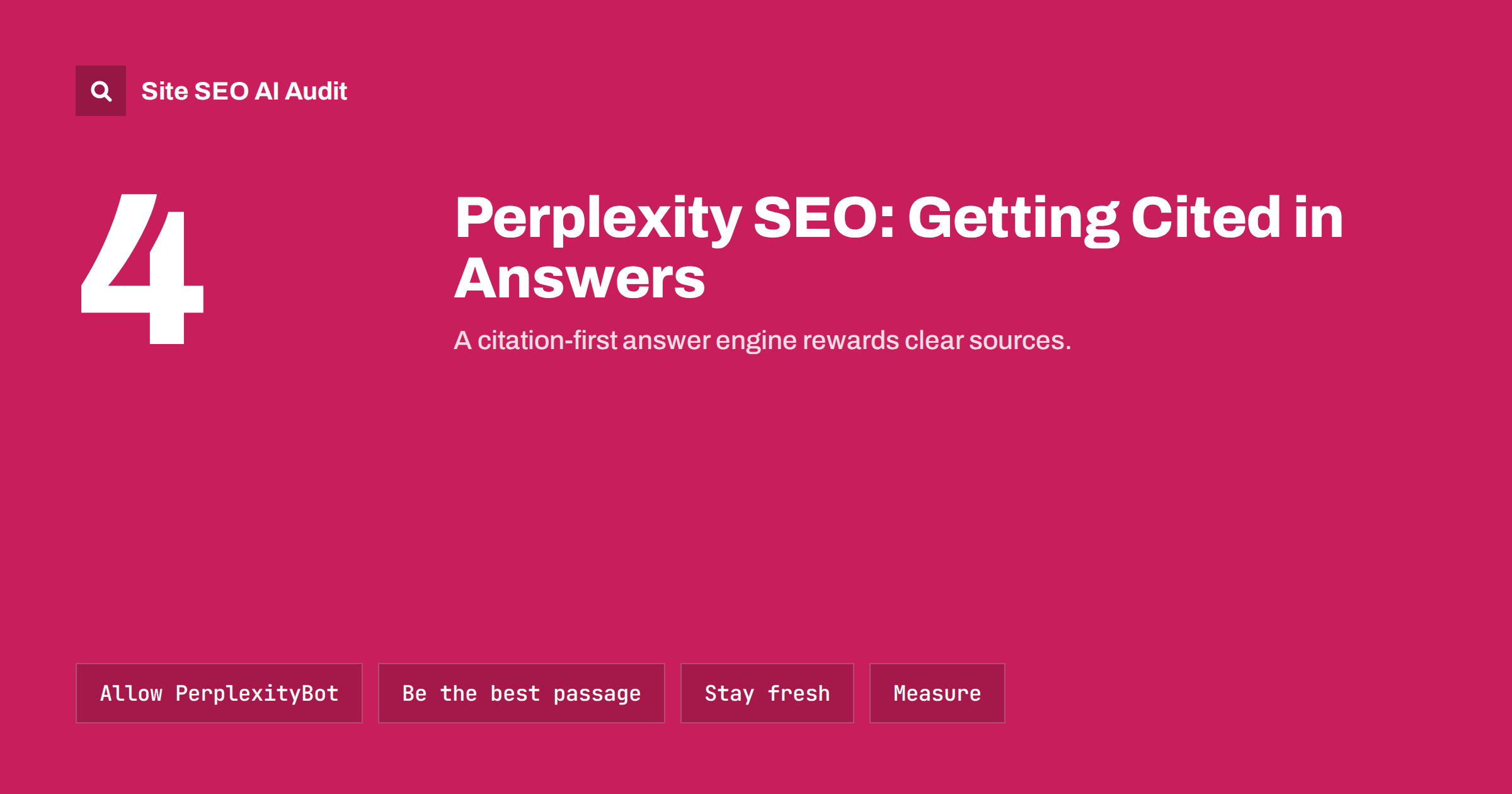
Short answer: Perplexity is an answer engine that searches the web for every query and shows numbered citations next to its answer. To be cited, your pages must be accessible to its crawler, PerplexityBot, and must contain clear, specific, up-to-date passages that answer the question better than competing pages. The same foundations that help in Google apply, but because Perplexity shows its sources so prominently, being a precise and trustworthy source has a direct payoff in visible citations.
How Perplexity differs from a search engine
A classic search engine returns a ranked list of links and leaves the reading to you. Perplexity reads for you. For each question it runs web searches, retrieves several pages, extracts the relevant passages and writes a summary with small numbered references. The sources appear at the top or beside the answer, and users can open them to check a claim.
This design has three consequences for site owners:
- Sources are always visible. Unlike answers that cite nothing or cite only on request, nearly every Perplexity answer lists its sources, so being chosen is a real, trackable outcome.
- Passages compete, not pages. A single paragraph that answers a subquestion precisely can earn a citation even if the rest of your page covers something broader.
- Freshness matters. Perplexity searches the live web for each query, so recent, updated pages have a genuine chance against older authoritative ones on topics that change.
Perplexity also offers deeper research modes that run many searches and read more sources for a longer report. These modes tend to cite a wider range of sites, including smaller specialist ones, which is an opportunity for niche experts.
Perplexity’s crawlers
Perplexity documents two user agents in its crawler guide:
- PerplexityBot crawls the web to surface and link websites in Perplexity’s search results. Perplexity says it respects robots.txt and is not used to crawl content for training foundation models.
- Perplexity-User fetches a page when a user’s question requires visiting it. Because these visits are triggered by a user, Perplexity has stated that this agent generally does not follow robots.txt rules.
If you want to appear in Perplexity answers, PerplexityBot must be allowed. Check your robots.txt for a group naming it, check that no wildcard rule blocks your content, and check your CDN and firewall logs for 403 or 429 responses to PerplexityBot requests. Perplexity publishes IP address ranges so you can confirm that requests really come from its crawler.
Perplexity has faced public criticism, including a 2025 report from a major CDN, alleging that some of its crawling used undeclared agents to get around blocks. Perplexity disputed parts of those claims. For site owners the practical takeaway is simple: robots.txt expresses your policy, but only server-level rules enforce it.
What makes a page a good Perplexity source
There is no published ranking formula. What we can say with confidence comes from how retrieval-based answer engines work and from what their answers consistently cite:
- A direct answer early in the page. The opening paragraph should answer the core question in plain words, so it can be lifted as a citation.
- Headings that match the question. Clear H2 and H3 headings let the system match a passage to a specific subquestion.
- Specific facts. Numbers, steps, requirements, dates, comparisons and definitions are more citable than general commentary.
- Content in the HTML. Many AI crawlers read raw HTML without running JavaScript. Text loaded by scripts may never be seen.
- Visible dates. A published and updated date helps the engine and the reader judge whether information is current.
- Credible context. An author with relevant expertise, clear business details and links to primary sources make a page easier to trust.
Topics where Perplexity cites smaller sites
Large publishers and well-known brands often dominate broad questions. Smaller sites get cited more often when they have something the big sites do not:
- Specialist depth. A detailed guide to configuring a specific tool, a regulation in one country, or a niche product category.
- First-hand experience. Real test results, photos, measurements and lessons from doing the work.
- Local knowledge. Services, prices and conditions in a particular town or region.
- Fresh information. Changes, releases and events that larger sites have not covered yet.
- Clear comparisons. Honest side-by-side comparisons with the criteria spelled out.
If your content strategy is a copy of what large competitors already publish, retrieval systems have little reason to prefer you. If it contains facts and experience that exist nowhere else, you become the natural source.
Writing for follow-up questions
Perplexity is built for conversations. After the first answer, it suggests related questions, and many users keep asking: “which one is cheaper?”, “does it work on WordPress?”, “what are the risks?”. Each follow-up triggers new searches, so a page that anticipates the next questions has several chances to be cited in the same session.
A practical way to plan for this is to take your main topic and write down the five or six questions a careful buyer would ask after the first answer. Then check whether your page answers each one in a clearly headed section. Typical follow-ups include:
- Cost and effort: what it costs, how long it takes, what skills it needs.
- Fit: who it suits, who it does not suit, and minimum requirements.
- Alternatives: how it compares with the two or three obvious options.
- Risks and limits: what can go wrong and how to avoid it.
- Next step: how to start, with concrete instructions.
An FAQ section at the end of the page is a natural home for short follow-up answers, as long as each answer is genuinely useful and not a repeat of the main text.
A practical checklist
| Area | Check | Why it matters |
|---|---|---|
| Access | PerplexityBot allowed in robots.txt and not blocked by CDN or firewall | Without access, pages cannot enter the index |
| Indexing | Pages return 200, are self-canonical and not noindexed | Broken or duplicate URLs waste crawl effort |
| Rendering | Main content visible in page source | Scripts may not be executed |
| Structure | Answer-first intro, question-style headings, short paragraphs | Passages are easier to match and quote |
| Freshness | Visible updated date, facts reviewed regularly | Live search favours current information |
| Trust | Author details, business information, cited sources | Helps the engine and readers weigh the source |
| Measurement | perplexity.ai referrals tracked as their own channel | Shows which pages are cited and clicked |
Measuring Perplexity visibility
Perplexity usually passes a referrer, so visits appear in analytics with a source of perplexity.ai. Group this with other assistants in a custom channel so you can see trends and landing pages. Your server logs add another layer: PerplexityBot requests show which pages are being crawled for the index, and Perplexity-User requests show pages fetched in real time for someone’s question.
Manual checks are also useful because Perplexity makes sources easy to see. Keep a list of ten to twenty questions that matter for your business, ask them each month, and record which sites are cited. Answers vary between sessions, so look for patterns over several months rather than reacting to a single result.
Mistakes to avoid
- Blocking PerplexityBot by accident with a blanket “block AI bots” setting at the CDN.
- Publishing thin question pages for every keyword variation. They rarely offer the best passage and dilute site quality.
- Hiding answers in PDFs or images without an HTML version.
- Leaving outdated facts on high-traffic pages. An old price or a discontinued feature can be repeated in answers.
- Keyword stuffing in an attempt to match queries. Answer engines match meaning, not repetition.
How Site SEO AI Audit helps
Site SEO AI Audit checks the technical conditions for AI citations across every page it crawls: whether AI crawlers such as PerplexityBot are allowed in robots.txt, whether content needs JavaScript to appear, and whether pages carry the structure and dates that answer engines quote. It also covers the classic foundations, including status codes, canonicals, noindex tags and internal links, and ranks every fix by the points it adds to your score. You can start with a free audit.
Related reading
- How to Get Your Website Cited in ChatGPT Search
- How to Allow or Block AI Crawlers in robots.txt
- How to Track AI Referral Traffic in Google Analytics 4
The bottom line
Perplexity rewards pages that are accessible, current and precise. Allow PerplexityBot, keep your main content in server-rendered HTML, answer questions directly with specific facts and visible dates, and bring something your competitors do not have. Then track perplexity.ai referrals and spot-check key questions to see which pages earn citations.
FAQ
Which crawler does Perplexity use?
Perplexity uses PerplexityBot to crawl and index pages for its answers, and Perplexity-User to fetch pages when a user’s question requires it. Both are documented in Perplexity’s crawler guide.
Does Perplexity use my content to train models?
Perplexity states that PerplexityBot is not used to crawl content for training foundation models. Its purpose is to surface and link websites in search results.
Can I block Perplexity completely?
You can disallow PerplexityBot in robots.txt, but Perplexity-User generally does not follow robots.txt because it acts for a user. To block all access, use server or firewall rules based on user agent and published IP ranges.
Why does Perplexity cite a competitor instead of me?
Usually because the competitor’s page answers the specific question more directly, is more current, or is easier to access. Compare the cited passage with your own page and close the gap with clearer, more specific content.
How do I know if Perplexity sends me traffic?
Look for sessions with perplexity.ai as the source in your analytics. Creating a dedicated AI referral channel makes these visits and their landing pages easy to follow over time.