ENEnglish
 LTLietuviškai
 DEDeutsch
 FRFrançais
 RUРусский
 ESEspañol
 PLPolski
 ITItaliano
 UKУкраїнська
 CSČeština
 PTPortuguês
 JA日本語
JA日本語 LVLatviešu valoda
 ETEesti
 HUMagyar
 IDBahasa Indonesia
 TRTürkçe
 HIहिन्दी
 ELΕλληνικά
 ARالعربية
 THไทย
THไทย VITiếng Việt
 RORomână
 MSBahasa Melayu
 BNবাংলা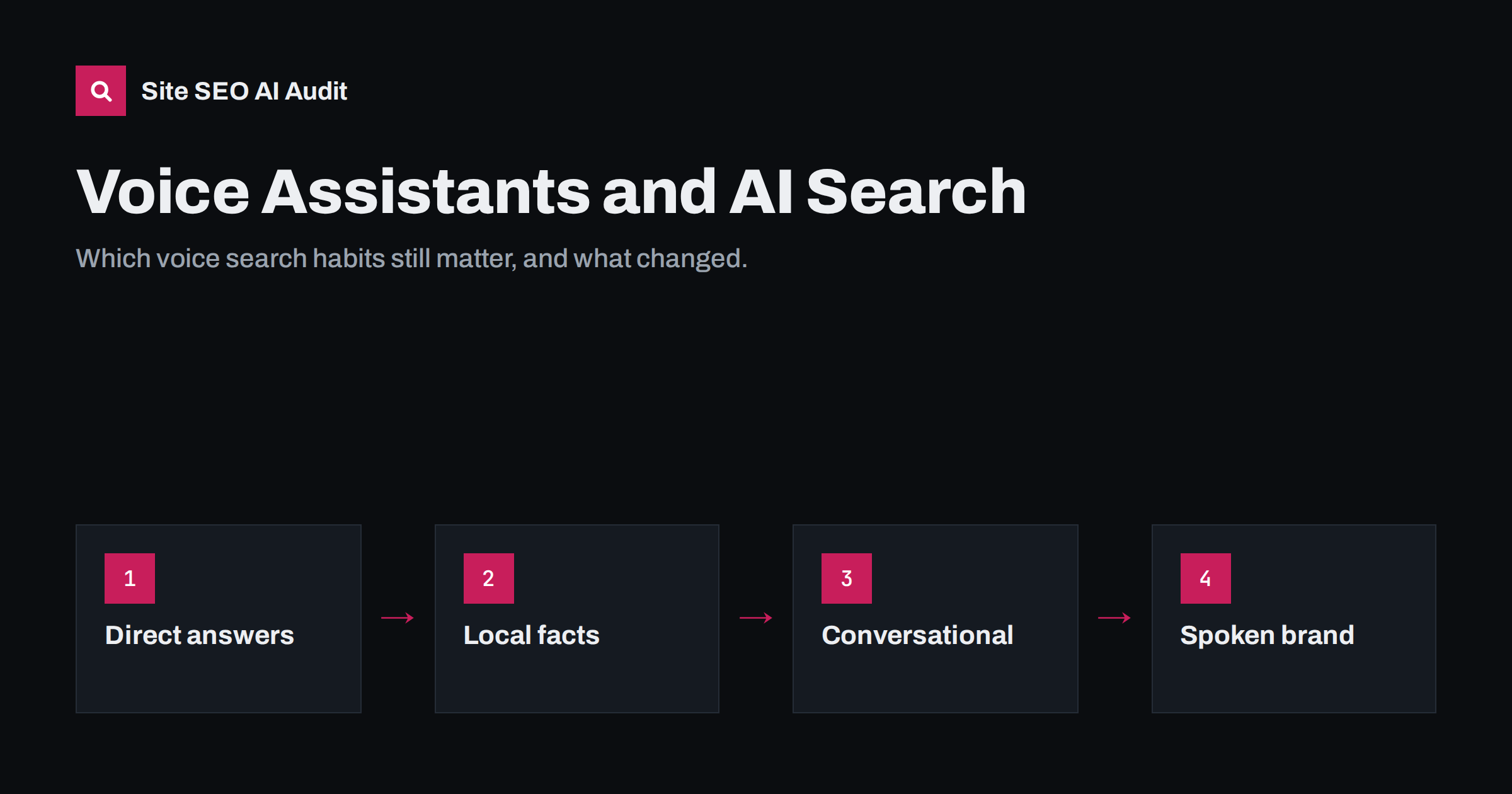
Short answer: Voice search did not replace typed search, but spoken questions are now often answered by AI assistants that combine search results into a short reply. The habits that helped with classic voice search still apply: answer common questions directly in the first sentences, keep local business information accurate everywhere, use natural question phrasing in headings and make pages fast and crawlable. What has changed is that spoken answers name fewer sources and rarely lead to a click, so being named, and having consistent facts, matters more than ranking position.
From voice search to voice-enabled AI assistants
A decade ago, “voice search optimisation” meant getting a page into the featured snippet or local result that a smart speaker or phone assistant would read aloud. Predictions that most searches would soon be spoken turned out to be exaggerated. Voice remained a convenient way to ask quick questions, set timers, get directions and call businesses, but typed search stayed dominant for research and purchases.
AI assistants have changed the picture again. Many now accept spoken questions and answer in a natural voice, drawing on web search, their own knowledge and connected services. Instead of reading one snippet, they compose an answer from several sources and allow follow-up questions. For site owners, voice is less a separate channel than one of several ways people interact with AI search.
If you are new to the underlying mechanics, how AI search engines work explains retrieval, ranking and answer generation.
What still applies from classic voice search
Several long-standing practices remain useful because they help any system that needs a short, reliable answer:
- Direct answers near the top. A clear two or three sentence answer at the start of a page or section is easy to quote, whether it is read aloud or shown on screen. See answer-first introductions.
- Question-based headings. People speak in full questions. Headings that match those questions, followed immediately by the answer, map well to spoken queries.
- Featured snippet structure. Short definitions, numbered steps and concise lists were the raw material of voice answers and are still good material for AI answers. The guide to featured snippets covers the formats.
- Fast, mobile-friendly, crawlable pages. Assistants cannot use content they cannot fetch or render.
- Accurate local information. “Is the pharmacy near me open now” was always a voice question, and it still is.
What has changed with AI assistants
Some old voice search advice no longer fits how assistants behave:
| Aspect | Classic voice search | Voice with AI assistants |
|---|---|---|
| Source of the answer | Usually one featured snippet or listing | Often several sources combined |
| Attribution | “According to example.com…” | Sometimes a named source, sometimes none |
| Query style | Short spoken keyword phrases | Longer, conversational questions with follow-ups |
| Result | One answer, then end | Dialogue that narrows down the need |
| Main opportunity | Winning position zero | Being the trusted, named option |
The practical consequence is that the goal shifts from “be the one snippet read aloud” to “be a source the assistant relies on and names when it recommends something”. That depends on clarity, consistency and reputation across the web, not on a single page format.
Follow-up questions also change what a good page looks like. A user might ask for a type of service, then for options nearby, then for prices, then for opening hours. An assistant that finds all of those facts clearly stated on one well-structured page, and confirmed by listings and reviews, can stay with your business through the whole conversation. A page that answers only the first question leaves room for a competitor at the next step.
Local businesses: the most voice-driven category
Many spoken questions have local intent: opening hours, directions, phone numbers, availability, “near me” services. Assistants answer these largely from business listings, maps data and websites. To be answered correctly:
- Keep business listings complete and current, including special hours for holidays.
- Use identical name, address and phone details on your website and on every listing and directory.
- Publish opening hours as text on the website, not only in an image, and mark them up with LocalBusiness structured data.
- Describe services in plain words that customers would say aloud, such as “same-day boiler repair”, not only internal product names.
- Make actions easy: a clickable phone number and a direct booking link, because a voice interaction often ends in a call or booking.
More on this in AI search for local businesses.
Write content that works when read aloud
A spoken answer has no headings, tables or bold text. Content that is easy to read aloud also tends to be easy to quote in written answers:
- Use short sentences and put the key fact first.
- Avoid depending on a table for the one fact people ask about most. State it in a sentence as well.
- Write numbers and units clearly, for example “about 20 minutes” rather than a range of symbols.
- Avoid ambiguous references like “see above” or “the table below” in answer paragraphs.
- Keep answers self-contained, so a single paragraph makes sense when quoted on its own.
- Define abbreviations the first time they appear, because a spoken answer cannot rely on a reader recognising them visually.
- Test a few key answers by reading them aloud yourself. If a sentence is hard to say in one breath, it is probably too long to quote.
These habits overlap with general readability; see readability and SEO.
Make your brand easy to say and recognise
In spoken answers, the brand name is often the only thing the listener remembers. That has a few consequences worth checking:
- Is your brand name easy to pronounce and to spell after hearing it? If not, make sure common spellings and misspellings still lead to you in search.
- Is the name used consistently across your site, listings and profiles, so that an assistant recognises it as one entity? The approach in entity SEO helps here.
- Does your Organization structured data state the official name, logo and profiles? Organization schema explains how.
Structured data and voice-specific markup
General structured data, such as LocalBusiness, Organization, Product and FAQPage where appropriate, helps machines understand facts on your pages, although no markup guarantees that an assistant will use them. Google has also offered a speakable property for marking sections suitable for text-to-speech, but it has remained limited in scope and availability, so it is not a priority for most sites. Focus on accurate, valid general markup and clear visible text instead.
Markup that is most useful for spoken, local and factual questions:
- LocalBusiness with address, phone number, opening hours and geographic coordinates.
- Organization with the official name, logo, contact points and links to official profiles.
- Product and Offer with price and availability for shops, so facts like “in stock” are unambiguous.
- Event with dates, times and location for businesses that run events.
Whatever you mark up must match what is visible on the page. Invalid or contradictory markup is worse than none, so validate it after every template change.
Measuring voice and assistant visibility
Voice queries are not reported separately in Search Console, and many spoken answers produce no click at all. Useful proxies:
- Calls, direction requests and bookings from business listings.
- Referral visits from AI assistants in analytics, as described in tracking AI referral traffic.
- Growth in branded searches after being mentioned in answers.
- Manual checks: ask assistants your customers’ typical questions aloud and note whether and how your business is mentioned.
Accept that much of the value is invisible in reports, as with other zero-click searches. Treat these signals as trends over several months rather than precise numbers, and compare them with the dates of changes you made to listings and content.
How Site SEO AI Audit helps
Site SEO AI Audit checks the website foundations that voice and AI answers depend on. Its AI visibility area looks at AI crawler access in robots.txt, llms.txt, content that needs JavaScript and the structure and dates that answers quote. The structured data checks validate Schema.org markup such as LocalBusiness and Organization, and the speed checks cover LCP, CLS and server response. You can start with a free audit of your website.
Related reading
- FAQ Sections That Work for Readers and AI Answers
- How to Write Content That AI Answers Actually Quote
- An AI Search Plan for Small Businesses: The First 90 Days
The bottom line
Voice search is now mostly one way of talking to AI assistants. The basics still hold: direct answers, natural question headings, fast crawlable pages and accurate local information. What matters more than before is being a consistent, recognisable source that assistants trust enough to name, because spoken answers mention few sources and rarely send clicks.
FAQ
Is voice search optimisation still worth doing?
Yes, but as part of optimising for AI answers rather than as a separate project. Direct answers, clear structure and accurate local information help in both spoken and written results.
Do voice assistants use featured snippets?
Classic voice assistants often read featured snippets or local results. AI assistants with voice modes usually combine several sources, but well-structured, concise answers remain the easiest content for them to use.
Which businesses benefit most from voice queries?
Local businesses, because many spoken questions are about opening hours, directions, availability and phone numbers. Keeping listings and website details accurate is the most important step.
Should I use speakable structured data?
For most sites it is not a priority, because its availability has remained limited. Valid general structured data and clear text that works when read aloud are more useful.
How can I measure voice search traffic?
Voice queries are not reported separately. Track calls and bookings from listings, AI referral visits, branded search growth and manual checks of how assistants answer your customers’ questions.