ENEnglish
 LTLietuviškai
 DEDeutsch
 FRFrançais
 RUРусский
 ESEspañol
 PLPolski
 ITItaliano
 UKУкраїнська
 CSČeština
 PTPortuguês
 JA日本語
JA日本語 LVLatviešu valoda
 ETEesti
 HUMagyar
 IDBahasa Indonesia
 TRTürkçe
 HIहिन्दी
 ELΕλληνικά
 ARالعربية
 THไทย
THไทย VITiếng Việt
 RORomână
 MSBahasa Melayu
 BNবাংলা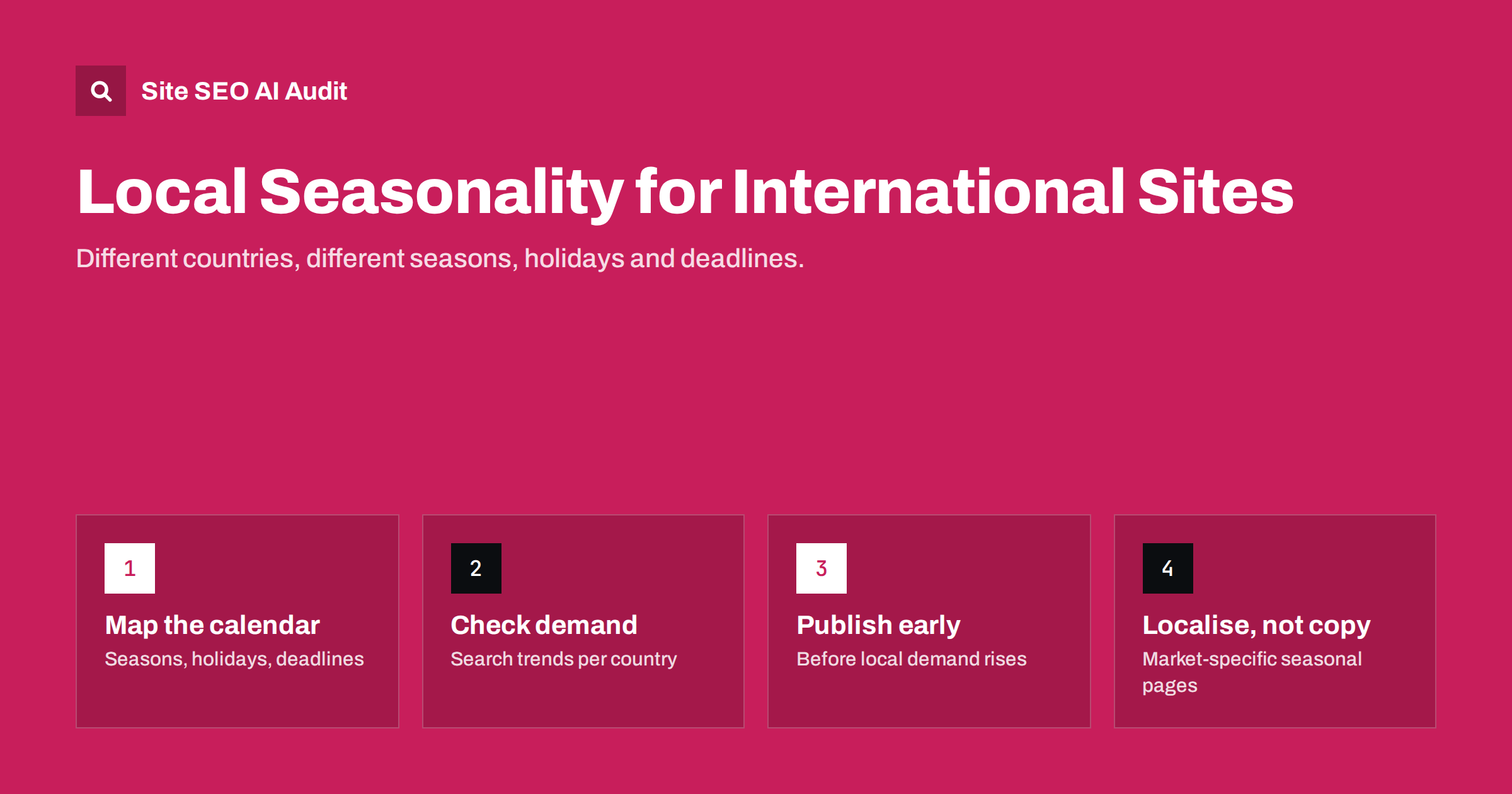
Short answer: Seasonal demand differs between countries: seasons are reversed in the southern hemisphere, holidays and shopping events vary, school years, summer breaks and tax deadlines fall on different dates, and some sales periods are set by law. An international site that publishes seasonal content on one global schedule will be early in some markets and late in others. Build a calendar per market, confirm the timing with local search data, publish before local demand rises, and create market-specific seasonal pages rather than translating one country’s campaign everywhere.
Why one global content calendar fails
Most content calendars are built around the home market. A European company plans summer content for June, gift guides for December and tax content for its own filing deadline. When the same calendar drives all language versions, several problems appear:
- Summer products are promoted in Australia, New Zealand or South Africa during their winter.
- Gift guides go live after the main gift-giving occasion in markets that celebrate at a different time.
- Tax and accounting content appears weeks after the local deadline has passed.
- Translated seasonal pages mention holidays or events that are unknown in the target country.
Search engines rank what is useful for the searcher at that moment. A page that arrives after local demand has peaked has missed its season, however well it is optimised. This is one reason localization goes beyond translation.
What differs from market to market
When building a market calendar, go through these categories for each country you serve.
| Category | Examples of differences |
|---|---|
| Climate seasons | Summer is December to February in the southern hemisphere |
| Religious and cultural holidays | Christmas, Easter, Ramadan and Eid, Diwali, Lunar New Year; several move every year |
| Shopping events | Black Friday is big in some countries and minor in others; Singles’ Day (11 November) matters in China and parts of Asia |
| Regulated sales periods | Some countries, such as France, set official dates for seasonal sales |
| School and holiday periods | School years start at different times; long summer breaks differ in timing and length |
| Tax and fiscal years | Fiscal years start in January in many countries, April in the United Kingdom, July in Australia |
| Industry events | Trade fairs, budget cycles and public procurement deadlines vary by country |
Not every category matters for every business. A software company cares about budget cycles and fiscal years; a clothing shop cares about climate and sales periods; a tax adviser cares mostly about deadlines.
Confirm timing with local search data
A calendar of events tells you when something happens. Search data tells you when people start looking for it, which is often much earlier. For each seasonal topic:
- Research the local search terms with a native speaker, because seasonal vocabulary is very culture-specific. The method in multilingual keyword research applies.
- Compare interest over time by country in a trends tool. Look at several years to separate recurring patterns from one-off spikes.
- Note when interest starts to rise, when it peaks and when it falls away.
- Check your own Search Console data by country for last year’s seasonal pages, as described in Search Console for international sites.
The start of the rise is your real deadline. Pages need time to be crawled, indexed and ranked, so they should be live and linked well before searches peak.
Build a market calendar
A simple shared spreadsheet is enough. For each market, list:
- The seasonal topic or event, with its local name.
- The date or period of the event, noting movable holidays that change every year.
- When search interest typically starts rising.
- The publish date and refresh date for the related page.
- The page URL in that market and the person responsible.
Review the calendar once a year, update movable dates and add events you learned about from local teams or customers. Market owners usually know the local rhythm far better than a central team.
Add a column for dependencies as well. Seasonal pages often need prices, stock information, promotional terms or legal texts from other teams, and those inputs usually determine whether a page can go live on time. Knowing them in advance avoids the common situation where a translated page is ready but waits for local prices until the season has already started.
Create local seasonal pages, not just translations
Seasonal content is where literal translation fails most visibly. A “summer checklist” translated for Australia and published in June is not just late; it is wrong. Treat seasonal pages as market-specific content:
- Some topics exist in only one or a few markets. A page about a regulated sales period or a local holiday does not need equivalents everywhere.
- Some topics exist everywhere but at different times. Summer, back-to-school and year-end pages need different publishing dates per market, and often different product selections.
- Some topics share a structure but not the details. Tax deadline guides follow the same pattern in each country, but every date, form and rule is local.
For hreflang, connect only pages that are true equivalents. A French page about the country’s official sales periods should not be forced into an hreflang set with an English page about Black Friday. Pages without equivalents can stand alone, as covered in untranslated pages on multilingual sites.
Keep seasonal URLs stable in every market
The same principle that applies to single-market seasonal pages applies here: keep one permanent URL per market for each recurring season and update it every year, instead of creating new yearly URLs. This lets the page build history and links over time. Our guide to seasonal pages and SEO explains the approach in detail.
Out of season, keep the page live with useful evergreen information and a note about when the next season starts, rather than deleting it or redirecting it to the home page. When the season returns, refresh the content following a routine like the one in how to refresh old content.
Internal linking and timing on the site
Search engines and visitors find seasonal pages faster when the site points to them at the right moment:
- Link the seasonal page from the market’s home page or main category pages while the season is approaching.
- Add links from related evergreen articles in the same language.
- Remove or reduce prominent links after the season, but keep the page reachable.
- Make sure the language switcher on a seasonal page leads to the matching page in other languages only where one exists.
Because markets run on different schedules, homepage and navigation changes must be scheduled per language version, not once for the whole site.
Measuring seasonal performance per market
Seasonal results are easy to misread if you compare the wrong periods. A few habits make reporting reliable:
- Compare year over year, not month over month. A drop from December to January means little for a seasonal page; a drop compared with last January does.
- Align movable holidays. When an event moves by several weeks between years, compare the weeks around the event rather than the same calendar dates.
- Report per market. Filter Search Console and analytics by country or language folder, so a strong season in one market does not hide a weak one elsewhere.
- Record publish dates. Note when each seasonal page went live or was refreshed. If rankings arrived after the peak, the next publish date should move earlier.
- Collect local feedback. Ask market owners and customer support what customers asked about during the season; it often reveals topics for next year.
After each season, spend an hour updating the market calendar with what you learned. Over two or three years, the calendar becomes one of the most valuable planning documents for international content.
How Site SEO AI Audit helps
Seasonal work creates many page changes across language versions in a short time. Site SEO AI Audit crawls every language version and checks hreflang return links, broken language versions and lang attributes, as well as titles, descriptions, internal links and orphan pages. That catches a seasonal page that was published without links, or an hreflang set that points to an outdated page, before the season peaks. See the plans for regular re-audits.
Related reading
- International Ecommerce SEO: Selling in Several Countries
- hreflang Return Links: How to Fix “No Return Tags” Errors
- Which Blog Posts to Translate First: A Data-Led Approach
The bottom line
Each market has its own seasons, holidays, sales periods and deadlines, and search demand rises before those dates. Replace one global content calendar with a calendar per market, confirm timing with local search data, publish market-specific seasonal pages on stable URLs before interest rises, connect only true equivalents with hreflang and schedule internal links per language version.
SSS
Why does seasonality matter for international SEO?
Searchers look for seasonal topics shortly before local events and seasons. If content is published on the home market’s schedule, it can arrive too late in other countries or promote the wrong season.
How early should seasonal content be published?
Publish before local search interest starts to rise, not at the peak. Check several years of trends data per country and allow time for crawling and indexing, which often means several weeks.
Should seasonal pages be translated for every language?
Only if the topic exists in that market at a similar time. Many seasonal pages need market-specific versions with local dates, events and products rather than direct translations.
Should seasonal pages use hreflang?
Use hreflang only between pages that are true equivalents. A page about a local holiday or sales period that has no counterpart in another market can stand alone.
What should happen to seasonal pages out of season?
Keep them live on the same URL with evergreen information and a note about the next season. Reduce prominent links, then refresh the page and its links before demand rises again.