ENEnglish
 LTLietuviškai
 DEDeutsch
 FRFrançais
 RUРусский
 ESEspañol
 PLPolski
 ITItaliano
 UKУкраїнська
 CSČeština
 PTPortuguês
 JA日本語
JA日本語 LVLatviešu valoda
 ETEesti
 HUMagyar
 IDBahasa Indonesia
 TRTürkçe
 HIहिन्दी
 ELΕλληνικά
 ARالعربية
 THไทย
THไทย VITiếng Việt
 RORomână
 MSBahasa Melayu
 BNবাংলা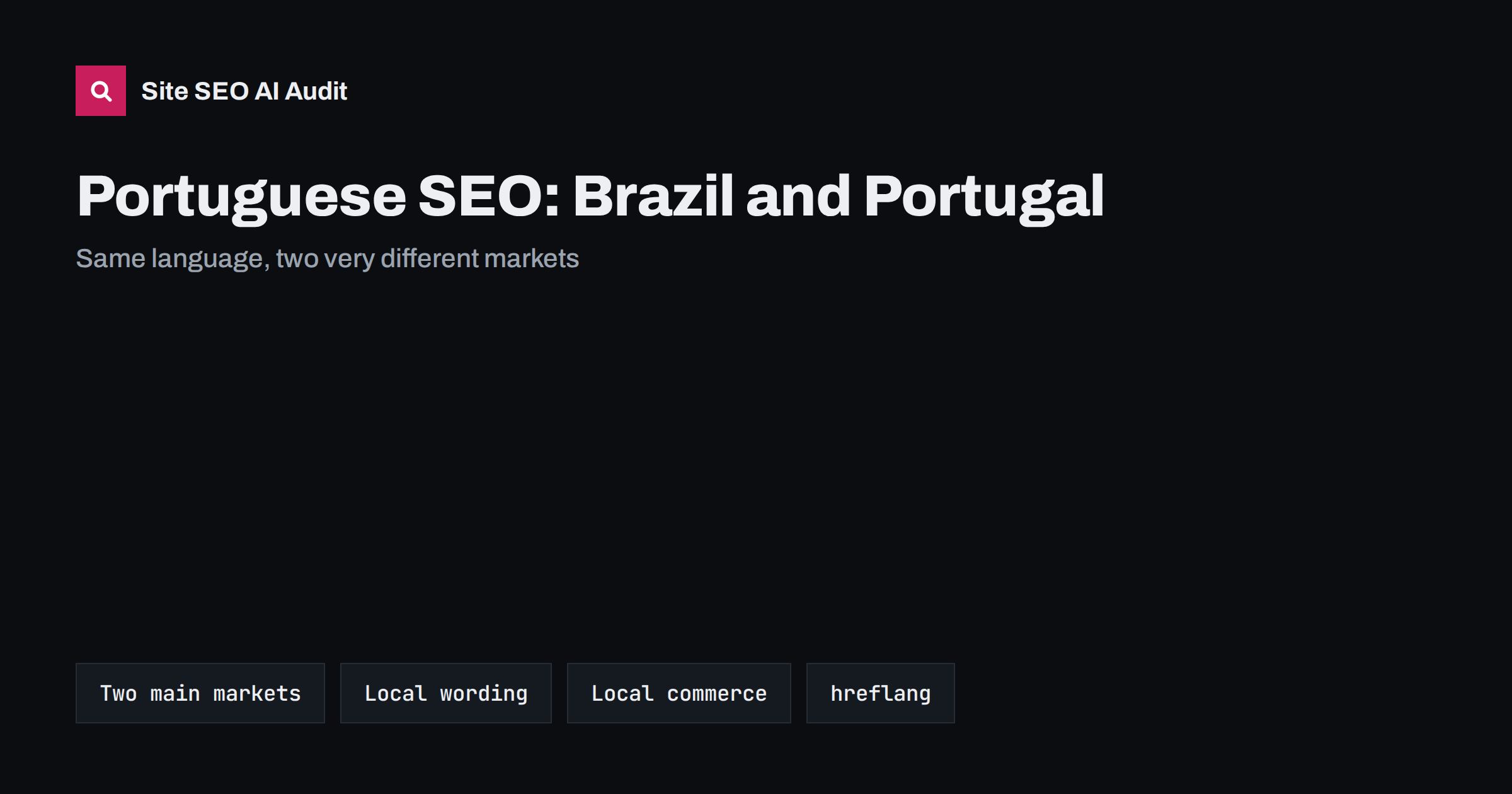
Short answer: Portuguese SEO usually means choosing between, or combining, two main versions: Brazilian Portuguese (pt-BR) and European Portuguese (pt-PT). They differ in vocabulary, grammar habits, spelling details, currency, payment methods and search behaviour. If you serve both markets, create separate versions with valid hreflang codes and local content. If you serve only one, target it clearly. Do not copy one text to the other country with a few words replaced, because readers notice and search engines may treat the pages as duplicates.
Portuguese is spoken by hundreds of millions of people, but the numbers hide an important imbalance. Brazil has by far the largest population of Portuguese speakers, while Portugal is a much smaller market with its own habits and expectations. Other countries, including Angola and Mozambique, add further audiences. A site that treats “Portuguese” as one language with one audience tends to feel slightly wrong to everyone. This article shows how to plan versions, research keywords and set up the technical side correctly.
Decide which market you serve
Start with the commercial question, not with the translation. Where are your customers, and where can you ship, invoice and provide support?
- Brazil: a very large online market with its own regulations, taxes, logistics and payment preferences. Most of the Portuguese-language search volume comes from here.
- Portugal: a smaller European market inside the EU, with euro pricing and European consumer rules.
- Other Portuguese-speaking countries: they have distinct conditions, and often use a form of the language closer to the European one. Serve them only if you can truly do business there.
If most of your audience is in one country, build for that country first. Our guide to choosing target markets explains how to compare them using demand and capacity.
The main differences between pt-BR and pt-PT
The two varieties are fully understandable to each other, but a reader notices the differences immediately:
- Vocabulary. Everyday words differ. Terms for common things such as a mobile phone, a bus, a breakfast or a bathroom change between countries, which directly affects keywords.
- Forms of address and grammar. The way people address each other, the use of pronouns and some verb forms differ. Brazilian copy tends to be warmer and more direct; European copy is often more formal.
- Spelling. An orthographic agreement brought the spelling closer, but differences remain in some words and in how foreign terms are adapted.
- Spoken and written style. Slang, humour and idioms differ, and translated jokes rarely survive.
Hire or consult a native speaker from the target market for headlines, calls to action and product names. A machine translation can be a starting point, but check our advice on machine translation and SEO before publishing it unreviewed.
Keyword research for each country
Do not assume that a keyword that works in one country will work in the other. Check each market separately:
- Use keyword tools with the correct country and language setting.
- Look at the search suggestions and the results seen from each country, not only your own.
- Compare the words used by competitors that are based in the country.
- Note which English terms people use unchanged, as some industries rely heavily on them.
For the method, see multilingual keyword research. The same product can have two entirely different main keywords in Brazil and Portugal, so a single page cannot target both well.
Structure: one version or two?
The choice depends on how much your offer differs:
- Brazil only or Portugal only. One Portuguese version, targeted at that country.
- Both markets with similar content. Two versions with shared structure but localised text, prices and legal pages.
- Both markets with different offers. Fully separate sections, possibly with a country-specific domain, if the business is large enough to support it.
The structural options are the same as for any international project: country domains, subdomains or subfolders. Our comparison of ccTLDs, subdomains and subfolders will help you decide. A subfolder structure such as /pt-br/ and /pt-pt/ is easy to manage for many sites.
Set up hreflang correctly
Hreflang tells search engines which Portuguese version to show in which country. A typical set looks like this:
<link rel="alternate" hreflang="pt-BR" href="https://example.com/pt-br/" />
<link rel="alternate" hreflang="pt-PT" href="https://example.com/pt-pt/" />
<link rel="alternate" hreflang="pt" href="https://example.com/pt/" />
<link rel="alternate" hreflang="x-default" href="https://example.com/" />
Check these details: every page must list itself and all its alternates; each alternate must link back; codes must be valid, so use pt-BR and pt-PT, not “pt-br-pt” or “br”. If you have only one Portuguese version, a plain pt code is enough. See the hreflang guide and hreflang return links for the details that often go wrong.
Localise the commercial experience
In e-commerce and services, local details decide whether a visitor buys:
- Currency and prices: reais in Brazil and euros in Portugal, with local tax rules shown clearly.
- Payment methods: each country has popular local options, and visitors expect to see them. Research what is common before choosing.
- Delivery and returns: shipping times, costs and return rules, adapted to each market.
- Legal and company information: local terms, privacy policy and identification details where the law requires them.
- Customer support: contact hours in the local time zone, and a phone number or chat in the local language.
More guidance is available in international e-commerce SEO and local currency prices and SEO.
Technical and content mistakes to avoid
- Publishing the same Portuguese text on both versions with no differences, so that search engines see duplicates.
- Redirecting visitors by IP address, which can block users and crawlers from the other version. See language redirects.
- Translating the body but leaving the title, description, image alt text and structured data in English.
- Using the wrong lang attribute, such as lang=”pt” everywhere, when the page is specifically pt-BR or pt-PT. See the HTML lang attribute.
- Relying on one version’s links and reviews to carry the other.
Content ideas that work in both markets
Once the structure is set, plan content with the two audiences in mind. Some topics are shared, such as general guides and explanations, and these can be written once and then adapted by a local editor. Others are specific, for example laws, public holidays, seasonal buying habits, local brands and examples. A shop that sells clothing will see different seasons in the two countries, and a service provider will need different regulatory references.
A practical workflow looks like this:
- Write the source article with clear, simple language that translates well.
- Give it to a local editor for each market, with a brief that lists the target keywords, the tone and the local examples to include.
- Have the editor adapt headings, examples, units, dates and calls to action, not only the words.
- Review the final pages together, checking that internal links point to the right version and that the metadata is localised.
- Keep a glossary of approved terms for each market, so that product names and key phrases stay consistent across pages and authors.
This approach costs more than a straight translation, but it avoids the typical problem of pages that are technically correct and still feel foreign. It also gives each market its own chance to rank for the phrases that people there actually use.
Measure the two versions separately. In Search Console, filter by country and by page folder, and compare impressions, clicks and the queries behind them. If one version attracts visitors from the wrong country, review hreflang, internal links and the language of titles before rewriting the text. Over time, the data will show which topics deserve more local content and which can be shared.
One last practical point concerns names and branding. Product names, slogans and even company descriptions may sound different, or carry unintended meanings, in the other variety. Test important names with a native speaker from each country before you print them on packaging, ads or landing pages, and keep a short list of approved translations so that every page uses the same wording.
Also review your support content. Help pages, FAQs and email templates should follow the same local conventions as the main pages, because visitors often judge a company by how well it answers a question after the sale.
Audit your Portuguese versions
With two or more versions, hreflang and language errors multiply quickly. Site SEO AI Audit crawls your site like a search engine and checks hreflang return links, broken language versions, x-default and lang attributes, as well as titles, links, speed and AI visibility. The first audit of up to 200 pages is free.
Related reading
The bottom line
Portuguese SEO works when you treat Brazil and Portugal as separate audiences that share a language. Pick the markets you can really serve, research keywords for each, write natural local text, set the technical language signals correctly and adapt prices, payments and legal pages. If you serve one country, say so clearly. If you serve both, give each its own version and connect them with valid hreflang.
SSS
Do I need separate pages for Brazil and Portugal?
If you serve both markets and your offer, wording or prices differ, yes. A single neutral version can work for informational content, but shops and services usually benefit from separate versions.
What hreflang codes should I use for Portuguese?
Use pt-BR for Brazil, pt-PT for Portugal and pt as a general fallback if needed. Add x-default for the page that should serve everyone else, and include return links on all versions.
Can I translate English text into Portuguese automatically?
You can create a draft that way, but have a native speaker of the target variety review it. Machine output often mixes Brazilian and European forms, which looks careless to readers.
Which Portuguese market is bigger?
Brazil has a much larger population and online audience than Portugal. That does not make it the right choice for every business, because logistics, rules and competition also matter.
Should I use a country domain for each market?
Country domains give a strong local signal but require separate maintenance and authority building. Subfolders on one domain are simpler for most sites. Choose according to your resources and long-term plans.