ENEnglish
 LTLietuviškai
 DEDeutsch
 FRFrançais
 RUРусский
 ESEspañol
 PLPolski
 ITItaliano
 UKУкраїнська
 CSČeština
 PTPortuguês
 JA日本語
JA日本語 LVLatviešu valoda
 ETEesti
 HUMagyar
 IDBahasa Indonesia
 TRTürkçe
 HIहिन्दी
 ELΕλληνικά
 ARالعربية
 THไทย
THไทย VITiếng Việt
 RORomână
 MSBahasa Melayu
 BNবাংলা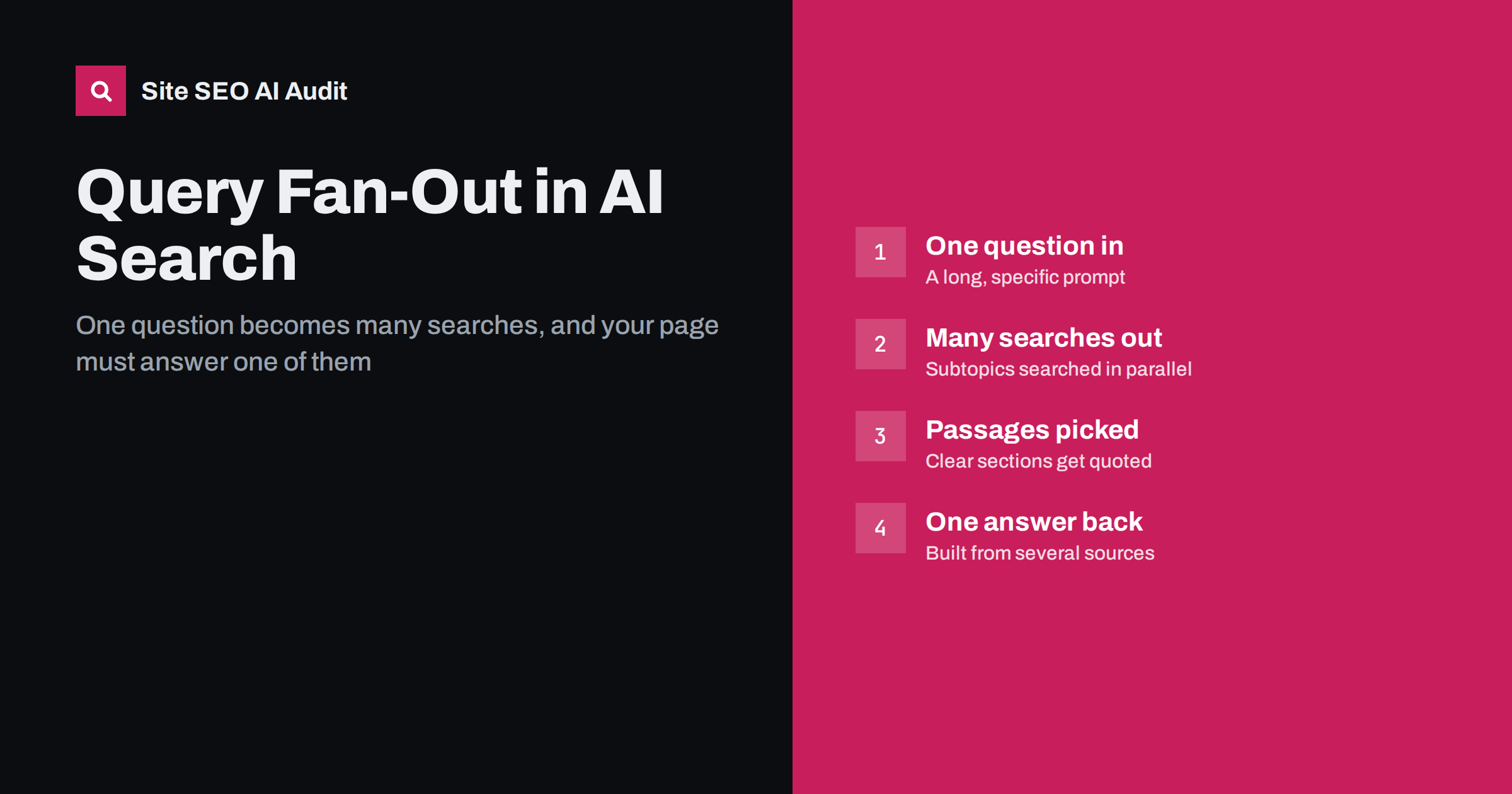
Short answer: Query fan-out is the technique AI search uses to split one complex question into several related sub-queries, run them at the same time, and combine the best passages into one answer. Google has described it publicly as the way its AI Mode works. For site owners it means a page no longer has to match the whole question: it needs to answer one of the sub-questions clearly enough to be picked.
Classic search matched a query to a list of pages. AI search works more like a research assistant: it reads the question, decides what it needs to know, looks those things up, and writes a summary. Understanding that middle step, the fan-out, explains a lot of things that look strange in your data, such as pages cited for questions they never targeted.
What query fan-out actually is
Imagine someone asks: “Which project management tool is best for a five-person design agency that works with clients in different time zones?” No single page is written for that exact sentence. An AI search system therefore breaks it into smaller questions, for example:
- project management tools for small agencies;
- client access and guest permissions in project tools;
- time zone and scheduling features;
- pricing for teams of around five people;
- reviews or comparisons from design teams.
Each of these runs as its own search, often in parallel. The system then reads the results, keeps the passages that answer each part best, and writes one response with links to the sources it used. Google explained this approach when it introduced AI Mode, and other AI search products describe similar multi-step retrieval. The exact number and wording of sub-queries is not public and changes from question to question.
Why it changes how pages get found
With fan-out, the unit of competition is no longer the page versus the query. It is the passage versus the sub-query. That has several consequences:
- Long-tail pages get a second life. A narrow page about “guest access for clients” may never rank for a broad keyword, but it can be the best answer to one sub-query and get cited.
- Sections matter more than whole pages. A clear section with its own heading and a direct answer can be lifted out and used, even if the rest of the page is about something else.
- Coverage beats repetition. Repeating a keyword does nothing for sub-queries you never address. Covering the related questions people actually have does.
- Traffic data gets noisier. Your page may be used for a question you cannot see in any keyword report, because the visible query was the user’s long prompt, not the sub-query that found you.
This fits the broader picture of how AI search engines work: retrieval first, generation second. Fan-out simply makes the retrieval step wider.
How to predict the sub-queries for your topic
You cannot see the exact sub-queries, but you can make good guesses. The sub-queries tend to follow the natural parts of a decision or task.
- Start with real questions. Collect the questions customers ask in emails, sales calls, support tickets and reviews. These are the prompts people type into AI tools.
- Split each question into facets. For a product decision, typical facets are: what it is, who it is for, features, price, alternatives, limitations, setup and proof. For a how-to task: prerequisites, steps, common errors, tools and time needed.
- Look at related searches. “People also ask” boxes and related searches in classic results are a useful public signal of how a topic branches.
- Ask AI tools yourself. Run the long questions your customers would ask and note which subtopics the answers cover and which sources they cite. Our guide to prompt research for AI search explains how to do this systematically.
Write the facets down as a list. That list becomes your content plan, and each item should have a clear home on your site.
Writing pages that answer sub-queries
Once you know the facets, the writing rules are simple, and most of them are good for human readers too.
- One facet per section. Give each sub-topic its own heading that says what the section answers, for example “Does it support client guest access?” rather than “More features”.
- Answer first. Put a direct, self-contained answer in the first one or two sentences under the heading, then the detail. A passage that only makes sense after reading the previous three paragraphs is hard to quote.
- Name things explicitly. Repeat the subject instead of “it” or “this” at the start of key paragraphs, so the passage still makes sense when it is taken out of context.
- Use lists and tables for facts. Specifications, steps, pros and cons and comparisons are easier to extract from structured HTML.
- Keep facts current and dated. Prices, version numbers and limits change. Show when the page was last updated.
For more on making passages quotable, see how to write content that AI answers quote.
Topic coverage across a site
Fan-out rewards sites that cover a topic broadly, not just pages that cover it deeply. If an AI system runs six sub-queries and your site has strong answers for four of them, you have four chances to be cited instead of one.
| Approach | What happens with fan-out |
|---|---|
| One long page that mentions everything briefly | Rarely the best answer to any single sub-query |
| One page with clear sections per facet | Several sections can be picked for different sub-queries |
| A hub page plus focused pages for big facets | Best coverage; each page can win its own sub-query |
| Many thin pages on tiny variations | Little value; thin pages are seldom chosen as sources |
This is the same idea behind semantic SEO and topic coverage and topic clusters with pillar pages. Fan-out gives it a very practical reason.
Technical basics that decide whether you are even considered
Good writing does not help if the retrieval step cannot reach or read the page. Check these first:
- Indexable pages. AI features that rely on a search index can only retrieve pages that are indexed. Noindex tags, wrong canonicals and blocked URLs remove you from the pool.
- Crawler access. Make sure robots.txt and any firewall or CDN rules do not block the search and AI crawlers you want to allow.
- Content in the HTML. Text that appears only after JavaScript runs may be missed by crawlers that do not render scripts.
- Clean structure. One H1, logical H2 and H3 headings, and real lists and tables instead of styled divs.
Site SEO AI Audit checks exactly this layer in its AI visibility area: AI crawlers in robots.txt, llms.txt, content that needs JavaScript, and the structure and dates that AI answers quote, alongside six classic SEO areas. Each issue comes with a fix and the number of points it adds, so you know where to start. You can audit your site for free to see where you stand.
Measuring the effect
Fan-out makes measurement harder, but not impossible.
- Referral traffic from AI tools. Track visits from AI assistants and AI search products separately in analytics.
- Landing pages, not keywords. Look at which pages receive AI referrals. Often they are focused, specific pages rather than your broad guides.
- Manual checks. Keep a list of 20 to 50 realistic customer prompts and check every month which sources the answers cite.
- Search Console impressions. Long, conversational queries with impressions but few clicks are a hint that your pages are being considered for complex questions.
Expect variation: AI answers change from run to run, so look at trends over weeks, not single results.
Common misunderstandings
- “I need a page for every possible prompt.” No. You need clear answers to the recurring facets of your topic. Prompts vary endlessly; facets do not.
- “Fan-out means keywords no longer matter.” Sub-queries are still searches. Using the words people use for a facet still helps your section get retrieved.
- “Only big sites benefit.” Fan-out can favour a small site with a precise answer to a narrow sub-query over a big site with a vague overview.
- “There is a special markup for fan-out.” There is none. Clear content, good structure and normal indexability are what count.
Related reading
- Google AI Mode for site owners
- How AI search engines work
- Prompt research for AI search
- FAQ sections and AI answers
The bottom line
Query fan-out turns one question into many smaller searches, and AI search builds its answer from the best passages it finds for each. To be part of those answers, map the facets of your topic, give each facet a clear section or page with a direct answer, and make sure crawlers can reach and read that content. The sites that win are not the ones that repeat a keyword most, but the ones that answer the most sub-questions well.
SSS
What is query fan-out in simple terms?
It is when an AI search system splits a question into several smaller searches, runs them, and combines the results into one answer. It lets the system answer long, specific questions that no single page targets directly.
Does query fan-out happen in Google AI Overviews and AI Mode?
Google has described query fan-out as a core technique of AI Mode, and similar multi-step retrieval is used in other AI search products. The exact sub-queries are not shown to users or site owners.
Can I see which sub-queries found my page?
Not directly. You can infer them from the pages that receive AI referral traffic, from long queries in Search Console, and by testing realistic prompts yourself and noting which sources are cited.
Should I rewrite all my pages for fan-out?
No. Start with your most important topics. Add clear headings, direct answers at the start of sections, and focused pages for the biggest facets that are missing. Many existing pages need only small structural changes.
Is query fan-out bad for small websites?
Not necessarily. Because answers are built from passages, a small site with a precise answer to one sub-question can be cited next to much larger sites. Clear, specific content is the advantage.