ENEnglish
 LTLietuviškai
 DEDeutsch
 FRFrançais
 RUРусский
 ESEspañol
 PLPolski
 ITItaliano
 UKУкраїнська
 CSČeština
 PTPortuguês
 JA日本語
JA日本語 LVLatviešu valoda
 ETEesti
 HUMagyar
 IDBahasa Indonesia
 TRTürkçe
 HIहिन्दी
 ELΕλληνικά
 ARالعربية
 THไทย
THไทย VITiếng Việt
 RORomână
 MSBahasa Melayu
 BNবাংলা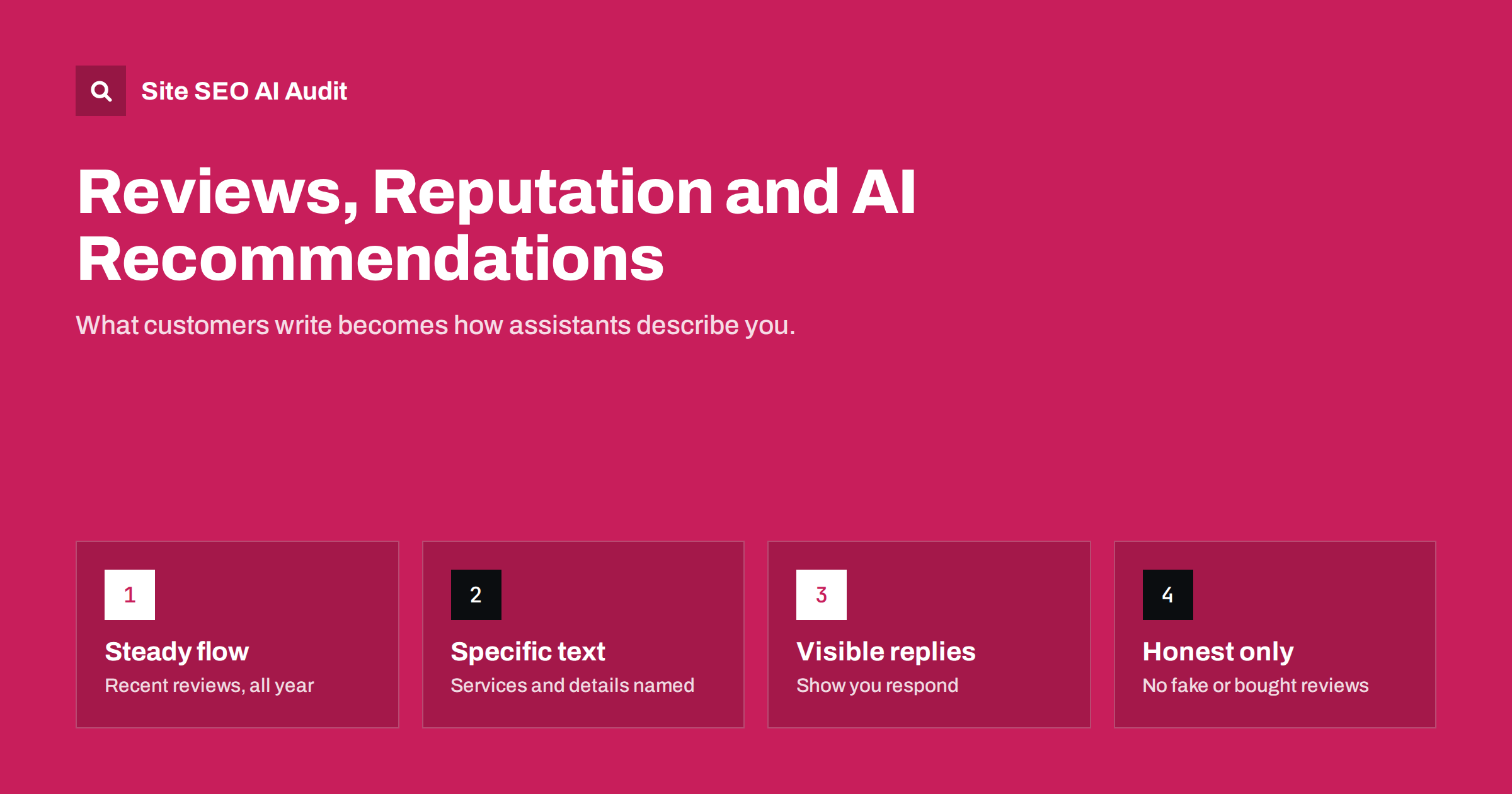
Short answer: When people ask AI assistants which business to choose, the answers often reflect what customers say online: ratings, review text, recurring praise and recurring complaints. Assistants draw on review platforms, business profiles, forums and articles, so your reputation across those sources shapes whether you are recommended and how you are described. The honest way to improve it is a steady flow of genuine, specific reviews, thoughtful replies, fixing the problems reviews reveal, and never buying or faking reviews.
Why reviews matter more in AI answers
In classic search, reviews appear as star ratings next to a listing and on review sites that users can choose to read. In an AI answer, the system reads reviews for the user and summarises them: “customers praise the fast delivery but some mention slow responses to emails”. That summary may be the only impression a potential customer gets before deciding whether to contact you.
Recommendation questions are especially sensitive to reputation. When someone asks “which accountant in Kaunas is good for small businesses?” or “best running shoes for flat feet”, the assistant needs some basis for calling one option better than another. Ratings, review volume, the content of reviews and independent recommendations are the most obvious basis available.
Operators do not publish exactly how they weigh reviews, and the weighting surely differs between products. But the direction is consistent: businesses with a strong, genuine, recent reputation are easier to recommend with confidence.
Reputation also affects how you are described, not just whether you appear. Two businesses may both be recommended, but one is described as “reliable and quick to respond” and the other as “cheaper but sometimes slow”. Those descriptions come from patterns in what customers write.
Where AI systems find reputation signals
| Source | What it contributes |
|---|---|
| Business profiles such as Google Business Profile | Ratings, review counts, review text, owner replies |
| Review platforms for your sector | Detailed experiences, often structured by topic |
| Marketplaces and app stores | Product and seller ratings |
| Forums and communities | Unprompted opinions and recommendations |
| News and industry articles | Independent mentions, awards, coverage |
| Your own site | Testimonials and case studies, weighed with appropriate caution |
Independent sources generally carry more weight than what a business says about itself. Testimonials on your own site are useful for visitors, but they are not a substitute for reviews on platforms you do not control.
What makes reviews useful to AI answers
- Recency. Recent reviews show the business is active and that the experience described is current. A burst of reviews from years ago says little about today.
- Volume over time. A steady flow suggests consistent quality and is harder to manipulate than a sudden spike.
- Specific content. Reviews that mention particular services, products, staff, timings and outcomes give systems detail to connect you with specific needs.
- Balance. A realistic mix, with occasional criticism handled well, is more credible than a wall of identical five-star comments.
- Owner replies. Thoughtful responses show that the business listens and resolves problems.
You cannot write your customers’ reviews, but you can influence their usefulness by delivering experiences worth describing and by asking at the right moment. Customers who have just had a problem solved well tend to write specific, detailed reviews without prompting.
How to earn more genuine reviews
- Ask every satisfied customer, at the moment they are happiest: after a successful delivery, project handover or appointment.
- Make it easy with a direct link to the review form on the platform that matters most for your business.
- Suggest what to mention, without scripting: “If you have a moment, tell others what we helped you with.”
- Build it into your process, for example a follow-up email or a card with a QR code, so asking does not depend on memory.
- Spread requests across platforms where your customers actually look, rather than concentrating on one.
Check each platform’s rules. Many prohibit incentives such as discounts in exchange for reviews, and some prohibit selectively asking only happy customers. Following the rules protects your listing.
Track the results. Note how many reviews you receive each month and on which platforms. If the number falls, check whether the request step has been dropped from your process, which happens easily when staff change.
Replying to reviews
Replies are read by future customers and can be included in what systems see about your business. A few principles:
- Thank positive reviewers briefly and specifically.
- Answer negative reviews calmly, acknowledge the problem, explain what you did or will do, and offer a direct contact.
- Never argue, reveal private customer information or accuse the reviewer of lying in public.
- Correct factual errors politely, for example if a review mentions a service you do not offer.
- Reply reasonably quickly; a response months later helps less.
Consider publishing a short, honest note about how you handle complaints on your website. It shows future customers, and any system reading your site, that problems are taken seriously and resolved.
Learning from what reviews say
Reviews are free feedback. If several customers mention slow replies, an AI summary may well repeat it. Fixing the underlying problem is the most effective reputation strategy there is. Read reviews regularly, group recurring themes, act on them, and mention improvements on your site where relevant. Over time, new reviews reflect the change, and summaries follow.
Reviews also show you the words customers use. If people describe your service as “same-day boiler repair” while your website says “rapid heating solutions”, adopt their language on your pages. It helps both search and AI systems connect your business with the questions customers ask.
Share recurring review themes with your whole team each month, so that everyone understands how customers see the business.
Reputation beyond reviews
Reviews are the most visible part of reputation, but not the only one. AI systems also encounter your business in places where customers and peers talk about it without being asked for a rating:
- Industry articles and roundups that list recommended providers or tools.
- Local news about your business, events you sponsor or community work.
- Professional communities and forums where people ask for recommendations.
- Partner and supplier websites that list you as a certified or preferred partner.
- Awards and memberships in recognised associations.
You cannot control these mentions, but you can earn them: do work worth talking about, take part in your industry and community, help journalists with genuine expertise, and make it easy for partners to describe you correctly by giving them an accurate short description and logo. Each independent mention adds to the picture that assistants form when someone asks about businesses like yours.
Keep an eye on what these sources say. An outdated partner listing or an old article with wrong details can shape descriptions just as much as a review, and it is usually easy to ask for a correction.
What not to do
- Buying or faking reviews. Platforms detect and remove them, may penalise listings, and fake reviews are prohibited under consumer protection rules in the EU and other regions.
- Review gating, sending only happy customers to public platforms and others to a private form, which many platforms forbid.
- Posting reviews for yourself from staff, friends or family.
- Marking up your own testimonials as review structured data for your business; Google does not show self-serving review rich results for LocalBusiness and Organization.
- Ignoring negative reviews in the hope they will go away.
If you discover past mistakes, such as incentivised reviews, stop the practice immediately and focus on earning genuine feedback from now on. Trying to hide or remove legitimate negative reviews usually draws more attention to them.
How Site SEO AI Audit helps
Reputation lives mostly off your site, but your site still needs to present it well and be readable. Site SEO AI Audit checks structured data and flags invalid JSON-LD, finds thin pages that could use real customer stories, and its AI visibility area confirms that AI crawlers can reach your pages and that content such as embedded review widgets does not depend on JavaScript to appear. You can run a free audit to check the site side.
Related reading
- AI Search for Local Businesses: What to Fix First
- E-E-A-T and AI Search: Showing Real Expertise on the Page
- When AI Gets Your Business Wrong: How to Fix It
The bottom line
AI assistants recommend businesses they can describe with confidence, and customer reviews are a major part of that description. Ask every satisfied customer for an honest review, reply to all reviews thoughtfully, fix the problems they reveal, use customers’ language on your site, and never fake or buy reviews. A genuine reputation is the most durable AI visibility asset a business can have.
SSS
Do reviews affect whether AI assistants recommend my business?
Reviews are one of the main signals of quality available to assistants, especially for local and product recommendations. Recent, genuine and specific reviews make it easier to recommend you confidently.
Which review platforms matter most?
The ones your customers and search engines use for your type of business, typically your Google Business Profile plus the leading review sites or marketplaces in your sector and country.
Should I reply to every review?
Replying to most reviews is good practice, and replying to every negative review is important. Keep replies brief, polite and specific, and move detailed discussions to private channels.
Can I offer a discount for reviews?
Many platforms prohibit incentives for reviews, and rules on fake or incentivised reviews are tightening. Check the platform’s policy, and generally ask without offering rewards.
Will AI assistants repeat negative reviews?
They may summarise recurring complaints. The best response is to fix the underlying issue, reply constructively, and earn new reviews that reflect the improvement.