ENEnglish
 LTLietuviškai
 DEDeutsch
 FRFrançais
 RUРусский
 ESEspañol
 PLPolski
 ITItaliano
 UKУкраїнська
 CSČeština
 PTPortuguês
 JA日本語
 LVLatviešu valoda
 ETEesti
 HUMagyar
 IDBahasa Indonesia
 TRTürkçe
 HIहिन्दी
 ELΕλληνικά
 ARالعربية
 THไทย
 VITiếng Việt
 RORomână
 MSBahasa Melayu
 BNবাংলা
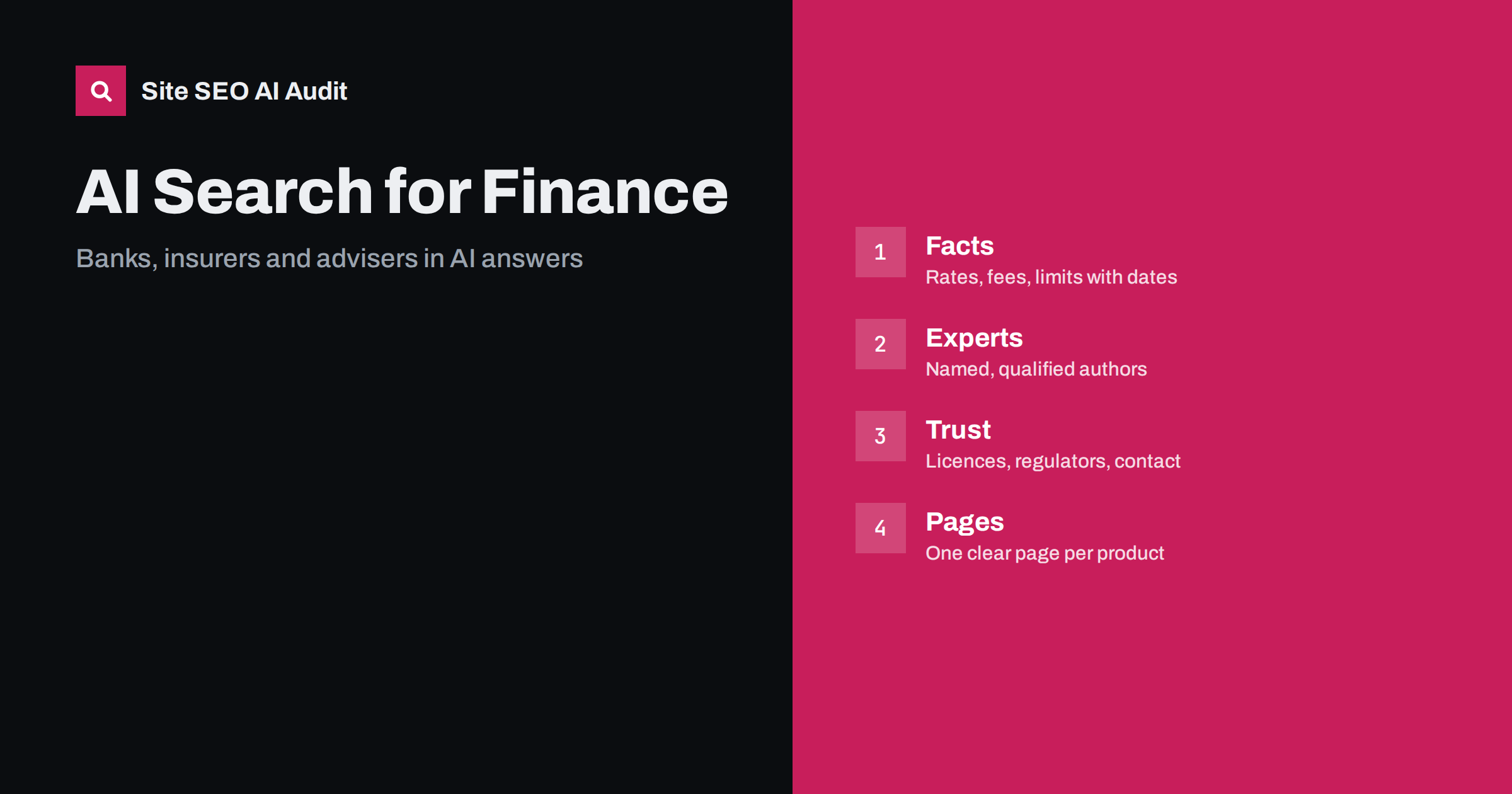
Short answer: AI assistants answer money questions carefully, because a wrong answer about a loan, a policy or a tax rule can cause real harm. They prefer sources that state facts plainly, name qualified authors, show when the information was updated and look like regulated, contactable businesses. A bank, an insurer or an adviser becomes citable by publishing one clear page per product with the numbers that matter, explanatory articles written by named experts, visible regulatory details and structured data that confirms who the organisation is. Vague marketing pages and gated PDFs are rarely cited.
People ask AI assistants the questions they used to type into a search box: what a fixed-rate mortgage is, whether travel insurance covers a cancelled flight, how much a pension contribution saves in tax. The assistant combines what it already knows with pages it retrieves and names a few sources. In finance those sources are chosen with extra weight on trust. This guide explains what that means in practice for banks, credit unions, insurers, brokers, fintech apps and independent advisers, and which pages to fix first. The general background is in YMYL topics in AI search; this article is about the specific decisions a financial business faces.
How money questions are handled differently
Financial topics fall into the “your money or your life” group, where search engines and AI systems apply stricter quality standards. In practice this shows up in three ways. First, the assistant adds disclaimers and tends to cite official or regulated sources alongside commercial ones. Second, it favours pages that are current, since rates and rules change often. Third, it checks that the author and the organisation are who they claim to be. A page from an anonymous blog about pension tax relief has a much lower chance of being quoted than the same text on a regulated adviser’s site with a named author and a date. The mechanics of retrieval and citation are explained in how AI search engines work.
Product pages: one page, all the numbers
The most useful page a financial business can publish is a product page that answers the obvious questions in plain language: what the product is, who can apply, the rate or premium range, fees, limits, how long it takes, what documents are needed and how to cancel. Put the numbers in text, not only in images or a calculator that needs JavaScript. Show the date the figures were last updated. When a rate is variable, say what it depends on. AI assistants extract these facts and, when the page is clear, present them with your name attached. Pages that bury the fees in a PDF or hide the rate behind a quote form give the assistant nothing to quote, and it will quote a comparison site instead. The structure of a strong page is covered in service page SEO and, for apps and digital banks, in SaaS feature pages.
Use one page per product and keep it stable. Many institutions have several near-identical pages for the same loan or policy created for campaigns. Those split the signals and confuse both search engines and assistants about which one is the canonical source.
Explanatory content that gets cited
Beyond product pages, the content that earns citations is explanatory: how a product works, how to compare options, what a term means, what happens in a specific situation. The best format is a direct answer in the first paragraph, followed by the detail, with headings that match the way people ask. Write for a reader who is deciding, not for a regulator, but do not remove the caveats that matter. Each article should have a named author with real credentials, a review date and, where appropriate, a note that a compliance review took place. Articles that explain the rules in a particular country should say which country and which tax year they refer to.
Examples that work well for finance sites: glossary entries for product terms, step-by-step guides for claims and applications, worked examples with realistic numbers, and comparison pages that are honest about when a competitor’s product fits better. The guidance in comparison pages in AI search and glossary pages applies directly.
Insurers and brokers: coverage questions
Insurance queries are usually about coverage in a specific situation: a lost phone abroad, a flooded basement, a cancelled trip, a pre-existing condition. Policy documents answer these questions, but assistants rarely read a forty-page PDF. Publish short coverage pages in HTML for the situations people ask about most, each stating what is covered, what is excluded, the usual excess and how to claim, with a link to the full wording. Brokers can do the same for the products they compare, adding an honest note about when each insurer fits. These pages are easy to quote, rank for long questions and reduce the number of calls to the support line. Keep the examples realistic and the numbers dated, as with any other financial page.
Trust signals that AI systems and people both check
Trust is the deciding factor for money content. Make the following visible on every page or in the footer: the legal name of the company, the regulator and licence or registration number, a physical address, a phone number and a complaints procedure. Add an about page that names the leadership and the advisers with qualifications. Mark up the organisation with Organization or FinancialService schema, including the same name, address and identifiers as on the page, and link the brand’s profiles on official registers. The practical steps are in organization schema for AI search and the wider principles in E-E-A-T in AI search.
Author pages matter more here than in most industries. A short biography that states qualifications, years of experience and areas of advice, with a photo and links to professional profiles, turns a generic article into a citable source. See author pages and bylines.
Keeping information current
Rates, thresholds and rules change, and an assistant that quotes last year’s allowance makes you look wrong even though you were right at the time. Keep a register of pages that contain time-sensitive numbers and review them on a schedule tied to the events that change them: central bank decisions, budget announcements, policy renewals. Show a visible “last reviewed” date and keep it honest; changing the date without changing the content is quickly noticed. When a product is withdrawn, keep the page with a clear notice and a link to the replacement rather than deleting it, so that assistants and customers do not land on a dead page. The approach is described in content dates and freshness for AI.
Access, compliance and technical details
Financial websites often block more than they intend. Security teams sometimes block all unknown bots, including AI crawlers that fetch pages for answers; compliance teams gate useful documents behind forms; marketing teams load content through scripts that crawlers do not execute. Decide deliberately which AI crawlers may fetch your public pages and check the server logs to confirm that they can; AI crawlers and robots.txt explains the options. Keep key facts in HTML, not only in interactive calculators. Make sure the site is fast and the pages are stable, since many finance queries happen on phones in the middle of a decision.
Local presence counts too. A bank with branches or an adviser with an office should have location pages with opening hours and services, and a complete business profile, so that questions like “mortgage adviser near me” can be answered with your name. The checklist in local businesses in AI search applies.
Measuring and prioritising the work
Track three things: referrals from AI assistants in analytics, the questions where your brand is mentioned or missing when you test them yourself, and the pages that assistants cite most often. Then fix in this order: product pages with unclear or outdated numbers, missing author and organisation details, blocked or script-only content, and finally the explanatory articles that would fill the gaps where competitors are cited and you are not. The measurement method is in measuring brand visibility in AI answers.
A site audit shows the technical side quickly: pages with missing titles, duplicate product pages, structured data errors, blocked crawlers and slow templates, ranked by impact. Site SEO AI Audit scores seven areas including AI visibility, and the first audit of up to 200 pages is free. Larger sites can see the plans on the pricing page.
Related reading
- YMYL Topics in AI Search: Health, Money and Trust
- E-E-A-T in AI Search: What It Means in Practice
- AI Search for Lawyers, Accountants and Consultants
- Organization Schema for AI Search
The bottom line
Financial businesses are cited by AI assistants when they look trustworthy and are easy to quote: one clear page per product with dated numbers, explanatory articles by named experts, visible regulatory details, consistent organisation markup and public pages that crawlers can actually fetch. Keep the facts current and the pages stable, and the mentions follow.
FAQ
Why do AI assistants cite comparison sites instead of my bank?
Usually because the comparison site states rates, fees and conditions in plain text with dates, while your page hides them behind a form or a PDF. Publish the facts on the page.
Can compliance rules and AI visibility coexist?
Yes. Required disclaimers and risk warnings do not stop citation. What hurts is removing the facts entirely or gating them. Keep the facts and the warnings together.
Do I need a named author on product pages?
Not necessarily on product pages, but explanatory articles should have a named, qualified author and a review date. Organisation details must be visible everywhere.
Should I block AI crawlers for security reasons?
Public marketing and product pages gain from being crawlable. Protect customer areas and internal tools separately rather than blocking everything at the edge.
How often should I review rate and threshold pages?
Tie reviews to the events that change the numbers, such as rate decisions and budget changes, and show an honest last-reviewed date on each page.